
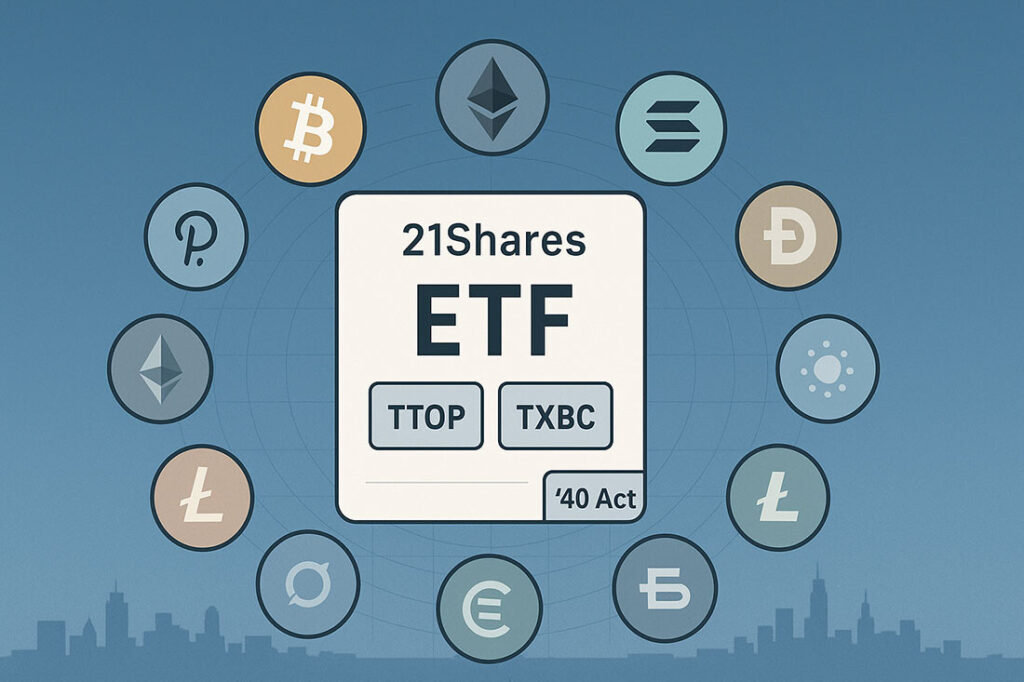
- 21Shares launches two US crypto index ETFs under the 40 Act, offering access to a basket of leading digital assets in one listed fund.
- TTOP tracks the FTSE Crypto 10 Index including Bitcoin, while TXBC follows the same index without Bitcoin to highlight other major tokens.
- Both ETFs rely on FTSE Russell indices and Teucrium support, aiming at advisers and institutions that want regulated diversified crypto exposure.
The launch of the new crypto index exchange-traded funds from 21Shares gives United States investors a regulated way to hold a broad mix of digital assets inside a familiar fund structure for the first time under the Investment Company Act of 1940. These products arrive at a moment when crypto prices swing sharply, with Bitcoin dipping below 100,000 dollars this month, while demand for simple, compliant market access continues to build among advisers and institutions. Against this backdrop, 21Shares positions its latest funds as a bridge between traditional fund rules and the evolving crypto market, using an index approach that removes the need to pick individual tokens or manage complex wallets.
21Shares crypto index ETFs under the 1940 Act
The first fund, the 21Shares FTSE Crypto 10 Index ETF with ticker TTOP, and the second fund, the 21Shares FTSE Crypto 10 ex-BTC Index ETF with ticker TXBC, both sit inside a management investment company registered under the 1940 Act, the same legal framework that governs many long-standing mutual funds and stock or bond ETFs in the United States. This structure differs from the 1933 Act framework used by most earlier crypto vehicles, including commodity-style products and many spot offerings that focus on a single asset, and it brings additional rules on board composition, disclosure, diversification, liquidity, and oversight that large financial firms often expect before they allocate meaningful client capital. Under this design, the funds seek to track two FTSE Russell indices that cover ten leading crypto assets by market capitalization, one basket that includes Bitcoin and one that deliberately removes it to highlight other chains and tokens. The sponsor describes these ETFs as a way to obtain adaptive exposure to the top layer of the crypto market with a single trade, while still complying with the reporting and governance standards built into the 1940 Act, and this mix aims to appeal to professional investors who prefer familiar wrappers but want a defined method to follow the broader digital asset universe, not only one coin.
Market structure and index design of the new crypto funds
The TTOP fund carries a management fee of 0.50 percent and tracks the FTSE Crypto 10 Select Index, a market-cap-weighted benchmark that currently includes large names such as Bitcoin, Ethereum, Solana, XRP, and Dogecoin, along with other top assets that qualify under the index rules at any given quarterly rebalance. The FTSE methodology sorts the eligible crypto universe by free-float market capitalization, applies liquidity and quality screens, and then assigns index weights according to size, which means the fund will hold larger positions in coins with deeper markets and smaller positions in secondary assets, while the quarterly review allows the composition to adjust as leadership in the sector changes. The TXBC fund charges a fee of 0.65 percent and follows the FTSE Crypto 10 ex Bitcoin Select Index, which uses the same index engine but excludes Bitcoin from the eligible list, leaving a basket that emphasises smart contract platforms, scaling networks, and other non-Bitcoin projects that support payment, infrastructure, gaming, or application layers in the crypto ecosystem. This design aims to separate a pure store-of-value narrative from other use cases and gives investors who already own Bitcoin through a spot ETF or direct holdings a way to add diversified altcoin exposure without unintentionally doubling their Bitcoin allocation inside the same portfolio sleeve. Both funds obtain their exposure indirectly rather than holding private keys to the underlying blockchains, because the portfolio invests primarily in other securities such as exchange-traded products and funds that reference the same crypto assets, including European-listed products that the group already manages. This approach mirrors commodity ETFs that hold other vehicles instead of physical barrels or vault assets, and it lets the adviser plug existing operational and custody systems into the new funds while staying inside a regulated framework that the 1940 Act permits, even for strategies that touch newer asset classes like digital tokens. Teucrium Trading, an advisor with long experience in commodity and alternative asset ETFs, supports the structure as a sub-advisor, bringing a background in futures-based and indirect exposure products that must meet strict exchange listing and risk management standards. That partnership links the index design of FTSE Russell, the crypto market experience of 21Shares, and the operational record of Teucrium into a single offering aimed at investors who want to treat a crypto basket in a similar way to how they treat a commodity basket or equity factor ETF in an ordinary brokerage account.
21Shares strategy, FalconX acquisition and institutional demand
The timing of these launches reflects how 21Shares reads current investor behaviour. Spot Bitcoin ETFs that arrived in early 2024, such as BlackRock’s IBIT, attracted tens of billions of dollars and became dominated by retail and tactical traders who wanted a clear bet on one asset rather than a blended basket, yet many advisers still hesitate to recommend concentrated exposure when they build long-term allocation models for clients. Management at 21Shares has made clear that they expect the new index funds to grow at a slower pace than those single-asset products, because diversified baskets require more due diligence but also line up better with model portfolios, where advisers think in terms of segments of the crypto market, not only one coin. Statements from executives highlight this focus. President Duncan Moir has described 1940 Act vehicles as a “gold standard” for professional investors due to their tax treatment, governance obligations, and the comfort level compliance teams have with these structures, and he has also argued that index funds suit participants who accept that nobody can reliably pick which token will hold its position ten years from now. In parallel, Global Head of Business Development Federico Brokate notes that many clients have asked for a simple and regulated way to access the crypto market as a whole rather than navigate lists of individual coins, and the new funds respond to that demand by wrapping ten assets into a single ticker that sits alongside equity and bond ETFs on mainstream platforms. The wider corporate strategy of 21Shares also changed in recent weeks as FalconX, a large digital asset prime broker, agreed in October 2025 to acquire the firm in a deal funded with cash and equity, marking FalconX’s third significant transaction of the year. The combination links a provider that manages more than eleven billion dollars in assets across dozens of exchange-traded products with a trading group that has handled over two trillion dollars in volume for more than two thousand institutional clients, creating a platform that spans derivatives, liquidity, and listed funds under one roof and potentially gives the new ETFs access to a broad network of professional users around the world. For 21Shares, the acquisition offers a larger distribution footprint in the United States, Europe, and Asia-Pacific while the company keeps operating its product line and index partnerships. For FalconX, the deal gives an in-house issuer of exchange-traded funds and products at a time when regulators approve more crypto ETFs and when institutional portfolios increasingly treat these instruments as standard tools for accessing the asset class, and the new index funds fit neatly into a roadmap that appears to include structured strategies and derivatives-linked listed products.
Impact of 21Shares ETFs on crypto regulation and market access
The introduction of these 1940 Act crypto index funds marks a notable step in how regulators and issuers manage diversified digital asset products, because earlier multi-coin offerings in the United States, such as the Grayscale Digital Large Cap Fund conversion and the Hashdex Nasdaq Crypto Index ETF, relied on the 1933 Act and functioned more like commodity pools with looser requirements on diversification and board structures. Now the United States market includes index coverage of the ten largest crypto assets inside a framework that many asset managers already use for bond ladders, sector equities, and multi-asset sleeves, which lowers the operational barrier for institutions that wish to add a defined crypto allocation without building entirely new due diligence templates from scratch. The move also arrives at a volatile moment. Bitcoin prices slipped below 100,000 dollars this month, the first time since June that they crossed this level on the downside, as investors reduced risk and locked in gains after strong rallies earlier in the year. At the same time, competition among issuers for altcoin spot ETFs and other thematic products intensified, with filings for index funds, sector-style baskets, and single-asset exposures all moving through the regulatory pipeline, and the presence of 21Shares in the 1940 Act category shows that large players now consider diversified crypto baskets compatible with mainstream fund rules rather than only with more flexible 1933 Act shelves. For financial advisers, the new funds create building blocks that fit into existing risk buckets and allocation models. A model that already includes a small allocation to a spot Bitcoin ETF can now pair that exposure with TXBC to obtain non-Bitcoin assets, or use TTOP alone to capture the combined top ten layer, and the quarterly rebalancing schedule ensures that the index responds to shifts in market leadership without requiring manual token selection or ongoing re-trading by the adviser. For wealth platforms, compliance teams can treat these ETFs like other 1940 Act funds when they assess suitability, disclosure, and oversight, which reduces friction compared to previous crypto products that sat in separate operational categories. In the broader regulatory landscape, the launch underscores a gradual convergence between digital asset markets and traditional securities law. The presence of FTSE Russell as index provider, Teucrium as advisor, and the 21Shares brand as issuer shows how established institutions and specialist firms collaborate to apply existing tools, such as diversified indices and open-end fund structures, to a new asset class without rewriting the rulebook. That pattern suggests that future developments may include more segmented index strategies, regional baskets, or volatility-managed approaches that still rely on the same 1940 Act framework, giving investors incremental options rather than sudden leaps into unfamiliar territory.
Conclusion
The arrival of the two new index ETFs gives the United States market a regulated way to hold a basket of ten leading crypto assets, either with or without Bitcoin, inside a structure that investment professionals already know from equity and bond funds. By using 1940 Act rules, detailed FTSE Russell indices, and operational links to existing European exchange-traded products, the issuer aligns digital assets with long-standing fund standards instead of leaving them in separate, lightly regulated wrappers. The launch sits alongside an acquisition by a large prime broker, continuing growth in spot Bitcoin ETFs, and new filings for other multi-coin products, and together these developments point to a steady integration of crypto into the mainstream toolkit used by advisers and institutions across global markets.
Disclaimer
The information provided in this article is for informational purposes only and should not be considered financial advice. The article does not offer sufficient information to make investment decisions, nor does it constitute an offer, recommendation, or solicitation to buy or sell any financial instrument. The content is opinion of the author and does not reflect any view or suggestion or any kind of advise from CryptoNewsBytes.com. The author declares he does not hold any of the above mentioned tokens or received any incentive from any company.
Featured image created by AI


Subscribe To Our Newsletter
Join our mailing list to receive the latest news and updates from our team.