
Ethereum is the undisputed king of all altcoins. However, being on top also means having a lot of competitors trying to snatch the crown. How true are the descriptions of several blockchains as Ethereum killers? Can they vie for the top spot? One of the contenders for the throne is Solana, a high-speed permissionless layer 1 blockchain with up to 65,000 transactions per second. It also boasts of cheaper gas fees. But is this enough to dethrone the current king?
What are Layer 1 Blockchains like Ethereum and Solana?
To get a better idea, let’s go back to the basics of blockchain technology.
A layer one (L1) blockchain is a system that records and verifies data in a secure and decentralized manner. This means that no one can change or delete the records without the agreement of others. In essence, this is a democratic way of storing and verifying data. The consensus between the stakeholders ensures the security and authenticity of all information.
Layer one blockchains consist of a network of computers, called nodes, that store and update copies of the same information, called blocks. Blocks link together to form blockchains. Each block contains data, which includes a code that identifies and connects it to the previous block. The nodes use a set of rules or a consensus mechanism, which determines if a block is valid or not. This consensus protocol prevents malicious actors from compromising the integrity of the whole chain.
The most popular L1 chains are Bitcoin, Ethereum, Cardano, and Solana.
The term layer 1 also signifies that the blockchain is the foundation of other chains. This means that a layer two or scaling solution layer can be built on top of an L1. Examples of layer 2’s are Polygon, Arbitrum, and Nitro.
Comparing the Consensus Layers of Ethereum and Solana
Ethereum used to have a Proof-of-Work (PoW) consensus mechanism but has migrated to Proof-of-Stake (PoS) in Sept 2022.
- PoS is a consensus mechanism that uses validators instead of miners to add new blocks to the network.
- Each Validator deposits a certain amount of ETH as collateral. Validators earn rewards for validating transactions and blocks, but they also risk losing their stake if they act maliciously or dishonestly.
- Validators are chosen to create new blocks based on their staked ETH.
- Compared with PoW, PoS is more energy efficient.
Solana has a unique consensus mechanism. It uses Proof-of-Stake (PoS), and Proof-of-History (PoH) with Tower Byzantine Fault Tolerance (Tower BFT).
- Aside from the more common PoS, Solana uses the unique PoH. It provides a way to measure the passage of time in the Network. This solves the issue of each node relying on its local clock without knowledge of the other participants’ clock. It allows the network to agree on a common source of time and order of events, without relying on external clocks.
- If PoH sounds too complicated, then look at it this way: If an employee reports to the office, he can prove his attendance by logging in to the company’s time tracker. He cannot simply take a selfie of himself while holding his watch to prove that he was not late. The company time tracker is the PoH
- Tower BFT allows validators to vote on blocks and forks using the timestamps provided by PoH.
- As a quick summary, Solana uses PoS to select validators and to enforce honesty within the network. PoH provides a verifiable source of time. While Tower BFT achieves consensus among validators using PoH timestamps.
Transaction Throughput
A transaction throughput is the rate at which transactions are completed within a given timeframe. The common measure is transactions per second or TPS
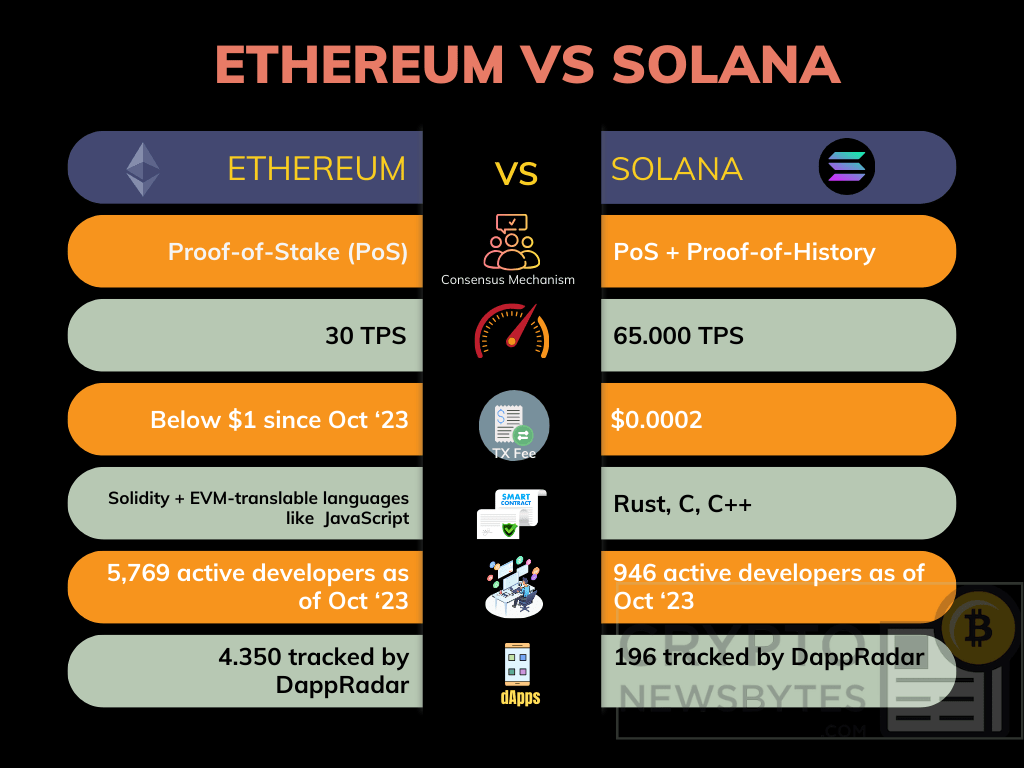
- Ethereum has a transaction throughput of 30 TPS.
- Solana is capable of reaching 65,000 TPS.
The big discrepancy is due to their different consensus mechanism. Solana’s PoH and Tower BFT allow it to achieve higher TPS and low latency, making it one of the fastest and most scalable blockchains.
Ethereum will take second place in the speed criterion.
Transaction Cost
The gas fee for transacting in the ETH network has been declining. However, when compared with other blockchains, it still has higher gas fees. For the last year, ETH has registered a high of around $30. But it has been below $5 for quite some time now. Since the start of October 2023, the price of transactions has been below a dollar on average

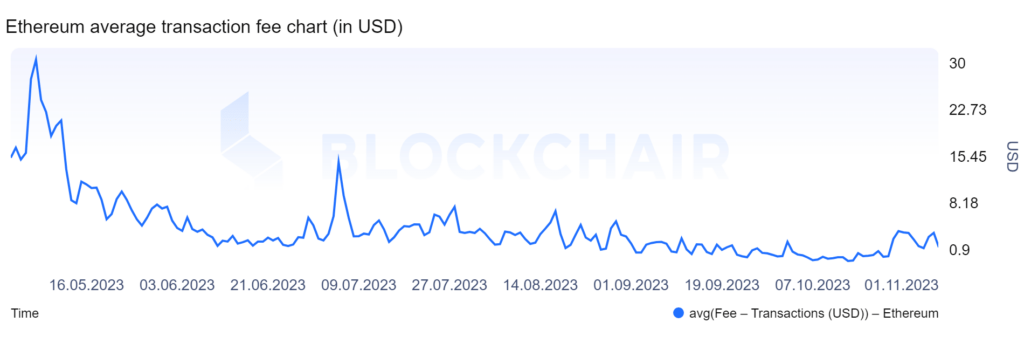
From Blockchai.com
Solana has always had low gas fees. The average fee per transaction is about 0.000005 SOL or $ 0.0002 (Calculated at $40 per token) – which is essentially nothing.
Solana wins the pricing battle.
Smart Contract Capabilities
Smart contracts are self-executing programs that can execute actions based on predefined rules and conditions. A smart contract is a digital agreement that is enforced by the blockchain network. It does not need for any intermediaries or trusted parties.
Ethereum uses Solidity as its main programming language for creating smart contracts. Solidity is a high-level language that is designed to run on the Ethereum Virtual Machine (EVM), which is the core component of the Ethereum network. However, Solidity is not the only language that can be used to make smart contracts on Ethereum. JavaScript developers can also make smart contracts on Ethereum since there are tools that can convert their code into a format that the EVM can understand.
According to Statistica.com, there are 17.4 million JavaScript developers (as of 2022). These are the potential developers that can contribute to the network.
On the other hand, Solana’s primary programming language is Rust. It has about 2.8 million developers. C and C++ are also supported. These two programming languages have around 11 million developers. Rust is designed to be fast and reliable, however, it has a steeper learning curve compared with Solidity. And Rust is said to be easier than C++.
According to the Developer Report of Electric Capital, there are 5,769 active monthly developers for the ETH network, while there are 946 for Solana. Data is as of Oct 1, 2023.

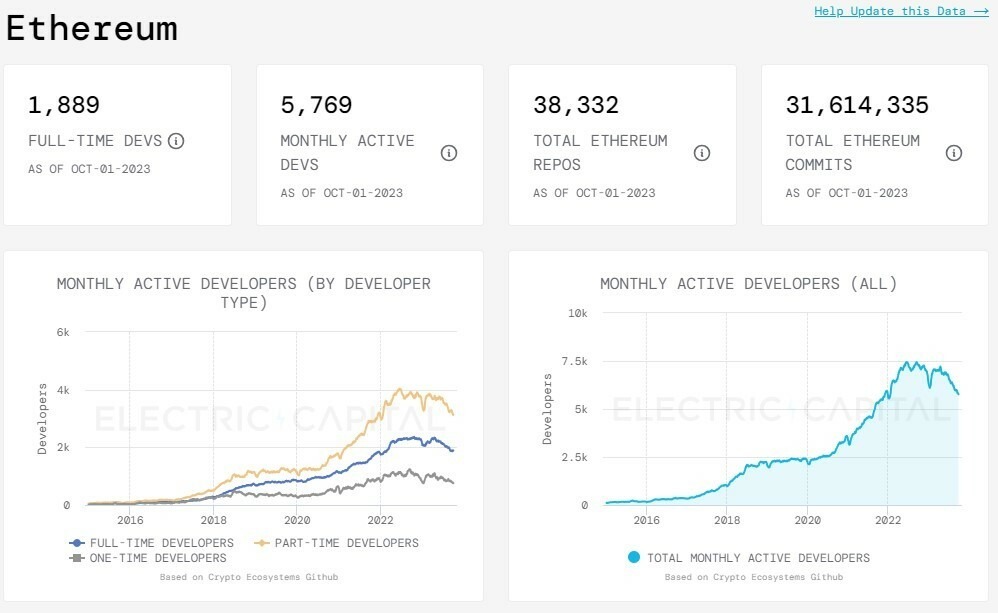

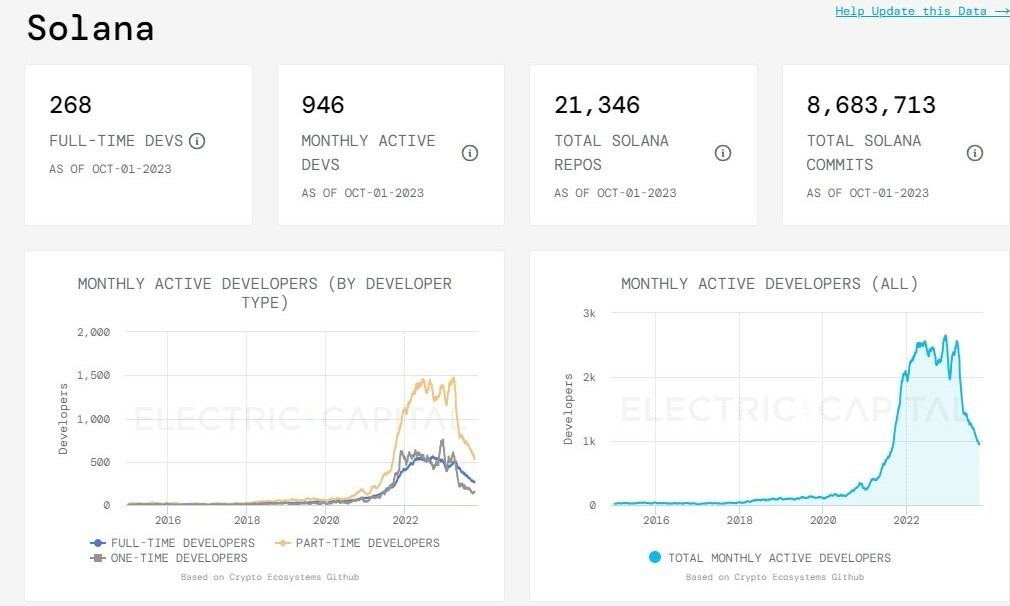
For ease of development and developer pool, ETH takes first place on this metric.
Popularity, Market Cap, and dApps
Ethereum enjoys being the undisputed king of all altcoins. It has the second highest market cap in the crypto world, second only to Bitcoin. ETH enjoys the privilege of being the first contract platform. It was created in July 2015.
Solana was launched in 2020, five years behind Ethereum. Despite its phenomenal growth, its market cap of $17.5 billion pales in comparison to ETH’s almost $300 billion.
Another way of looking at a certain blockchain’s popularity is by looking at the deployed dApps or decentralized applications in a specific network. DappRadar is tracking 4.350 for the Ethereum ecosystem. On the other hand, DappRadar is only tracking 196 for Solana (some sources list more than 350 dApps). There is a big discrepancy in the number of applications between the two.
The number of dApps is a good way to gauge popularity because it indicates the level of adoption and usage of a blockchain platform. More dApps mean more developers interested in building and more users who can potentially use the network.
Ethereum is the undisputed winner in the popularity contest.
Can Solana kill Ethereum?
Ethereum’s market cap alone shows how it dominates the altcoin hierarchy. Its success is partly because of it being the first smart contract platform.
Another factor that contributed to its success is the programming language it is using. It is primarily using Solidity with an estimated 200,000 developers. This number is not a lot, but we have to remember that there are several EVM-translatable languages. One of these is JavaScript with more than 17 million developers. The “ease” of developing in Ethereum enticed almost 6,000 active developers.
The more developers there are, the more dApps there will be. This is the reason why Ethereum has more dApps compared to others. More dApps also means more users.
However, Ethereum is also notorious for having high gas fees. The highest gas fee observed was $196 in May 2022. While Solana always kept a low gas fee, which is practically a negligible amount.
Network speed affects gas fees since congestion can result in higher transaction payments. This is where Solana shines. It has a potential speed of up to 65,000 TPS. Higher speed means less chance of having a congested network. This speed is due to its unique consensus mechanism of using a combination of PoS and PoH.
Solana still has a lot of catching up to do. It needs to grow its ecosystem if it wants to usurp the current king. Rust, its primary programming language, is not as popular and is seen as harder than Solidity. This is probably the reason why it has fewer active developers.
Can Solana kill Ethereum? It has the potential, however, dethroning the current king is a tall order. Instead of a definitive answer, we leave you with an infographic to decide for yourself.


Subscribe To Our Newsletter
Join our mailing list to receive the latest news and updates from our team.