
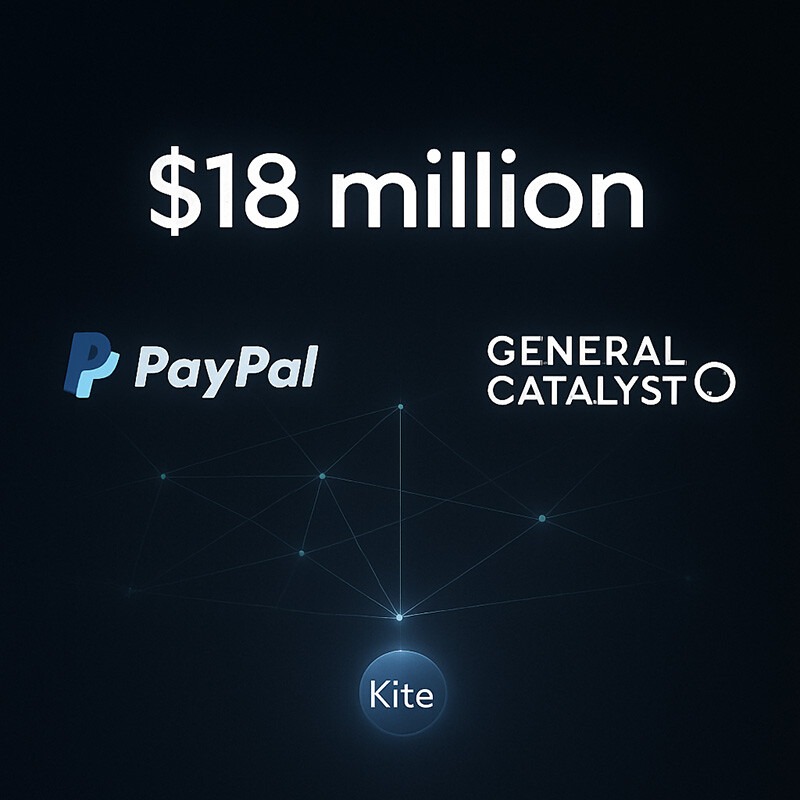
- Kite raises $18M led by PayPal Ventures and General Catalyst; total funding $33M
- Building a blockchain layer for AI agents to verify and transact across apps
- CEO Chi Zhang; ex-Zettablock; valuation and deal structure not disclosed
Kite sets out to link AI agents with a verifiable identity layer, backed by an $18 million Series A led by PayPal Ventures and General Catalyst and $33 million raised in total. Since 2022, many AI-crypto efforts have lacked clear use, but this project targets simple handoffs between assistants and services. The aim is shopping and similar tasks done inside ChatGPT or Perplexity, with agents that can confirm an Amazon or Shopify representative before acting.
Kite at a glance: the agent communication layer
Kite is building a blockchain network to let AI agents verify one another and exchange authenticated messages. Instead of confining large language models to server responses, the goal is to enable agents to act across applications, devices, and services with auditability and clear provenance. The company positions its chain as a neutral registry where participants can confirm that an agent claiming to represent a brand or platform truly does so, and where actions can be logged in a way that is tamper resistant.
Kite funding: $18 million Series A, $33 million to date
On Tuesday, the company announced an $18 million Series A led by PayPal Ventures and General Catalyst, with participation from 8VC, Samsung Next, and Alumni Ventures. Including a previously undisclosed seed round, the total raised stands at $33 million. Kite did not disclose its valuation. The company also did not specify whether the Series A is purely equity or includes token warrants tied to a future network launch.
Kite vision: an open trust fabric for AI agents
Kite proposes that agents will not remain siloed within single products. The company expects routine tasks—shopping, booking, research, and simple workflows—to be delegated to specialized agents. For such agents to work safely together, the system needs a common identity layer and a signed event history. By using a blockchain as a shared database, Kite aims to let agents verify each other’s credentials and authorization before executing actions, while recording outcomes that other agents can consume.
How agents work today and where Kite fits
General-purpose models like GPT and Gemini respond to prompts but historically have had limited direct integration with external apps. Agent frameworks now invoke tools, browse, or call APIs, and some agents are tailored for defined roles, such as coding assistance. A known example is Cursor, which optimizes for software development workflows. Kite wants to sit underneath this agent layer, so a shopping agent, a coding agent, and a customer-support agent can trust each other’s identities and hand off tasks with low friction.
From Zettablock to Kite: timeline and team
Kite operated under the name Zettablock before adopting its current brand. The team is led by cofounder and CEO Chi Zhang, who holds a doctorate in statistics from the University of California, Berkeley. The academic grounding in data systems and inference aligns with the company’s emphasis on verifiable records and identity, both of which are central to making autonomous actions acceptable to users and enterprises.
Kite architecture: blockchain, identity, and registries
At the core is a chain-backed registry that binds agent identifiers to cryptographic keys and delegated permissions. An agent representing a store, for example, can present signed claims that reference a verifiable issuer, while a receiving agent checks those claims against the registry before proceeding. The same substrate can log state changes, such as a placed order or a fulfilled request, so downstream agents can reason over a trustworthy history rather than opaque screenshots or brittle scraping. Kite frames this as infrastructure that other agent platforms can embed through SDKs and APIs, without forcing a single orchestration model.
Agent shopping flow across ChatGPT, Perplexity, Shopify, and Amazon
A simple scenario illustrates the intended experience. A user asks an assistant to find a t-shirt in a given style and size. The assistant calls a shopping agent to search across a Shopify store or Amazon. If the cart and checkout agents are verified through the registry, the assistant can confirm the seller’s identity, place the order, and document the transaction in a way that other agents can later verify, such as a shipping or returns agent. Kite’s approach targets this kind of end-to-end flow so that the user never needs to leave ChatGPT or Perplexity, while still benefiting from checks on who is acting on their behalf.
Investor view: PayPal Ventures and General Catalyst on agents
PayPal Ventures partner Alan Du has described present-day agentic activity as small and experimental, noting that infrastructure work remains before agents become broadly useful. The presence of PayPal Ventures and General Catalyst in an $18 million Series A signals attention on settlement, identity, and compliance layers rather than only front-end copilots. Additional participation from 8VC, Samsung Next, and Alumni Ventures rounds out a mix of enterprise, venture, and corporate investors who track commerce, payments, and developer tooling.
Token and structure: equity, token warrants, and disclosures
Kite declined to disclose its valuation and did not specify whether the Series A is purely equity or includes token warrants. Token warrants are promises for a slice of future network tokens once a chain goes live, typically tied to vesting and performance. If a token is introduced later, it would need a clear role within the identity and message layer, such as stake-based validation, registration fees, or incentives for indexing and verification services. Until then, the key takeaway is the $33 million total raised and the named investors rather than a published token design.
Security, verification, and compliance for agentic actions
Security rests on verifying three things: who the agent is, what it is allowed to do, and what it actually did. Identity binds agents to organizations and roles, authorization defines permitted actions, and logged outcomes give observers a trace. A blockchain registry makes those checks portable across products, which matters when an assistant touches data from multiple vendors. For payments and commerce, agent frameworks must also coordinate with existing anti-fraud, KYC, and dispute-resolution processes. Kite’s design focuses on verifiable identity and signed events so that downstream systems can integrate with established controls.
Kite versus other agent stacks
Many agent stacks concentrate on planning, tool selection, and code execution. That work improves how an agent decides what to do. Kite focuses on who is allowed to act and how actions are recorded for others to trust. In practice, this means the company can complement orchestration frameworks and vertical agents by offering a network that others reference for identity proofs and action attestations. The differentiator is scope: rather than locking agents inside one vendor’s ecosystem, the registry is intended to be a common substrate any agent can query.
Roadmap signals: what to watch next
Practical adoption will hinge on SDKs for popular languages, easy key management for developers, and reference integrations with platforms like Shopify and major marketplaces. Clear documentation of registration flows, permission delegation, and revocation is essential, especially for teams that rotate keys and service accounts. If Kite later introduces a token, governance, fees, and validator incentives will need transparent rules that do not burden developers. Short term signals include pilot shopping flows, open-source client libraries, and published schemas for agent claims so other projects can interoperate without guesswork.
Conclusion
The market has moved from single-app chat to agent workflows that reach across services. Funding of $18 million in a Series A, $33 million raised in total, and backing from PayPal Ventures and General Catalyst underscore attention on the foundation agents need to operate safely. The approach places identity, permissions, and signed outcomes at the center so that assistants in tools like ChatGPT or Perplexity can hand off tasks to verified services without the user switching tabs. If adoption grows, Kite will be judged by the clarity of its developer experience, the resilience of its registry, and the ease with which agents confirm who they are before they act.
Disclaimer
The information provided in this article is for informational purposes only and should not be considered financial advice. The article does not offer sufficient information to make investment decisions, nor does it constitute an offer, recommendation, or solicitation to buy or sell any financial instrument. The content is opinion of the author and does not reflect any view or suggestion or any kind of advise from CryptoNewsBytes.com. The author declares he does not hold any of the above mentioned tokens or received any incentive from any company.
Featured image created by AI


Subscribe To Our Newsletter
Join our mailing list to receive the latest news and updates from our team.