
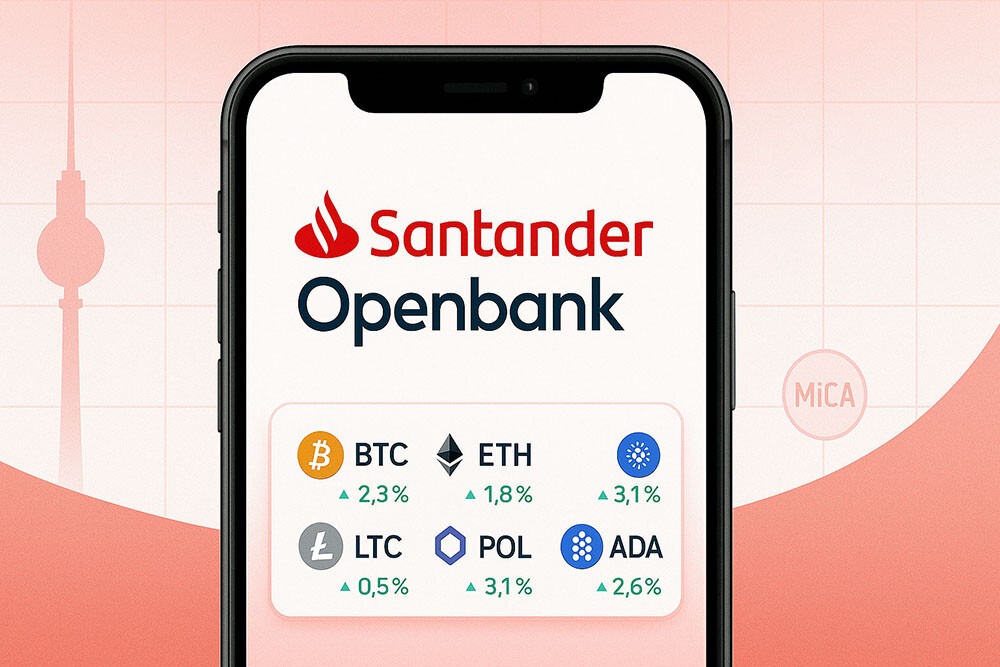
- Santander’s Openbank launches crypto trading in Germany
- Service includes Bitcoin, Ether, Litecoin, Polygon, and Cardano
- Spain rollout and crypto-to-crypto features coming soon
Santander’s Openbank has launched crypto trading in Germany, giving customers access to Bitcoin, Ether, Litecoin, Polygon (POL), and Cardano. The service runs under the EU’s Markets in Crypto-Assets Regulation, allowing trading within the same platform used for traditional investments. With over 2 million clients across several countries, Santander’s Openbank now integrates digital assets into daily banking. The rollout will expand to Spain in the coming weeks, adding more tokens and crypto-to-crypto conversions. This move follows the bank’s earlier digital projects, such as its Ripple-based payments app in 2018, and comes as major German lenders prepare their own crypto offerings under MiCA
Santander’s Openbank launches crypto trading in Germany under MiCA
The launch brings crypto inside the same platform German customers already use for stocks and funds, removing the need for third-party accounts and keeping activity under the Markets in Crypto-Assets Regulation. Santander is based in Spain and counts more than 175 million customers in over 40 countries, while its fully digital arm serves more than 2 million clients across Spain, Germany, Portugal, the Netherlands, the United States, and Mexico. Santander’s Openbank now extends that reach by letting German users buy, sell, and hold the listed tokens without leaving their banking environment. The bank’s head of crypto, Coty de Monteverde, tied the move to customer demand, aligning the offering with a framework that seeks consistent treatment of assets and firms across the EU. MiCA’s passporting lets a licensed platform operate across the bloc, and folding crypto into a bank app gives clients a single login and one compliance perimeter. Short setup steps and familiar user flows lower friction for first-time buyers. Consolidated statements help with tax tracking when national rules require reporting.
Germany’s largest lenders move toward crypto services
The shift is not isolated. In September 2024, DZ Bank, the country’s second-largest lender, started a crypto pilot across roughly 700 cooperative banks using Börse Stuttgart Digital’s infrastructure. That pilot highlighted institutional plumbing that retail users never see, like settlement rails, cold storage, and permissioning. In July 2025, Deutsche Bank said it would launch a digital asset custody service in 2026 in partnership with Austria’s Bitpanda and Swiss technology firm Taurus, reviving a plan first outlined in 2020 and placing custody at the center of its roadmap. Sabih Behzad, who leads digital assets at the bank, also flagged interest in stablecoins, either by issuing a token or joining existing projects. More recently, Sparkassen-Finanzgruppe announced retail crypto trading for nearly 50 million customers via the Sparkasse app by mid-2026, powered by DekaBank and Börse Stuttgart Digital. Those timelines point to staged adoption: pilots in 2024, custody commitments in 2025 for delivery in 2026, and mass-market access via the largest retail footprint around the same window. Santander’s Openbank adds a live product for Germany now, tightening the link between plans and daily banking use.
Santander’s Openbank plans for Spain and added tokens
Santander’s Openbank will extend the service to Spain in the coming weeks, with additional tokens and crypto-to-crypto conversions on the roadmap. The staged rollout gives the team a chance to monitor liquidity, spreads, and order routing during peak hours in Germany before adding another country. It also leaves room to align disclosures with Spanish requirements while staying inside MiCA. A controlled expansion allows Openbank to refine onboarding questions, transaction limits, and risk flags based on observed behavior, not only policy. The integration with existing investment products means portfolio views can show both listed securities and digital assets side by side. Clear labeling keeps asset types distinct while enabling tools like cost basis tracking. As token coverage grows, the bank can define listing criteria that reference liquidity, chain stability, and legal clarity. That keeps the catalog focused while still offering range beyond the initial set of five. Santander’s Openbank benefits from the group’s earlier work too. In 2018, the bank launched One Pay FX, a Ripple-powered app that enabled same-day international transfers for retail users in Spain, the United Kingdom, Brazil, and Poland. That experience with on-chain messaging and treasury flows supports operational playbooks for wallets, keys, and reconciliations today.
Stablecoins, custody, and market structure across the EU and US
The launch lands as stablecoins move higher on bank agendas. Several European lenders now explore euro- and dollar-pegged tokens for payments, liquidity, and settlement, with governance and reserve disclosure under review. Santander has publicly explored entering the stablecoin market and expanding retail services, which would sit next to the new trading feature if the bank proceeds. Custody remains the foundation. Without tested storage and signing, token rails cannot scale safely inside banks. That is why Deutsche Bank’s custody plan with Bitpanda and Taurus matters for 2026, and why Börse Stuttgart Digital’s stack appears across multiple German initiatives. On the other side of the Atlantic, the GENIUS Act passed in July 2025 gave US banks more clarity for stablecoin issuance and retail-facing crypto services. JPMorgan, Citigroup, and Bank of America began work streams to evaluate issuance models, partner structures, and controls after that date. The directions are not identical across regions, yet the goals look similar: let users hold and move tokenized value within supervised institutions, apply uniform rules, and connect to existing payment rails where needed. Santander’s Openbank extends that approach by making crypto part of a standard bank login in Germany first, then Spain, with more tokens and direct conversions next.
Conclusion
Santander’s Openbank has introduced crypto trading in Germany, adding Bitcoin, Ether, Litecoin, Polygon (POL), and Cardano under MiCA. Spain is next, with more tokens and features planned. The move places digital assets beside traditional investments in one platform, reducing reliance on third parties. Germany’s wider banking sector is also advancing, with DZ Bank pilots, Deutsche Bank custody services set for 2026, and Sparkassen preparing retail trading for millions of clients. Santander’s earlier work with Ripple and its stablecoin research strengthen its position. By starting in Germany, Santander’s Openbank signals a practical step during a period of rapid regulatory change.
Disclaimer
The information provided in this article is for informational purposes only and should not be considered financial advice. The article does not offer sufficient information to make investment decisions, nor does it constitute an offer, recommendation, or solicitation to buy or sell any financial instrument. The content is opinion of the author and does not reflect any view or suggestion or any kind of advise from CryptoNewsBytes.com. The author declares he does not hold any of the above mentioned tokens or received any incentive from any company.
Featured image created by AI


Subscribe To Our Newsletter
Join our mailing list to receive the latest news and updates from our team.