
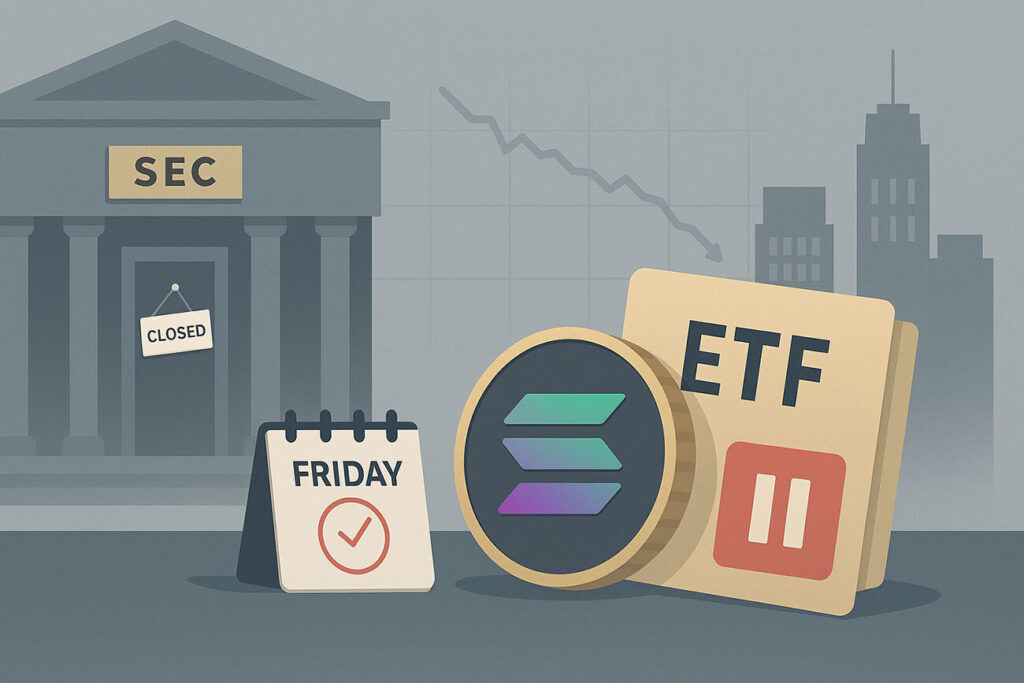
- SEC shutdown halted solana ETF reviews; Friday decisions for Fidelity, Franklin Templeton, and Invesco now uncertain.
- Prices: SOL −7.9% ~$183.27; BTC −4.1% ~$111,917; XRP −19.53%; DOGE −12.35%; ETH +0.04%.
- New rule enables generic listings on NYSE, Nasdaq, and Cboe, cutting filing-to-launch to ~75 days.
Crypto bulls entered the week expecting a decision on U.S. exchange-traded funds tied to solana, only to see the process pause under a partial government shutdown that began on October 1, which halted routine Securities and Exchange Commission reviews and pushed a widely watched Friday deadline into uncertainty for issuers like Fidelity, Franklin Templeton (BEN −4.06%), and Invesco (IVZ −5.98%), while traders weighed near-term delays against a larger structural shift that has made crypto listings faster since September and tracked sharp price moves including solana down 7.9% to about $183.27, XRP off 19.53% to $2.03, dogecoin down 12.35% to $0.22, ether roughly flat at +0.04%, and bitcoin down 4.1% to near $111,917.
Crypto bulls weigh SEC shutdown impact on solana ETF timeline
The SEC confirmed it is operating under its shutdown plan, which limits the agency to essential work and stops reviews of new financial products and registrations, including applications from investment companies and exchanges; this pause covers spot crypto ETFs, so the solana filings sit in limbo until normal operations resume, despite a Friday decision window that had fueled positioning across desks this week and fueled discussion about whether the first wave should include multiple large issuers rather than a single product from a smaller sponsor approved earlier in July under a different structure. Crypto bulls who marked the calendar now face an open-ended queue, and that change matters because investors had already penciled in a 2025 launch window for solana funds, and some had priced in cross-flows from existing bitcoin and ether vehicles into multi-asset allocations once a broader shelf exists.
Roxanna Islam of VettaFi described the practical problem in plain terms, noting that no one knows when, in what order, or how fast the agency will process the backlog after a reopening, even if decisions still arrive this year; she also flagged a behavioral risk that people get tired of waiting after nearly eight months of headlines and small delays, which could cool demand right before approvals, and that effect could show up in near-term price pressure that reverses once funds start trading. The market took the pause in stride but not without stress, since solana fell 7.9% to around $183.27 by Friday afternoon after showing an earlier change of −5.84%, while bitcoin slipped 4.1% to about $111,917, which framed risk in a way that keeps positioning cautious until a new timetable appears.
Crypto bulls track the September rule change that shortens listings
A key structural shift still supports the case for faster launches once the government reopens because, in September, the SEC approved a rule change that lets the New York Stock Exchange (ICE −1.13%), Nasdaq (NDAQ −2.74%), and Cboe Global Markets (CBOE +1.64%) adopt generic listing standards for spot crypto ETFs and other commodity products without case-by-case rulemaking; Adrian Fritz at 21Shares estimated that this framework can reduce the maximum time from filing to launch to about 75 days from 240 days or more, which compresses calendar risk and lowers the cost of capital for issuers planning seed sizes and market-making commitments. Crypto bulls see this as the bigger story because faster, standardized paths allow several products to arrive in a tight window, which can increase competition on fees and spreads and improve secondary-market depth for solana and other assets once the first approvals land.
The agency’s shutdown plan makes the near-term pause clear, stating that it will not review or approve registrations by entities such as investment advisers, broker-dealers, transfer agents, and investment companies, nor will it move on new financial products, which places every pending spot crypto ETF inside the same holding pattern; that said, the post-September pathway remains in place, and it should restart as soon as funding returns, which helps issuers plan for synchronized launches rather than scattered dates that fragment liquidity and confuse allocators. In practice, this means a short pause and then a tighter runway, especially if exchanges coordinate with issuers and market makers to line up listing notices and creation-redemption mechanics for first-day flows.
Market snapshot and issuer field across solana, XRP, dogecoin, and cardano
Solana remains the sixth-largest crypto asset by market capitalization and stands as a direct competitor to ether because both blockchains support decentralized applications; that rivalry explains the focus on a spot solana ETF after the market saw the impact of direct bitcoin and ether funds earlier this year and after the July approval of a solana product from a smaller issuer under a different structure, which served as a proof point while large firms queued for a broader launch. The current issuer slate includes Fidelity, Franklin Templeton, and Invesco, and the same calendar month also brings SEC decision windows for ETFs tied to XRP, dogecoin, and cardano, which hold the fifth, eighth, and tenth spots by market value, according to CryptoMarketCap data cited in the filings context, making this cluster of assets a likely second wave after bitcoin and ether.
Price action reflected the pause and the wider risk tone, with XRP down 19.53% to $2.03, dogecoin down 12.35% to $0.22, and ether near flat at +0.04%, while bitcoin slipped 4.1% and solana settled near $183.27 after a sharper intraday drop, which echoed the idea that some holders prefer to wait for clarity on listings before adding exposure; this pattern aligns with comments that delays can weigh on near-term demand, then reverse as liquidity improves when funds start to trade. Crypto bulls also watch international signals, since exchange-traded products tied to smaller assets have attracted notable inflows in Europe and Canada in recent weeks, which suggests that anticipation can build through pauses and then show up in faster ramps once a U.S. launch unlocks larger advisory platforms.
Crypto bulls look ahead to the post-shutdown processing queue
The most direct near-term question is order and speed, because once the government reopens the SEC can resume reviews that stopped on October 1, and staff will have to triage filings that include multiple solana funds and, later this month, applications tied to XRP, dogecoin, and cardano; a compact calendar would help liquidity by clustering first-day volumes, while a staggered schedule could spread attention without overwhelming creation desks. Crypto bulls will measure the first week back by two signals, namely exchange notices that point to listing readiness under generic standards and updated staff comments that clear any final disclosure or surveillance issues, since those steps map to Fritz’s 75-day outer bound and give allocators a simple way to pencil in launch windows for portfolio rebalancing.
Issuers still need to manage seed, market-making agreements, and risk controls, yet the framework now looks simpler than before September, which improves odds that several products clear in the same quarter; that outcome would answer months of waiting with a broader set of tools for registered investment advisers and self-directed accounts that want direct exposure to solana and a few other large assets without using offshore vehicles or closed-end workarounds. If delays sap interest before approvals, lower prices can follow, but that move tends to reset positioning rather than change the longer arc, and prior comments from VettaFi’s Islam suggest that once approvals arrive the demand picture can improve as investors who stepped aside return with a clear path to add exposure through listed funds.
Conclusion
The shutdown paused a Friday decision on solana ETFs and stopped routine SEC work on new financial products, yet a September rule change now gives exchanges generic standards that can cut listing windows to about 75 days from 240 or more, which sets up a faster path once operations resume and places solana, XRP, dogecoin, and cardano in a likely second wave behind bitcoin and ether, while recent moves show solana down 7.9% to near $183.27, XRP off 19.53% to $2.03, dogecoin down 12.35% to $0.22, ether at +0.04%, and bitcoin down 4.1% to around $111,917, and crypto bulls will track the reopening sequence, the issuer queue led by Fidelity, Franklin Templeton, and Invesco, and the first exchange notices under the new standards to judge timing and depth for the next phase of crypto ETFs in the United States.
Disclaimer
The information provided in this article is for informational purposes only and should not be considered financial advice. The article does not offer sufficient information to make investment decisions, nor does it constitute an offer, recommendation, or solicitation to buy or sell any financial instrument. The content is opinion of the author and does not reflect any view or suggestion or any kind of advise from CryptoNewsBytes.com. The author declares he does not hold any of the above mentioned tokens or received any incentive from any company.
Featured image created by AI


Subscribe To Our Newsletter
Join our mailing list to receive the latest news and updates from our team.