

- Bitcoin trades near $107k with a 5% loss this October, putting pressure on the “Uptober” trend that usually brings gains.
- Around $1.2 billion in long positions were liquidated after the drop, while DOGE and ADA lost over 20% and majors slid 4%–7%.
Bitcoin enters October with a red start that breaks the “Uptober” habit traders like to cite, as month-to-date losses sit near 5% while spot trades hover around $107,000 in late Asian hours on Sunday, according to CoinGlass. The gap between this weak print and the month’s historical average gain of about 19.8% looks wide, especially when November’s mean return near 42% stands out as the strongest month on record. Seasonality has not helped, because macro risk took the driver’s seat and forced the market to respect tightening liquidity and a rise in event-driven stress rather than calendar effects.

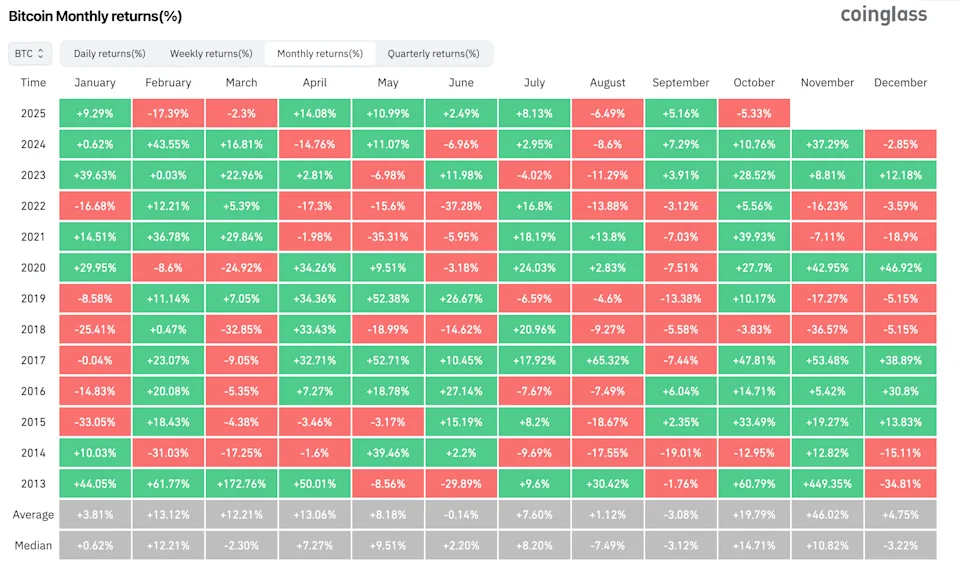
October slump tests “Uptober” lore for Bitcoin
The month’s drawdown comes with a rare backdrop. Over the past twelve years, October ended lower only twice, in 2014 and 2018, with the latter closing about 3% down for the month. That track record frames the current 5% slide as notable, not unprecedented, yet clearly outside the pattern traders expect. Across majors, performance confirms the pressure. Ethereum, Solana, and BNB each fell roughly 4%–7% over the week, while smaller tokens sold harder, with Dogecoin and Cardano down more than 20%. Breadth looks weak as well, with the CoinDesk 20 Index showing an 8% drop for October, which lines up with a broad risk-off tone rather than an idiosyncratic move in one asset. Bitcoin still anchors sentiment, yet the cross-market picture signals that positioning and liquidity conditions matter more than seasonal lore when stress builds and narratives collide with tape.
Macro drivers: tariffs, liquidity, and leverage
A cluster of macro forces has pinned risk appetite down. The U.S.–China tariff standoff keeps policy uncertainty elevated and blunts cyclical impulses that often lift risk assets into year-end. Liquidity looks thin across venues, which magnifies intraday swings and allows small flows to move price faster than usual. Leveraged structures added fragility. Traders built exposure after September’s rebound and leaned on funding, so de-risking hit harder when spot slipped. These three drivers now interact. Headlines around tariffs weaken growth hopes, weak order books reduce shock absorption, and leverage turns small declines into steeper cascades. Bitcoin trades through that mix, so even modest selling finds an easier path and pushes the market into areas where bids retreat and spreads widen.
Liquidations and market breadth with Bitcoin under $107,000
The slip below $107,000 last week sparked another sharp clean-out, with about $1.2 billion in liquidations erasing a stack of long positions built after the late-September bounce. Forced selling tends to arrive in waves. One round knocks out margined longs, price gaps lower, and then the next set of stops triggers as traders try to defend levels that no longer hold. Bitcoin bears down on the rest of the market when that happens. Ethereum, Solana, and BNB tracked lower in tight ranges, while the beta cohort sold harder and faster. Dogecoin and Cardano both dropped more than 20% as liquidity thinned and market makers stepped back. The picture supports a straightforward read. When Bitcoin breaks a well-watched level, liquidation math starts to drive flows, and breadth confirms stress rather than relief, which helps explain the CoinDesk 20 Index’s 8% decline for the month so far.
History and path ahead for late-month reversals
History allows for late turns. In 2020, the market started October on the back foot, then flipped into a 27% rally by month-end and set up the following year’s record highs. The setup today differs, yet the calendar still shows time. Two weeks remain on the clock, which leaves room for a squeeze if positioning resets and macro headlines cool. Traders will watch funding rates, spot-derivatives basis, and open interest as real-time signals for stress relief. A drift lower in leverage after the $1.2 billion wipeout would tighten ranges and prepare the ground for steadier flows. Any easing in the tariff narrative could help restore risk appetite at the margin and guide bids back toward the $107,000 area that just failed. Bitcoin needs stability first and momentum second, because sustained rallies tend to follow periods where forced supply clears, liquidity rebuilds, and breadth stops deteriorating across majors and mid-caps.
Conclusion
October’s start challenged the “Uptober” story, with a 5% month-to-date drop, spot near $107,000, about $1.2 billion in liquidations, and cross-market losses that pulled Ethereum, Solana, and BNB lower by 4%–7% while Dogecoin and Cardano sank more than 20%. The CoinDesk 20 Index fell about 8% for the month, which underscores how broad the move looks and how macro risk diluted seasonality. History still shows room for a turn, as 2020 proved with a late 27% surge from an early loss, and the calendar holds two more weeks for a possible reset. Bitcoin now faces a simple sequence. Stabilize under lighter leverage, rebuild liquidity as volatility cools, and test prior levels with better breadth so that any bounce can carry past crowded resistance instead of sparking another round of forced selling.
Disclaimer
The information provided in this article is for informational purposes only and should not be considered financial advice. The article does not offer sufficient information to make investment decisions, nor does it constitute an offer, recommendation, or solicitation to buy or sell any financial instrument. The content is opinion of the author and does not reflect any view or suggestion or any kind of advise from CryptoNewsBytes.com. The author declares he does not hold any of the above mentioned tokens or received any incentive from any company.
Featured image created by AI


Subscribe To Our Newsletter
Join our mailing list to receive the latest news and updates from our team.