
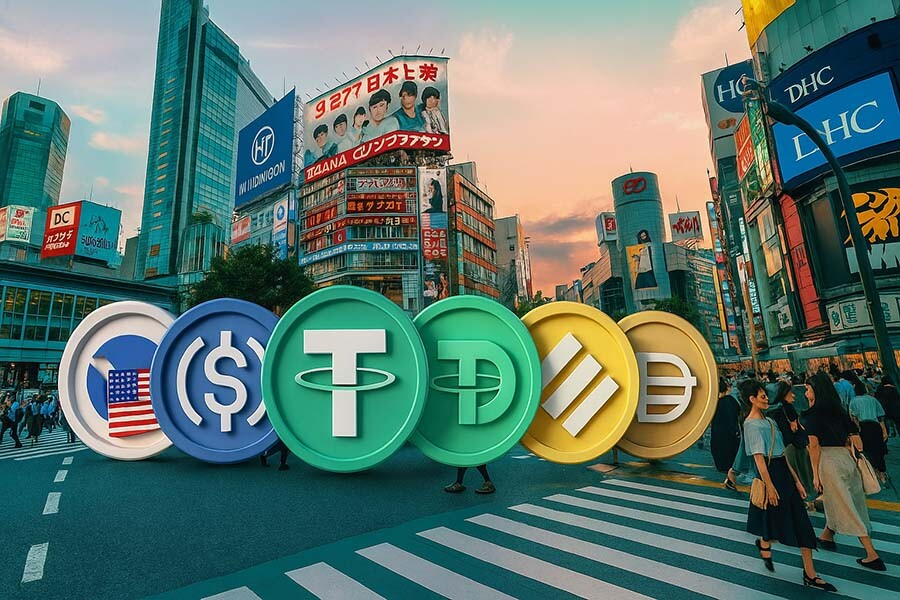
- Japan’s Financial Services Agency plans to let local banks hold and trade crypto under revised supervisory rules discussed this quarter.
- The agency may also allow banks to register as crypto exchanges to offer safer access for retail investors through regulated channels.
- Upcoming reforms include insider-trading penalties tied to illegal gains to align Japan’s crypto laws with existing securities standards.
Japan’s Financial Services Agency is preparing to discuss a significant policy reform that may allow domestic banks to buy, hold, and trade cryptocurrencies like bitcoin and ether. According to a report published on Sunday by Yomiuri Shimbun, the agency seeks to revise existing supervisory guidelines that currently prohibit banks from holding digital assets due to their price volatility. The reform aims to place crypto assets on par with traditional financial instruments such as stocks and government bonds. The FSA is expected to bring the matter forward during a meeting of the Financial Services Council, an official advisory group to the Prime Minister. Alongside these changes, Japan is also considering granting banks the ability to register as crypto exchanges. This would streamline access for retail investors while introducing stricter market controls. Additionally, new penalties are being drafted to address the misuse of non-public information in crypto trading.
Japan banking reform: scope and timeline
Local media said the agency will examine changes to supervisory guidelines so bank groups can acquire digital assets for their own books and trade them within regulated parameters. The language mirrors securities treatment, which keeps risk controls embedded in daily operations and separates trading, custody, and client services inside bank structures. Officials plan to table the matter at the Financial Services Council, an advisory body to the Prime Minister, cementing the debate on a formal policy track rather than leaving it to industry speculation. The initiative builds on a broader legislative arc. Earlier this year, Nikkei reported that the regulator intends to revise the Financial Instruments and Exchange Act to give crypto assets explicit status as financial products, including insider-trading restrictions like those covering equities and bonds. The plan envisages submitting a bill to parliament as early as 2026, which sets a clear horizon for full alignment between crypto oversight and the securities rulebook.
Regulatory guardrails and risk controls
The FSA’s outline stresses guardrails before broader bank participation. The agency wants a system that treats digital-asset risk like market risk for bonds and stocks, with capital, liquidity, and disclosure requirements to match. An official quoted by Bloomberg Tax said banks would need structures to manage asset-linked risks properly if they buy or hold crypto on their own balance sheets, and the agency is also considering licensing paths that let banking groups operate exchange businesses under the same umbrella. Market integrity sits next to prudential concerns. Authorities in Japan have moved to outlaw trading on non-public information in crypto markets, pairing enforcement muscle with proportional financial penalties tied to illicit gains. The Securities and Exchange Surveillance Commission would investigate suspicious cases and make referrals, bringing crypto surveillance closer to public-equity standards within the country’s enforcement framework.
Banks as exchange operators and retail access in Japan
The reform path includes allowing banks to register as crypto-asset exchange operators. That change would let retail customers access trading and custody services through trusted banking brands, while giving supervisors a single view of risks across deposit-taking, brokerage, and digital-asset activities. Local reports describe a model in which bank groups run exchange services under existing financial-group controls rather than outsourcing core functions to third parties. Japan’s retail market shows steady growth that banks could channel into regulated access points. FSA data cited by industry press counted more than 12 million registered crypto accounts as of February 2025, roughly 3.5 times higher than five years earlier. Consolidating that flow within bank-run venues would simplify onboarding, tighten suitability checks, and align custody with incumbent standards that already govern securities and foreign-exchange services.
Japan market impact and next steps
If adopted, the policy would give Japan’s banks the option to treat bitcoin and other assets like mainstream instruments within internal risk systems. It would also place market-abuse rules, disclosure, and surveillance on firmer legal ground, addressing gaps flagged by global watchdogs who warn that uneven regulations invite jurisdictional arbitrage. The next formal marker is the Financial Services Council session, where the FSA presents its case, seeks feedback, and outlines specific implementation steps. Insider-trading curbs appear set to arrive first, since the framework has advanced through consultation and public signaling. Local coverage says penalties will scale with unlawful profits, which aligns incentives and gives investigators measurable recovery targets. As integrity measures take hold, banks can map crypto-asset activity into compliance workflows they already use for securities and derivatives, reducing operational friction when the trading door opens.
Conclusion
Japan’s reform discussion signals a major structural change for its financial system, blending traditional banking oversight with the evolving digital-asset space. The Financial Services Agency is setting the stage for banks to participate directly in crypto trading and holding, ending years of exclusion under rules shaped by volatility concerns. Once these guidelines are revised, local banks could trade bitcoin and other digital assets under the same framework used for equities and government bonds. Such access could expand retail participation through bank-operated exchanges while preserving strong consumer protection. The plan to enforce insider-trading penalties reinforces market integrity and aligns Japan’s crypto governance with its established securities laws. Together, these moves reflect Japan’s measured attempt to bring digital assets into its financial mainstream while maintaining the stability that defines its regulatory reputation.
Disclaimer
The information provided in this article is for informational purposes only and should not be considered financial advice. The article does not offer sufficient information to make investment decisions, nor does it constitute an offer, recommendation, or solicitation to buy or sell any financial instrument. The content is opinion of the author and does not reflect any view or suggestion or any kind of advise from CryptoNewsBytes.com. The author declares he does not hold any of the above mentioned tokens or received any incentive from any company.
Featured image created by AI


Subscribe To Our Newsletter
Join our mailing list to receive the latest news and updates from our team.