
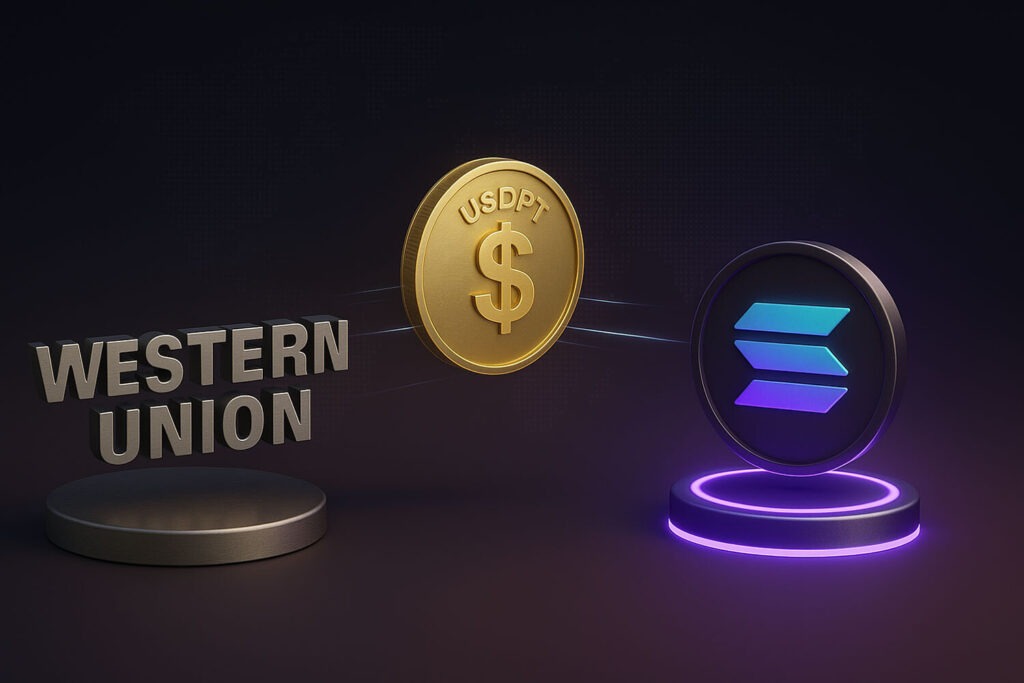
- Western Union plans to release its USDPT stablecoin on the Solana blockchain in 2026 through Anchorage Digital Bank under full compliance.
- The company will introduce a new Digital Asset Network that supports sending, receiving, and holding USDPT for global money transfers.
- The project aligns with a fast-growing stablecoin market valued at around $312 billion in 2025, projected to reach $750 billion by 2026.
Western Union has announced plans to launch a new stablecoin called USDPT on the Solana blockchain in 2026, signaling a major step toward integrating digital assets into its global money transfer operations. The company, headquartered in Denver, Colorado, will issue the token through Anchorage Digital Bank, ensuring compliance with U.S. banking regulations. With this initiative, Western Union aims to let users send, receive, spend, and hold USDPT across its network through a user-friendly digital experience. The firm also introduced a new “Digital Asset Network” designed to provide real-world utility for blockchain-based assets. By combining Solana’s high-speed infrastructure with Western Union’s trusted global reach, the company seeks to bridge traditional finance with emerging blockchain systems. This move comes amid a rapidly expanding stablecoin market that has grown nearly 50% in 2025, reflecting strong demand from institutions, regulators, and consumers worldwide.
Western Union stablecoin on Solana: USDPT, issuer details, and launch window
Western Union confirmed USDPT as the U.S. Dollar Payment Token and selected Solana for low-cost, high-throughput settlement, while Anchorage Digital Bank will issue the token under a federally regulated framework; the launch is scheduled for 2026, aligning with the company’s push to integrate digital assets into its money movement stack for retail and commercial flows. The firm, which serves a vast global user base for cross-border payments, positions this step as an extension of its existing rails rather than a parallel product, aiming for simple access within familiar touchpoints across its ecosystem. Western Union also introduced a Digital Asset Network to anchor USDPT and related services; it described the network as a way to create real-world utility for digital assets, while leaving open questions about support for other coins and tokens. That careful stance signals an iterative rollout that can meet regulatory obligations in core markets first, then expand scope as governance and licensing allow.
Western Union Digital Asset Network: access, compliance, and corridors
Western Union says its users will gain access to digital assets through a seamless interface supported by global compliance and risk capabilities, a point that matters for licensed money transmitters operating in diverse jurisdictions. The company’s statement emphasizes the ability to hold USDPT and use it across sending and spending contexts, suggesting potential links between on-chain balances and fiat payout options where local rules permit. That architecture could bridge on-chain rails with cash-out hubs and bank partners in established corridors, a model that addresses the last-mile challenge common in remittances. In public comments around the reveal, Western Union framed the initiative as part of a mission to expand access to financial services everywhere. Anchorage Digital brings issuance and custody under a bank charter, while Solana provides performant settlement for consumer-grade experiences. The combination targets speed and predictable fees without asking end users to navigate complex wallet setups. Details on third-party asset support remain undisclosed, which keeps the first phase focused on USDPT and the firm’s own compliance perimeter.
Stablecoin market size, GENIUS Act, and growth outlook into 2026
The stablecoin market has climbed to roughly $312 billion in 2025, up close to 50% this year, with analysts at Standard Chartered projecting about $750 billion by the end of 2026; that backdrop shows why a large payments brand would move now, as regulatory clarity improves and on-chain dollars see broader use beyond trading. Tether’s USDT holds near $183 billion in market value, while Circle’s USDC stands above $76 billion, keeping the pair among the largest crypto assets by capitalization. The U.S. regulatory picture shifted in July 2025 when President Donald Trump signed the GENIUS Act into law, establishing a federal framework for payment stablecoins that must be fully backed by cash and short-term Treasuries, with monthly reserve disclosures; that law reduced uncertainty for banks and fintechs that wish to issue or integrate dollar-pegged tokens, and it set the stage for new products to reach mainstream users through regulated channels. Western Union’s plan arrives in that context, which helps explain the timing and structure of USDPT and its bank issuer.
Solana’s role, SOL price context, and how Western Union compares with peers
Solana underpins the sixth-largest crypto asset by market capitalization and continues to court payment use cases through low latency and high throughput; around the time of the announcement, SOL traded near $203, up about 2% on the day and almost 6% on the week, while a Myriad prediction market showed roughly two-thirds of respondents not expecting a new all-time high this year. For Western Union, choosing Solana signals a focus on consumer-ready performance and fees, which may prove critical for micro-remittances and habitual spending. Peers are also experimenting with digital dollars. PayPal has issued PYUSD, JPMorgan has advanced tokenized cash for wholesale clients, and several U.S. states continue to explore localized stablecoin programs; together these efforts show a sector-wide move toward on-chain settlement under clearer rules. Western Union arrives with deep distribution and payout networks, which could differentiate its approach if the company links on-chain balances to cash pickup, bank deposits, and card endpoints in compliant ways.
Conclusion
Western Union plans to bring USDPT to Solana in 2026 with Anchorage Digital Bank as issuer and a Digital Asset Network designed to deliver practical use at scale; the plan lands after U.S. lawmakers passed the GENIUS Act, as the stablecoin market approaches about $312 billion with forecasts of $750 billion by late 2026, while USDT and USDC remain dominant and SOL trades near $203 during the news cycle, leaving a clear runway for a regulated, consumer-facing dollar token that integrates with existing payment rails and trusted compliance processes.
Disclaimer
The information provided in this article is for informational purposes only and should not be considered financial advice. The article does not offer sufficient information to make investment decisions, nor does it constitute an offer, recommendation, or solicitation to buy or sell any financial instrument. The content is opinion of the author and does not reflect any view or suggestion or any kind of advise from CryptoNewsBytes.com. The author declares he does not hold any of the above mentioned tokens or received any incentive from any company.
Featured image created by AI


Subscribe To Our Newsletter
Join our mailing list to receive the latest news and updates from our team.