
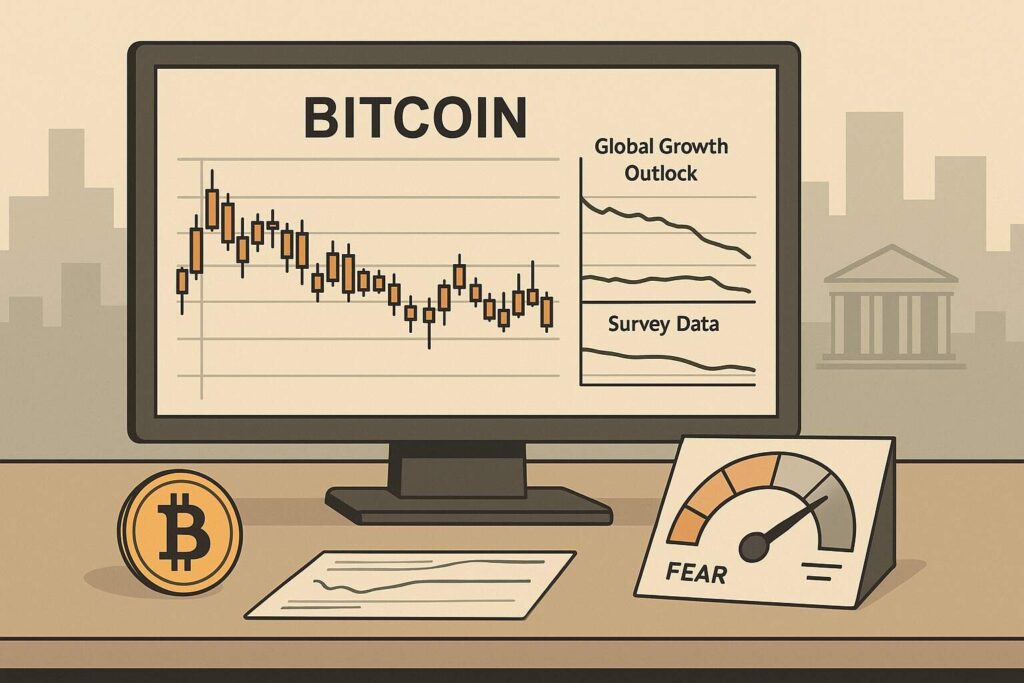
- Bitcoin trades around $90,559, about 28% below its high
- Bitwise says Bitcoin prices in a recession-style growth outlook
- Fear index sits at 20 while markets see a likely Fed rate cut
Bitcoin sits near ninety thousand dollars while economic data points to improving growth, creating a striking contrast between market pricing and macro surveys. At first glance, the coin looks weak, yet research from Bitwise suggests that investors treat it as if a recession is around the corner, even though survey data from major institutions does not confirm such a severe slowdown. This gap between perception and data defines the current market narrative and shapes how traders view risk, sentiment and the next policy move from the Federal Reserve.
Bitcoin and macro growth expectations diverge
André Dragosch, European Head of Research at Bitwise Asset Management, compared the growth outlook implied by Bitcoin with a composite of global macro surveys from Sentix, ISM and the Philadelphia Fed. His chart plots two lines: a survey-based indicator near neutral and an implied growth signal derived from price action that has dropped below minus one standard deviation. In practice, that means the market prices in a recession-type environment, even while survey respondents report conditions that look more balanced than outright contraction. The signal echoes the mood of 2020 during the Covid shock and late 2022 near the FTX collapse, when the asset also priced very bleak outcomes before later staging large rebounds. Dragosch describes the current configuration as an asymmetric setup, where much bad news already sits in the price while improving macro data has yet to filter fully into valuations. He argues that Bitcoin now trades as if global growth will deteriorate sharply, even though expectations for expansion show early signs of recovery and may strengthen into 2026. The implied message for traders is simple but not sensational: the market discounts a scenario that looks worse than what most surveys record, which leaves room for upside if growth meets, or even slightly exceeds, those improving expectations. That view does not guarantee a repeat of the sixfold advance following March 2020, yet it frames today’s discount as unusually deep relative to recent macro history.
Sentiment, fear index and Bitcoin market performance
Price and sentiment support the idea of caution without outright panic. At 11:30 a.m. UTC on November 29, Bitcoin traded at 90,559 dollars, down 0.8 percent over the previous twenty-four hours. Year to date, it has slipped about 3.04 percent and stands 28.17 percent below its all-time high of 126,080 dollars set on October 6. Those figures show a market that cooled from peak levels but did not collapse in the way seen during earlier crises. The CMC Crypto Fear and Greed Index adds another layer. The gauge holds at 20, a zone classified as “Fear,” matching the previous day and sitting just above the year-to-date low of 10, recorded on November 22. A month earlier, the same index read 39, also in the fear band, while in late November 2024 it reached 84, a level tagged as “Extreme Greed.” The swing from 84 to 20 over one year captures the full journey from exuberant optimism to reserved caution. Traders now operate in conditions where participants hesitate to add risk, yet broad capitulation has not taken hold. In this context, Bitcoin reflects a market that already absorbed a long reset after a strong run into late 2024. Short-term traders see a range near ninety thousand dollars, while longer-term investors track the drawdown from the record high as a measure of how much excess has already cleared. The current level leaves room for both paths: further drift lower if growth disappoints or a snap higher if macro data and flows start to align with the more neutral tone of surveys.
Recession pricing, history and Bitcoin rally setups
When Dragosch says that Bitcoin is “essentially pricing in a recessionary growth environment,” he points directly to that deep gap between implied and surveyed outlooks. Previous episodes with similar patterns occurred around March 2020 and November 2022. In both cases, global growth expectations from surveys already pointed to stress, yet price action in the coin suggested an even harsher scenario. After those dislocations, policy support, improving data and renewed inflows helped the asset move sharply higher over the following months. The present situation shares some features with those moments without perfectly matching them. Implied growth from Bitcoin again sits well below neutral, while survey composites hold near the middle of their historical range. This time, however, inflation has eased from its peak, and central banks approach the next stage of their policy cycles. The asset therefore serves as a kind of stress barometer, reacting not only to past tightening but also to uncertainty about how quickly monetary conditions might relax. Dragosch highlights the asymmetry in simple terms. If the world slips into a hard downturn, then Bitcoin already reflects a large portion of that risk through its implied growth signal and distance from its high. If growth avoids a deep contraction and follows the improving survey trend instead, then the current discount looks too severe relative to the macro path. In that case, the asset could again move higher over time as investors adjust their expectations and close the gap between perception and data. None of this removes volatility, yet it frames today’s levels as a possible mispricing rather than a calm equilibrium.
Macro policy outlook and risk for crypto markets
Macro expectations also shape the picture. According to the CME FedWatch Tool, traders assign an 86.4 percent probability that the Federal Reserve will cut its benchmark rate by twenty-five basis points at the December meeting, moving the target range to 3.5–3.75 percent. This probability matters because it tells markets that the tightening phase has likely ended and that policy may shift toward modest easing over the coming quarters. For a risk asset that often trades alongside broader equity sentiment, that change in stance can influence flows and positioning. If the cut arrives as expected, the move would signal that central bankers now see enough progress on inflation and growth to justify a gentler policy path. Investors holding Bitcoin would then weigh two opposing forces. On one side, slower growth and lingering uncertainty still support the recession pricing revealed by Dragosch’s implied growth indicator. On the other, a lower policy rate supports liquidity conditions and can nudge some investors back toward risk. How those forces balance will shape the next stage of the market. Other assets follow this story as well. Equity indices respond to the same growth and policy signals, while credit markets track changes in funding costs and default risk. Crypto does not sit outside this system. Bitcoin remains a liquid, global instrument that reacts quickly to shifts in expectations, often before slower indicators, such as surveys or hard data, fully adjust. That speed explains why its implied growth signal can move far below survey readings and why it sometimes leads rather than lags macro turning points.
Conclusion
The current phase shows a clear split between what macro surveys suggest and what Bitcoin prices imply about future growth. Research from Bitwise places the implied outlook more than one standard deviation below neutral, a level that resembles the darkest moments of 2020 and 2022, while indicators from Sentix, ISM and the Philadelphia Fed move toward a more stable path. At the same time, the asset trades about 28 percent under its October high at 126,080 dollars, with a spot level near 90,559 dollars and a modest year-to-date decline of just over 3 percent. Sentiment data from the CMC Crypto Fear and Greed Index confirms caution but not despair, with a reading of 20 after a trough at 10 and a prior peak at 84 one year earlier. Policy expectations add another piece, as futures markets indicate an 86.4 percent chance of a December rate cut to a 3.5–3.75 percent band. Together, these elements describe a market where much negative news already sits inside the price while macro data and policy signals turn gradually more supportive. For traders and long-term holders who follow Bitcoin, the key question now is whether that gap closes through weaker growth or through a reassessment of how this asset should trade in a world where recession risk fades but caution still guides positioning.
Disclaimer
The information provided in this article is for informational purposes only and should not be considered financial advice. The article does not offer sufficient information to make investment decisions, nor does it constitute an offer, recommendation, or solicitation to buy or sell any financial instrument. The content is opinion of the author and does not reflect any view or suggestion or any kind of advise from CryptoNewsBytes.com. The author declares he does not hold any of the above mentioned tokens or received any incentive from any company.
Featured image created by AI


Subscribe To Our Newsletter
Join our mailing list to receive the latest news and updates from our team.