
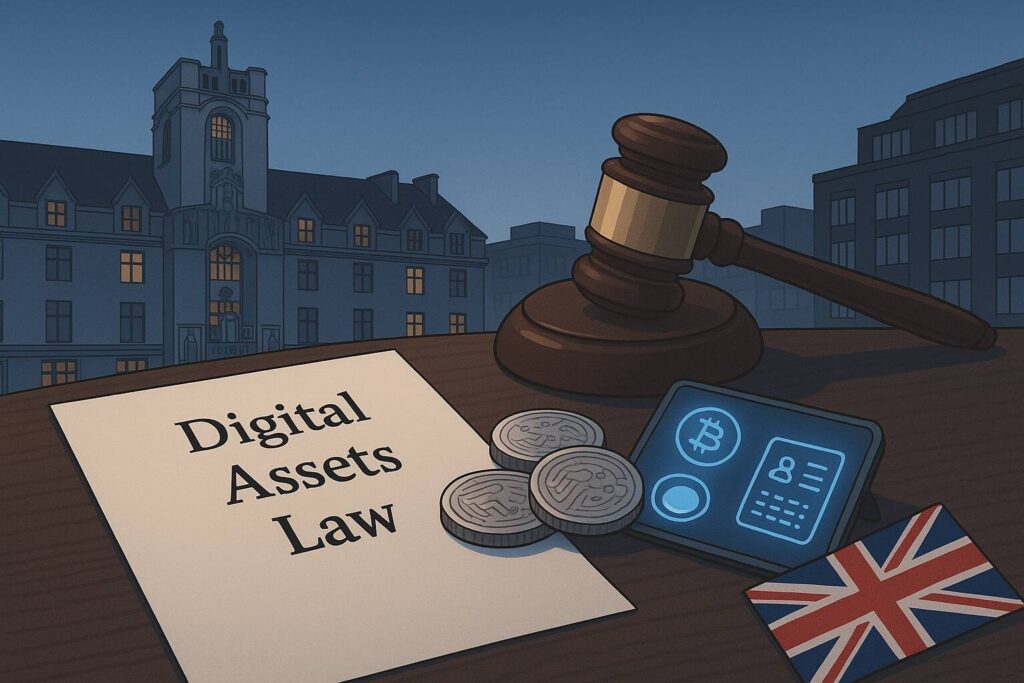
- UK law now treats crypto and stablecoins as personal property
- Clearer rules for disputes, fraud cases and inheritance
- Government also reviews rules on DeFi tax and crypto donations
The United Kingdom has just turned years of legal debate into clear statute by enacting the Property (Digital Assets etc) Act 2025, often described as the new Digital Assets Law. With royal assent confirmed in Parliament, cryptocurrencies and stablecoins now sit inside the core of UK property law under the Digital Assets Law rather than on the edges of case-by-case rulings. The move gives around 12% of UK adults who hold some form of crypto a clearer sense of what they own and how courts will protect those holdings in disputes, fraud cases, insolvencies and estates, at a time when crypto ownership has risen sharply from about 4% in 2021 to around 12% in 2024.
How the Digital Assets Law Changes UK Property Rights
For more than a century, English law divided personal property into two neat groups, known as “things in possession” and “things in action”. A car or a laptop counted as a thing in possession. A contract claim or a debt sat in the second group as a thing in action.
Cryptoassets never fitted comfortably into either box, which left judges to improvise rules in individual disputes and forced investors to rely on scattered case law and interim guidance from regulators. The Digital Assets Law reacts to that problem by confirming in statute that a thing which is digital or electronic in nature can still be the object of personal property rights even when it falls into neither of the older categories. The Digital Assets Law gives that idea a simple structure. It states that a digital thing is not excluded from property rights merely because it is not a physical object and not a traditional claim. Courts now work with a third category of personal property, designed to hold assets such as crypto tokens, stablecoins, non-fungible tokens and other digitally native items whose value exists only on a ledger. Under the statute, those assets can attract the same style of ownership claims as more familiar property, subject to the usual tests about who controls the private keys or has legal title in law or equity. Legislators built the Digital Assets Law on advice from the Law Commission of England and Wales, which in 2024 urged Parliament to codify a distinct category of personal property for digital assets. That advice noted that common law already treated many tokens as property but warned that leaving everything to judges created uncertainty, higher costs and uneven outcomes between different courts. By turning the recommendation into a short, focused Act, Parliament has given courts a starting point and left detailed boundaries to future case law, which can adapt as token designs and market practices change. The statute extends to England and Wales and Northern Ireland and took effect the moment it received royal assent, with Scotland pursuing its own parallel Digital Assets Bill under Scots private law. That immediate commencement matters for businesses that structure collateral, custody and settlement using crypto or tokenised instruments. They no longer need to ask whether an English court will recognise the underlying asset as property at all. Instead, they can focus on lien priority, trust structures and security documents in much the same way that they do when they use shares or other traditional instruments. In that sense the Digital Assets Law works as a missing piece that lets other parts of the system settle into place.
Practical effects of the Digital Assets Law for holders, courts and firms
The most direct impact of the Digital Assets Law appears in disputes over stolen funds, frozen accounts or failed platforms. When a hacker drains a wallet or an exchange collapses, victims and administrators now have a firmer basis to argue that specific digital assets are property that courts can trace, freeze and recover, rather than a vague bundle of contractual expectations. Industry groups such as CryptoUK and Bitcoin Policy UK have already highlighted how clearer property status should help in cases involving fraud, exchange failures and cross-border asset tracing. Clearer property status also helps in inheritance planning, since executors and trustees can treat a deceased person’s wallets in a way that aligns with other assets in the estate. Fraud and insolvency cases stand to change in practice. If a court accepts that a token is property, it can impose proprietary remedies such as constructive trusts or tracing claims through on-chain transfers. Insolvency practitioners can identify which coins belong to customers and which sit on the firm’s own balance sheet, an issue that caused confusion in earlier exchange failures around the world. The Digital Assets Law does not solve every conflict about priorities, but it removes the threshold argument over whether the assets are property in the first place, which often consumed time and legal fees before any discussion of facts could begin. For consumers, the law should reduce the grey area that has surrounded day-to-day crypto use. Someone who sends coins to the wrong address, or who loses funds in a scam, can point to a statutory foundation when asking a court to recognise their continuing rights. Insurers and custodians can design products, coverage terms and risk models on the assumption that the underlying tokens qualify as property, which allows more standard wording and clearer disclosure. As these products mature, the Digital Assets Law will quietly shape how businesses think about custody, recovery and risk and how they describe those issues in terms that retail users can understand. The change arrives at a time when UK regulators already track growing adoption. Research from the Financial Conduct Authority in 2024 showed that about 12% of UK adults owned crypto, up from roughly 4% in 2021, with awareness of cryptoassets above 90% and average holdings exceeding £1,800 per person. Firms now need to reflect the Digital Assets Law in their terms of business, custody agreements and disclosure documents, since disputes will increasingly turn on who held property rights at each stage of a transaction, not just on what the platform’s marketing material promised.
Political and tax context around the UK’s new crypto rules
The new property regime does not sit in isolation. It lands while ministers test ideas that would reshape how money and influence flow through the political system and through decentralised finance. One of the most sensitive debates concerns whether to allow parties to accept crypto donations at all. Reform UK, led by Nigel Farage, became the first party to accept digital-asset contributions this year through its own portal, presenting itself as the most crypto-friendly force in British politics. Soon after, reports from Politico and other outlets revealed that officials were considering a ban on such donations in an upcoming Elections Bill, citing concerns about anonymity, foreign interference and the difficulty of tracing funds that move across borders. If ministers push ahead, the UK could join countries such as Ireland and Brazil, which already restrict or prohibit donations in crypto. Campaign groups like Spotlight on Corruption argue that banning or tightly regulating digital-asset funding is necessary to close gaps in the political finance system, especially where foreign actors might exploit opaque wallets or mixers. Any final Elections Bill text will need to resolve the tension between a Digital Assets Law that treats tokens as property like other assets and electoral rules that may treat the same tokens as too opaque or risky for campaign finance. Tax policy is evolving in parallel. HM Revenue and Customs has been consulting on how to tax decentralised finance transactions that involve lending, staking and liquidity pools. Under current rules, a user who moves tokens into a lending protocol or automated market-making pool can trigger a capital gains tax event even when they still hold an economic interest and have not sold the asset. Officials now favour a “no gain, no loss” approach for many of these transfers, so that tax only falls due when the holder actually disposes of the asset for consideration. Recent budget documents and consultation outcomes confirm that the government is working on a dedicated DeFi tax framework along these lines, although final legislation has not yet taken effect. That would stop routine protocol deposits from generating capital gains calculations on each move, while still taxing yields as income or gains when realised. Together, the Digital Assets Law, a possible ban on crypto donations and a revised DeFi tax framework show how the UK is trying to build a coherent legal environment around tokens rather than regulating by press release or enforcement alone. Property law sets the base layer. Electoral law decides where tokens can support political activity. Tax law determines when and how the state shares in the value created by decentralised markets.
Digital Assets Law and the UK’s ambition as a digital finance hub
Government ministers have repeatedly said they want Britain to become a hub for digital finance, and the Digital Assets Law ties directly into that ambition. In April 2025 the Treasury outlined plans to bring exchanges, brokers and custodians into the formal financial-services regulatory perimeter, with draft legislation to regulate crypto exchanges and dealers for the first time. The Financial Conduct Authority has set out a crypto roadmap and has already permitted certain crypto exchange-traded notes to trade for appropriate investors, reversing a previous ban and deepening links between digital-asset markets and the broader capital market. The new property statute answers a question that many global firms asked when deciding where to base custody, lending or tokenisation projects. They wanted to know whether a jurisdiction could offer clear recognition that the assets they hold or issue count as property with enforceable rights and predictable remedies. By defining that position in primary legislation, the UK can now point to a stable baseline backed by Parliament, not just by individual judgments. That should help banks, asset managers and fintech companies when they assess whether English law offers the certainty they need for long-term products and cross-border deals that rely on tokens as collateral or settlement assets. Industry groups welcomed the change in those terms. Advocacy organisations that focus on Bitcoin policy described the Act as a major step in aligning legal treatment of digital assets with the way people already use them in payments, savings and custody. Trade bodies such as CryptoUK noted that courts had been edging in this direction for years but stressed that statutory confirmation reduces the risk of a future judgment pulling the law in a different direction or reopening basic questions about property status. The Digital Assets Law also supports work in other areas, such as tokenised securities, voluntary carbon credits or loyalty points, which may rely on the same third category of property even when they are not classic cryptocurrencies. For ordinary users, the link between the Digital Assets Law and the idea of a digital finance hub will show up in more subtle ways. Banks and payment firms may feel more comfortable building products that include wallets or tokenised balances once they can rely on clear property concepts in the event of disputes. Lawyers will design standard documentation for custody and security interests that assume digital-property status as a given and allocate risk in ways that match existing practice for shares or bonds. Over time, those quiet shifts can matter more than individual headlines, because they set practical norms for who owns what and how those rights move between people and institutions.
Conclusion
The Property (Digital Assets etc) Act 2025 closes a long-running gap between technological reality and legal doctrine in the UK. By confirming that digital objects can attract personal property rights even when they are neither things in possession nor things in action, the Digital Assets Law gives crypto holders, businesses and courts a common language for future disputes. Its impact will stretch beyond Bitcoin and major stablecoins to any system that records value on a ledger and expects courts to recognise that value as property that can be owned, transferred, pledged or recovered. As ministers refine rules on political donations and decentralised finance taxation, this new property framework will sit at the centre of how the UK manages digital assets in daily life and how it presents itself as a venue for responsible innovation in digital finance.
Disclaimer
The information provided in this article is for informational purposes only and should not be considered financial advice. The article does not offer sufficient information to make investment decisions, nor does it constitute an offer, recommendation, or solicitation to buy or sell any financial instrument. The content is opinion of the author and does not reflect any view or suggestion or any kind of advise from CryptoNewsBytes.com. The author declares he does not hold any of the above mentioned tokens or received any incentive from any company.
Featured image created by AI


Subscribe To Our Newsletter
Join our mailing list to receive the latest news and updates from our team.