
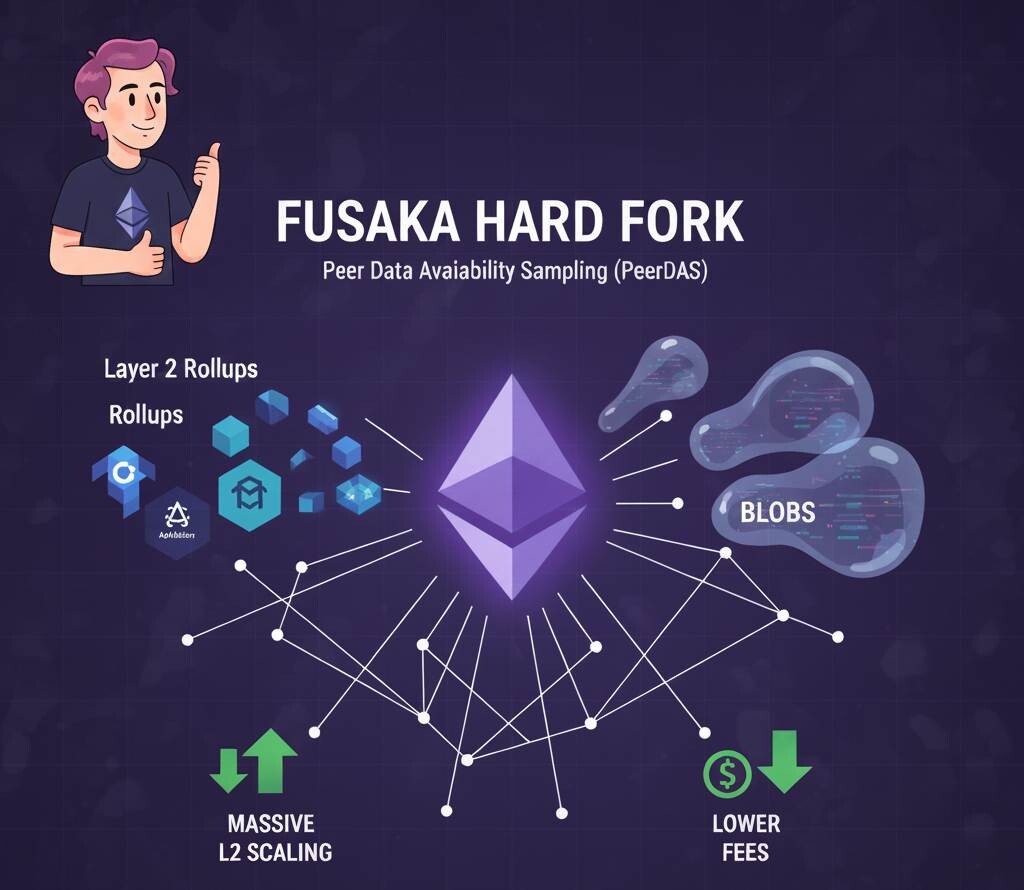
- Fusaka hard fork successfully activated Dec 3, 2025 – the second major Ethereum upgrade this year and the first under the new biannual schedule.
- PeerDAS + 8× blob capacity live: Layer-2 transaction fees expected to drop 60-95%, with many already down 40-60% in the first 24 hours.
- Doubled gas limit, Verkle Tree prep, and minimum blob fee introduced – paving the way for 100,000+ TPS and a potential return to ETH deflation.
In a pivotal moment for the blockchain ecosystem, Ethereum successfully activated its Fusaka hard fork on December 3, 2025, marking the network’s second major upgrade of the year. Named after a fusion of “Fulu” (consensus layer) and “Osaka” (execution layer), Fusaka introduces transformative enhancements aimed at supercharging scalability while dramatically reducing costs for Layer-2 (L2) solutions. This upgrade, which went live at epoch 411,392 around 21:49 UTC, has already sparked optimism across the crypto community, with Ethereum’s native token, ETH, surging over 9% to top $3,000 amid the news. Analysts predict this could usher in a new era of affordability and efficiency, potentially cutting L2 transaction fees by 60-95% and boosting overall network throughput.
The Road to Fusaka: Ethereum’s Evolving Roadmap
Ethereum’s journey toward greater scalability has been methodical, building on previous milestones like the 2024 Dencun upgrade, which introduced proto-danksharding and data blobs to lower L2 costs, and the earlier Pectra fork in May 2025. Fusaka represents a critical step in “The Surge” phase of Ethereum’s roadmap, focusing on rollup-centric scaling to achieve over 100,000 transactions per second (TPS) without compromising decentralization. With 13 Ethereum Improvement Proposals (EIPs) implemented, Fusaka addresses key bottlenecks in data availability, gas limits, and validation processes.
At its core, Fusaka shifts Ethereum from annual upgrades to a biannual hard fork schedule, as announced by ConsenSys, allowing for more agile development and quicker responses to ecosystem demands. This accelerated cadence ensures the network remains competitive against rivals like Solana, which boast high TPS but often at the expense of decentralization.
Key Innovations Driving the Upgrade
The star of Fusaka is PeerDAS (Peer Data Availability Sampling, EIP-7594), a protocol that revolutionizes how nodes handle data blobs—bundles of transactions posted by L2 rollups to Ethereum’s mainnet for settlement. Previously, every node downloaded and stored full blob data, creating bandwidth strain and limiting scalability. PeerDAS allows nodes to sample only small portions (about 1/8th) of each blob while still verifying its availability with high confidence. This reduces validator bandwidth requirements by up to 85%, making it easier for individuals to run nodes and enhancing decentralization.
Coupled with this is an eightfold increase in blob capacity, expanding from three to up to 24 blobs per block in phases. Blobs, introduced in Dencun, are off-chain data storage mechanisms that keep L2 costs low by avoiding mainnet congestion. With more space, rollups like Arbitrum, Optimism, and Base can process higher volumes without fee spikes, leading to more stable and affordable transactions.
Fusaka also doubles the block gas limit from 30 million to 60 million (with potential for 120-150 million), enabling more transactions per block and reducing congestion. Verkle Trees, another highlight, optimize state validation for faster syncing and lighter clients. Additional features include EIP-7918, which imposes a minimum blob base fee (about 1/16th of the standard base fee) to prevent near-zero costs during low activity, ensuring consistent ETH burns and countering inflation. User experience improvements, such as native passkey support (EIP-7212), allow biometric logins like Face ID, eliminating cumbersome seed phrases and making Ethereum more accessible to mainstream users.
Slashing L2 Fees: A Game-Changer for Users and Developers
The most immediate impact of Fusaka is on L2 fees, which could plummet by 40-95% depending on network activity. L2s, which handle the bulk of Ethereum’s transactions (over 85%), rely on blobs to post data cheaply. With expanded capacity and efficient sampling, costs for swaps, trades, and transfers on platforms like Uniswap or Aave could drop to sub-cent levels, even during peak times. Early data post-activation shows blob posting costs already down 40-60%, benefiting DeFi protocols, on-chain gaming, and social apps.
This fee reduction creates a virtuous cycle: lower costs drive more usage, increasing blob demand and ETH burns via base fees. Ethereum, which has been slightly inflationary due to staking rewards outpacing burns, could flip deflationary. Conservative models predict an additional 200,000-400,000 ETH burned annually from L2 activity, potentially shrinking supply by 200,000-300,000 ETH per year in bullish scenarios. This aligns L2 growth with ETH value accrual, fixing a long-standing issue where rollups profited without sufficiently contributing to mainnet security.
Validators also win big. Lower resource demands from PeerDAS encourage more solo staking, bolstering network resilience. Total Value Locked (TVL) in the Ethereum ecosystem has surged 4.2% to over $138 billion, with staking ratios hitting 28.7%.
Looking Ahead: From Fusaka to Glamsterdam
Fusaka sets the stage for future upgrades like Glamsterdam in 2026, which will introduce parallel transaction processing and block-level access lists for even greater efficiency. As Ethereum solidifies its role as the premier settlement layer, it positions itself for institutional adoption, tokenized real-world assets (RWAs), and mass-market applications.
In summary, Fusaka isn’t just a technical tweak—it’s a foundational shift that makes Ethereum faster, cheaper, and more inclusive. By slashing L2 fees and enhancing scalability, it paves the way for a trillion-dollar ecosystem. As one X user put it, “Ethereum keeps shipping.” For holders and builders alike, this upgrade signals that the best is yet to come.
Source :
- Ethereum Foundation, “Fusaka Hard Fork Live,” blog.ethereum.org, 3 Dec 2025
- Tim Beiko, ACDE Call #199 – Fusaka Scope, timbeiko.io, 28 Nov 2025
- ConsenSys, “Ethereum Switches to Biannual Forks with Fusaka,” consensys.io/blog, 3 Dec 2025
- EIP-7594: PeerDAS – github.com/ethereum/EIPs
- EIP-7691: 8× Blob Capacity Increase – github.com/ethereum/EIPs
- EIP-7918: Minimum Blob Base Fee – github.com/ethereum/EIPs
- L2Beat Scaling Dashboard (real-time blob costs), l2beat.com, 4 Dec 2025
- Ultrasound.money ETH supply tracker, ultrasound.money
- TokenTerminal Ethereum metrics, tokenterminal.com, 4 Dec 2025
- PeerDAS explainer thread, X, 3 Dec 2025
- Galaxy Research, “The Surge: Q4 2025 Update,” Nov 2025x


Subscribe To Our Newsletter
Join our mailing list to receive the latest news and updates from our team.