
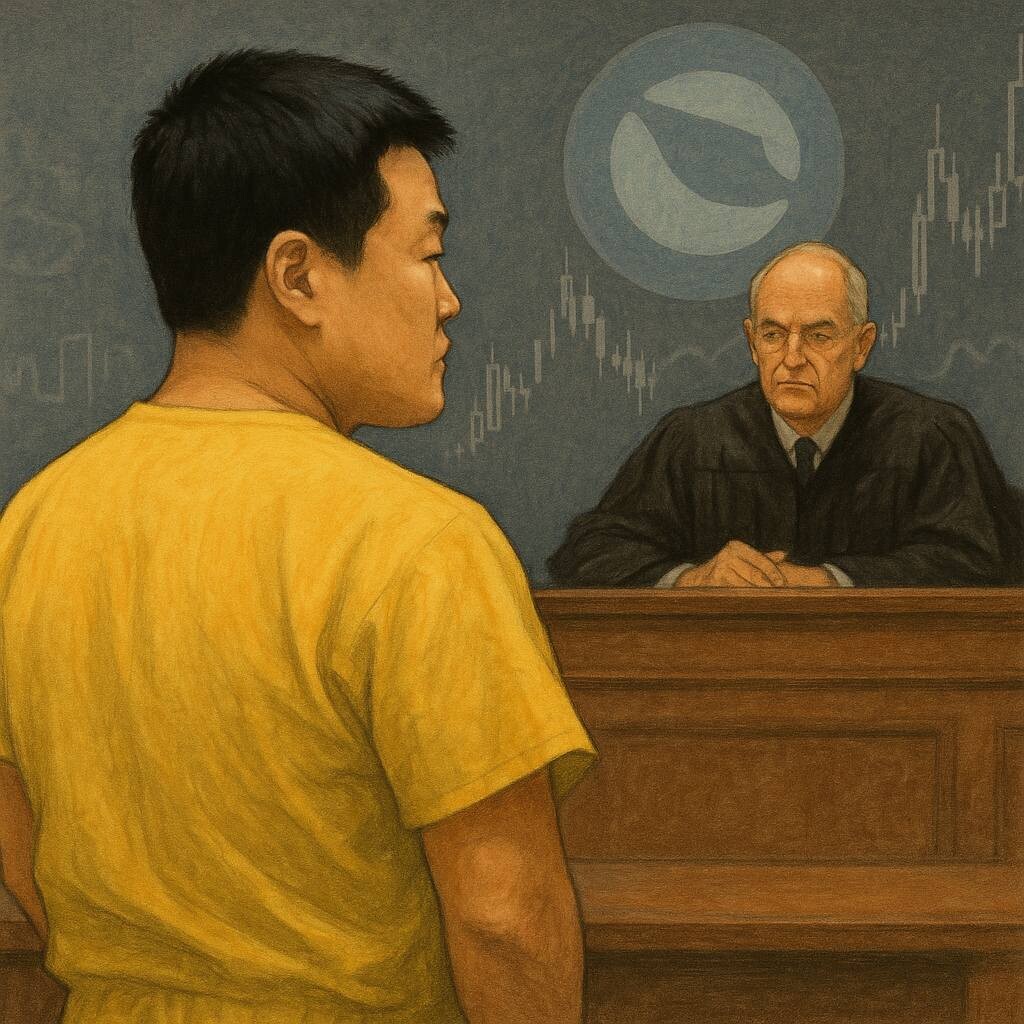
- Terra founder Do Kwon receives a 15 year US prison sentence linked to the 2022 Terra collapse
- The failure of Terra and its tokens erased about 40 billion dollars and affected many investors
- Further legal steps may follow in South Korea while civil claims from Terra losses continue
Terra founder Do Kwon received a 15-year prison sentence in New York, closing one of the most consequential fraud cases in the short history of digital assets. The court focused on the collapse of the Terra blockchain and its algorithmic stablecoin ecosystem, which erased around 40 billion dollars in value and affected possibly more than one million investors worldwide The sentence came more than three years after the failure of TerraUSD and Luna triggered a chain reaction that pushed several large crypto firms into bankruptcy and deepened the 2022 “crypto winter.” In the courtroom, the judge described the fraud as operating on a generational scale and rejected attempts to portray the case as a simple business miscalculation rather than a deliberate deception of the market.
Terra founder Do Kwon sentenced after multibillion-dollar stablecoin crash
The sentence against Terra founder Do Kwon was handed down by US District Judge Paul Engelmayer in Manhattan federal court after a lengthy hearing that examined both the technical structure of TerraUSD and the human cost of its collapse. Prosecutors asked for a 12-year prison term under the August plea agreement, while the defense urged the court to limit incarceration to five years, arguing that authorities in South Korea would pursue a separate case. The judge concluded that a five-year term would be “utterly unthinkable and wildly unreasonable,” and instead imposed 15 years, exceeding the recommendation from the US Department of Justice but staying below the 25-year statutory maximum tied to the plea. During the hearing, the court revisited the events of May 2022, when the algorithmic pair of TerraUSD and Luna began to unravel. TerraUSD was designed to hold a one-dollar value through a mechanism linked to Luna rather than through reserves of cash or government bonds. When the peg broke, the system could not absorb the selling pressure, and the combined market capitalization of the ecosystem fell by about 40 billion dollars in a very short period. That collapse pushed retail traders, institutional funds and small investors into steep losses, while prices across the broader crypto market dropped sharply. In court, the judge referred to letters from 315 victims who described losing homes, retirement savings and education funds, and said those “hard facts” justified a very long sentence.
Legal journey of Terra founder Do Kwon from collapse to conviction
The legal path of Terra founder Do Kwon began soon after the Terraform Labs ecosystem failed. US prosecutors eventually charged him with nine counts of fraud, including securities fraud, commodities fraud and wire fraud, exposing him to a theoretical maximum of around 130 years in prison if convicted on all counts at trial. At first he pleaded not guilty, and the court scheduled a criminal trial for January 2026, reflecting the complexity of the case and the global reach of the alleged misconduct. In parallel, the US Securities and Exchange Commission pursued a civil case, which later resulted in an agreement for Terraform Labs and Kwon to pay multi-billion-dollar penalties for misleading investors about TerraUSD and Luna. Before any trial could begin, Terra founder Do Kwon spent months on the run, moving between jurisdictions while both South Korea and the United States sought his arrest. Authorities finally detained him in Montenegro in March 2023, when he attempted to board a flight using forged travel documents on a route toward the United Arab Emirates, a country without extradition treaties with either of the requesting states. What followed was an extended tug-of-war over extradition, which ended when Montenegro allowed his transfer to the US, where he arrived at the end of the year to face the federal criminal charges. In August 2025, Terra founder Do Kwon changed course and entered a guilty plea to two counts of fraud, dramatically narrowing the case from the original nine counts but leaving a significant custodial exposure. Under the plea agreement, prosecutors committed to seek no more than 12 years of imprisonment, while the defense signaled that it would request a five-year term by pointing to parallel proceedings in South Korea and the already significant pre-trial detention in Montenegro. As part of the deal, he agreed to forfeit about 19 million dollars in assets and several properties linked to the fraud, while the government declined to pursue complex restitution calculations for thousands of individual victims.
How Terra founder case reshaped the crypto landscape
The saga of Terra founder Do Kwon sits at the center of the 2022 market breakdown that reshaped perceptions of digital assets among regulators and investors. The collapse of TerraUSD and Luna did more than erase tens of billions in value; it undermined trust in algorithmic stablecoins that rely on financial engineering rather than traditional reserves. Once Terra failed to maintain its dollar peg, confidence in other leveraged structures faltered, and funding dried up across several corners of the industry. The resulting downturn contributed to the failures of major platforms such as Celsius, Three Arrows Capital and the FTX exchange, each of which entered bankruptcy with multibillion-dollar liabilities. In that wider context, the sentence against Terra founder Do Kwon follows other high-profile criminal cases, including the 25-year term imposed on former FTX chief executive Sam Bankman-Fried. Together, these cases signal that courts now treat large crypto-related frauds similarly to long-running schemes in traditional finance. Prosecutors argued that Kwon misled investors about the mechanisms used to defend the TerraUSD peg, including undisclosed support from a high-frequency trading firm that bought tokens during earlier depegging episodes to create the impression of an autonomous, self-correcting system. The judge accepted that narrative and emphasized that the damage extended beyond market charts, affecting ordinary households, long-term savers and small businesses that had allocated money to Terra-linked products. For the broader market, the case has already encouraged stricter scrutiny of stablecoin designs and disclosure practices. Lawmakers and regulators in the US, Europe and Asia have pointed to Terra as an example when drafting new frameworks for asset-backed stablecoins and for the listing of complex tokens on exchanges. In that sense, the conviction of Terra founder Do Kwon functions both as an individual punishment and as a reference point in policy debates about how to balance innovation with clear limits on leverage, marketing claims and risk transfer to unsophisticated investors.
What lies ahead for Terra founder Do Kwon after the US sentence
Although the US case produced a clear outcome, the story of Terra founder Do Kwon does not end with the 15-year federal sentence. Under the terms discussed in court, he must serve at least half of that term in the United States before he can ask to transfer to South Korea under prisoner-transfer arrangements. Prosecutors have indicated they will not oppose such a move if he complies with all conditions of the plea agreement, but South Korean authorities still plan to pursue their own charges related to violations of local capital-markets law. Civil exposure also continues. Investors in several jurisdictions have filed or prepared class actions seeking compensation for Terra-related losses, and those suits may move forward even while Terra founder Do Kwon remains in custody. The SEC settlement and the criminal forfeiture cover significant sums, yet they do not automatically make affected holders whole, leaving a patchwork of private litigation around the world. At the same time, ongoing enforcement against other firms involved in the Terra ecosystem, including market-making partners, shows that regulators view the collapse as a networked event rather than the work of a single actor.
Conclusion
The sentencing of Terra founder Do Kwon to 15 years in prison marks a turning point for accountability in large-scale crypto failures. The court weighed the 40-billion-dollar loss, the scale of investor harm and the pattern of misleading statements and decided that a term longer than the one requested by prosecutors was necessary. At the same time, the case illustrates how a single project, marketed as a self-stabilizing financial system, can destabilize an entire sector when its promises break. The continuing proceedings in South Korea and the many civil claims ensure that the legal consequences will stretch well beyond this first sentence, while the industry adapts to a new reality shaped by the rise and fall of Terra and its founder.
Disclaimer
The information provided in this article is for informational purposes only and should not be considered financial advice. The article does not offer sufficient information to make investment decisions, nor does it constitute an offer, recommendation, or solicitation to buy or sell any financial instrument. The content is opinion of the author and does not reflect any view or suggestion or any kind of advise from CryptoNewsBytes.com. The author declares he does not hold any of the above mentioned tokens or received any incentive from any company.
Featured image created by AI


Subscribe To Our Newsletter
Join our mailing list to receive the latest news and updates from our team.