
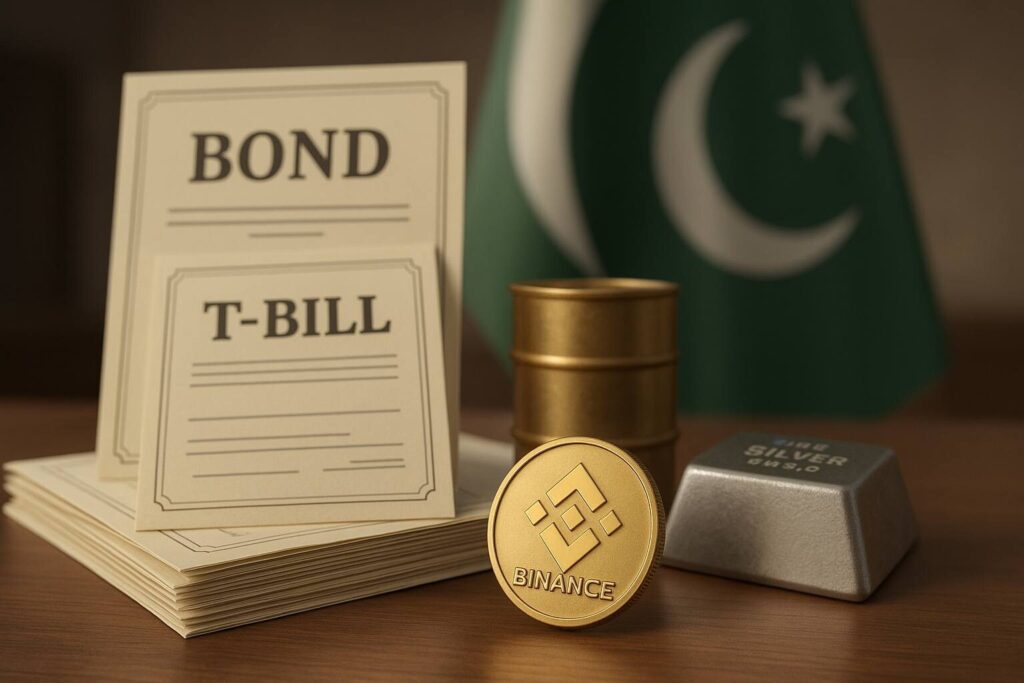
- Pakistan signed an MoU with Binance to tokenise up to $2B in sovereign assets
- Pakistan gave initial clearances for Binance and HTX to set up local units
- The plan covers sovereign bonds, T-bills, and government commodity reserves
On December 12, 2025, Pakistan signed a memorandum of understanding with Binance to explore tokenising up to $2 billion in sovereign assets. The finance ministry framed the plan around liquidity and investor access, with tokenisation focused on instruments that already sit at the core of public finance. Alongside the MoU, Pakistan also issued initial regulatory clearances for Binance and HTX, allowing both platforms to begin formal steps toward operating through local subsidiaries under a phased licensing process. The approach links asset tokenisation with compliance gates, so exchanges move forward only if they meet governance and control standards that regulators accept.
Pakistan – Binance MoU for tokenising up to $2 billion in sovereign assets
The MoU sets a framework to explore tokenisation and blockchain-based distribution of Pakistan’s real-world assets, with an upper scope of $2 billion, subject to approvals. The finance ministry described the target pool as sovereign bonds and treasury bills, plus commodity reserves that the government holds, including oil, gas, metals, and other raw materials. In practical terms, the plan explores issuing digital representations of these assets while keeping the underlying instruments anchored to government ownership and issuance processes. Finance Minister Muhammad Aurangzeb described the MoU as a signal of Pakistan’s reform direction and a “long-term partnership.” Binance founder Changpeng Zhao called the agreement a constructive signal for the global blockchain industry and for Pakistan, and he pointed to it as the start of a wider deployment path for tokenisation initiatives. The ministry also tied the effort to goals that include improved liquidity, more transparent distribution, and stronger international market access for eligible sovereign instruments once approvals and infrastructure align.
Tokenisation scope: sovereign bonds, T-bills, and commodity reserves
The asset scope in the announcement stayed close to public-sector instruments that markets already understand, which helps keep the project framed as infrastructure rather than a speculative product line. Sovereign bonds and treasury bills sit at the center of government financing, so tokenised distribution would focus on how investors access and transfer exposure, not on changing the underlying credit risk. Commodity reserves broaden the range by introducing state-owned holdings that can include oil, gas, metals, or other raw materials, with tokenisation creating a digital version of the claim while the government retains control of the underlying reserve policy. The ministry indicated that the total value involved could reach $2 billion, but it conditioned that figure on approvals, which implies staged rollout rather than a single issuance event. The statement also placed the initiative in a world where licensing rules for exchanges are expanding in jurisdictions such as the United Arab Emirates, Japan, and parts of the European Union, while regulators tighten oversight in parallel. That context matters for Pakistan because it signals alignment with formal licensing and supervised market access rather than informal exchange activity.
Pakistan licensing track for Binance and HTX under the Virtual Assets Regulatory Authority
Separate from the MoU, the Pakistan Virtual Assets Regulatory Authority said it issued early approvals to Binance and HTX after reviewing governance and compliance controls. Those clearances allow both firms to register on the Anti-Money Laundering system, establish local units, and prepare full exchange licence applications as Pakistan rolls out a structured licensing regime. The authority’s chair, Bilal bin Saqib, described the approach as phased and linked progress to compliance strength, signaling that the regulator intends to differentiate platforms by control quality rather than by brand visibility. The sequence matters because it gives regulators a gatekeeping mechanism before full licensing, and it sets expectations for how local subsidiaries should operate while rules mature. It also gives Pakistan a way to bring major offshore platforms into a domestic framework without granting immediate, full operating status. For market participants, the message is that exchange access will likely depend on passing defined checks around governance, operational controls, and financial-crime safeguards, with formal licensing positioned as the later stage once the regime is complete.
Digital-finance timeline: Crypto Council, planned CBDC pilot, and 2025 legal framework
The MoU and early approvals sit inside a faster digital-finance buildout that Pakistan has compressed into months. Authorities created the Pakistan Crypto Council and established the Virtual Assets Regulatory Authority while drafting a formal licensing regime for virtual-asset service providers. Saqib said Pakistan ranks as the world’s third-largest crypto market by retail activity, and he referenced that position during Binance Blockchain Week Dubai 2025 earlier in the week. Regulators also plan a central bank digital currency pilot and a Virtual Assets Act in 2025, which indicates that policy makers want both an operational test for state-backed digital money and a statutory base for licensing and supervision. The finance ministry has also said the Crypto Council signed a letter of intent with U.S.-based World Liberty Financial in April to explore stablecoin use, tokenisation, and wider digital-asset infrastructure. Taken together, these steps show Pakistan building parallel tracks: one for regulated exchange access, one for tokenised sovereign and real-world assets, and one for state-led digital money experiments that may run under central bank oversight.
Conclusion
The latest announcements place Pakistan’s tokenisation plans and exchange licensing on the same policy timeline, with the MoU setting a $2 billion exploration ceiling and the regulator setting staged conditions for exchange entry. The focus stays on sovereign bonds, treasury bills, and government-held commodity reserves, while Binance and HTX move through early approvals that require AML registration, local setup, and preparation for full licence applications. With the Crypto Council, the Virtual Assets Regulatory Authority, and plans for a 2025 CBDC pilot plus a Virtual Assets Act, Pakistan is tying market access to compliance gates and formal legal structure at the same time.
Disclaimer
The information provided in this article is for informational purposes only and should not be considered financial advice. The article does not offer sufficient information to make investment decisions, nor does it constitute an offer, recommendation, or solicitation to buy or sell any financial instrument. The content is opinion of the author and does not reflect any view or suggestion or any kind of advise from CryptoNewsBytes.com. The author declares he does not hold any of the above mentioned tokens or received any incentive from any company.
Featured image created by AI


Subscribe To Our Newsletter
Join our mailing list to receive the latest news and updates from our team.