
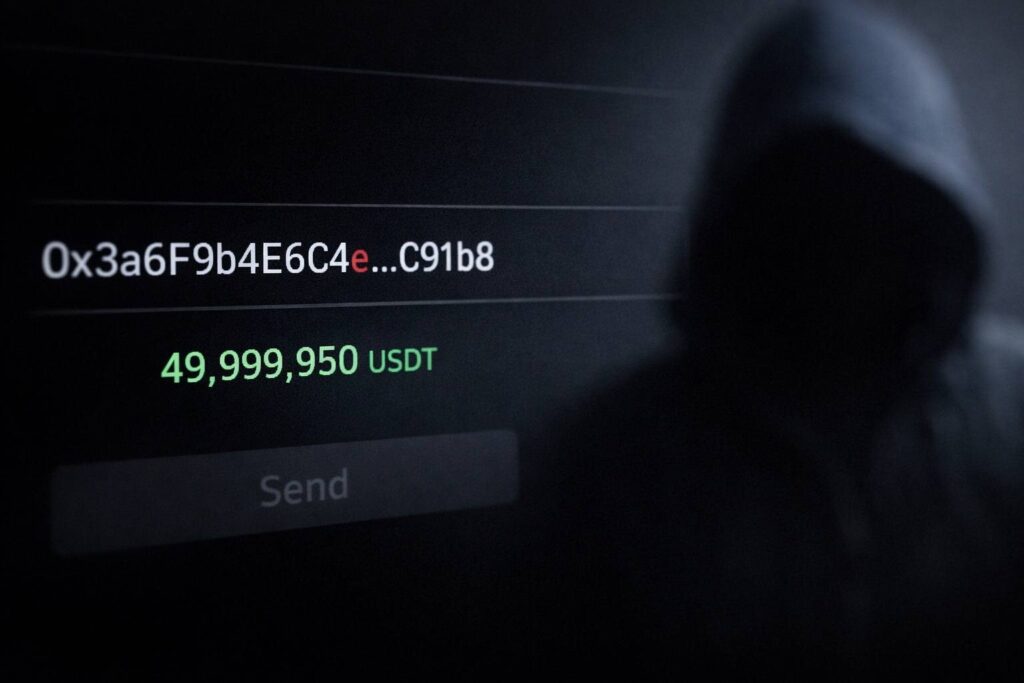
- A Scammer creates a look-alike wallet address and uses address poisoning so the victim sends 49,999,950 USDT to the wrong destination.
- The victim copies an address from recent transaction history, does only a quick visual check, and the large transfer goes straight to the Scammer.
- The Scammer quickly swaps the stolen USDT into DAI and then Ethereum, sending the funds through Tornado Cash to make tracking movements harder.
A single error in copying a wallet address allowed a Scammer to drain almost 50 million dollars in stablecoins, turning a routine transfer into one of the most painful on-chain losses ever recorded. The victim sent 49,999,950 USDT to a look-alike address crafted through an address poisoning tactic, and the funds disappeared in less than an hour. This incident shows how a Scammer can convert a small moment of inattention into a life-changing loss and how social engineering now works together with on-chain techniques to target individual users rather than only exchanges.
How a Scammer used address poisoning to capture almost 50 million USDT
Address poisoning exploits a simple habit that many crypto users develop over time. Instead of typing long hexadecimal addresses, users often copy an address from their recent transaction history, trusting that the entry must be correct because it appears in their wallet interface. A Scammer takes advantage of this by generating a wallet that looks almost identical to a known address and then sends a tiny transaction to the victim. That small transfer “poisons” the history, because the fake address now appears next to legitimate ones. In this case, the victim later prepared a large transfer of USDT and needed a destination address. Rather than fetching the address from a safe note or hardware wallet, they copied an entry from their previous activity list. The problem was that the list now contained the Scammer’s look-alike address, not the intended one. When the victim pasted that string into the send field, every character looked familiar, especially the first and last few digits, which many people use as a quick visual check. The transfer of 49,999,950 USDT then went straight to the Scammer, and the transaction settled on-chain with no way to reverse it. Crypto security researchers described this transaction as one of the largest known address poisoning incidents on record. On-chain sleuths quickly flagged the movement and traced the funds to a cluster of addresses tied to the Scammer, but the damage had already occurred. The event did not exploit a smart contract bug or a protocol flaw. Instead, the Scammer relied on user interface habits, human memory limits, and a similarity in address strings that looks harmless until a large transfer goes out.
Technical breakdown of the transaction and the Scammer’s laundering path
Once the victim broadcast the transaction with 49,999,950 USDT, the Scammer acted with clear preparation and speed. Analyses show that the stolen stablecoins did not sit in the receiving address for long. Within roughly 30 minutes, the address began to interact with decentralized exchanges and other smart contracts, turning the USDT into different assets.
That tempo suggests that the Scammer had a predefined script or playbook ready before the victim even clicked send. Security firm SlowMist detailed how the Scammer handled the funds after the initial transfer. First, the USDT balance converted into DAI, another widely used dollar-pegged stablecoin. Converting into DAI may have helped the Scammer access deeper liquidity on certain pools or avoid immediate blacklist actions on specific tokens. After that, the DAI position swapped into Ethereum, which offers many paths for further movement through decentralized protocols and bridges. Each swap left its trace on-chain, but the Scammer tried to balance speed with slippage and liquidity considerations. The Scammer then moved the Ethereum into Tornado Cash, a mixing protocol that breaks direct transaction links between deposit and withdrawal addresses. This step aimed to obscure the final destination of the assets by mixing them with many other deposits in the same pool. While observers can still see that the Scammer deposited a specific amount of ETH into Tornado Cash, it becomes far harder to prove which withdrawals later represent those exact coins. Even so, sophisticated analytics sometimes cluster Tornado Cash withdrawals and may still associate a portion of them with the original Scammer over time. A separate on-chain analyst, known as Specter Analyst, commented that such a large address poisoning case should be rare. According to that assessment, most users reserve very large transfers for more cautious procedures, such as test transactions or multi-person checks, which reduce the chance that a Scammer succeeds with a simple look-alike address. The fact that this event still occurred shows that even large holders sometimes rely on routine habits that a patient Scammer can exploit.
Growing role of the Scammer in personal wallet crime and North Korean links
The address poisoning case does not stand alone. It comes during a year in which personal wallets and targeted social engineering have become central to crypto crime. Blockchain analytics company Chainalysis reported that, in 2025, digital assets stolen by North Korean hackers increased by 51 percent compared with previous periods. Since those groups began to target the industry in 2016, state-linked actors have accumulated an estimated 6.7 billion dollars in stolen crypto. These figures show how a Scammer with nation-state backing can combine off-chain social engineering with on-chain obfuscation to reach high volumes. The Bybit security breach in February gives another clear example. In that incident, attackers believed to be tied to North Korea stole more than 1.5 billion dollars in Ethereum and Ethereum-related tokens from the exchange. Investigations suggest that the Scammer in that case compromised internal systems and leveraged multisignature wallets, rather than using an address poisoning approach. Even so, both events share a focus on careful planning, rapid asset movement, and a sophisticated understanding of DeFi infrastructure. The Scammer does not rely on one method; instead, they shift between exchange exploits, malware, phishing, and personal wallet tricks like poisoning. This broader pattern matters because it shows how a Scammer increasingly targets individuals, not only platforms. Centralized exchanges have invested in compliance teams, monitoring tools, and endpoint security, which raises the cost of direct breaches. As a result, more attacks now flow toward single users whose wallets can hold millions in assets but who may still rely on basic habits like copying addresses from past transactions. When a Scammer finds such a target, the time between a small “test” transaction and a large poisoned transfer can be short. Regulators and law enforcement agencies treat this trend as a policy challenge as well as a technical one. Funds stolen by a Scammer often help sanctioned states sidestep traditional finance restrictions, which turns each major theft into both a criminal and geopolitical topic. Yet even with increased attention, most of the burden still falls on users and service providers to detect risky patterns early. Data from 2025 shows that stolen funds now concentrate in a smaller number of very large cases, meaning that a single mistake benefits the Scammer more than ever.
Risk lessons for everyday users as Scammer techniques evolve
The address poisoning incident underlines several risk lessons that everyday users can apply without specialized tools. First, copying an address from a recent transaction list creates a soft spot that a Scammer can target. Instead of relying on that list, users can store critical destination addresses in a password manager, on a hardware wallet, or in another secure note where a Scammer cannot easily insert a fake entry. Reading at least the full first several characters and the full last several characters of an address, rather than only glancing at the tail, also lowers risk. Second, large transfers deserve a stricter process than small ones. Before sending tens of millions in USDT or another asset, users can send a small probe transaction and wait for confirmation. If the amount arrives correctly, the sender then proceeds with the main transfer. A Scammer may still receive the small test if the address is poisoned, but the user discovers the mismatch before losing the full amount. In this case, a test transfer of ten dollars would have revealed the Scammer’s address and saved 49,999,940 dollars. Third, modern wallet software can build more defenses against a Scammer. Some interfaces already mark new addresses, label known contracts, and display human-readable warnings if a user sends funds to an address that has just appeared in their history with a tiny incoming transfer. Others support address books, where users assign clear names such as “cold storage” or “exchange deposit” and avoid manual copying. The more widely these features appear, the harder it becomes for a Scammer to exploit visual similarity alone. Education also plays a role. Many users understand that they should avoid clicking unknown links or entering seed phrases into websites, but fewer know the details of address poisoning. Clear explanations from exchanges, wallets, and educational sites can close that gap. When users hear the term and see examples of how a Scammer sets up look-alike addresses, they may notice the pattern in their own transaction lists and treat new entries with more caution.
Conclusion
The loss of 49,999,950 USDT in an address poisoning attack shows how one Scammer can turn a familiar user habit into a severe personal loss. The victim did not fall for a complex contract exploit or a deeply hidden software bug; the mistake came from copying a look-alike address that had slipped into their history. Within about thirty minutes, the Scammer converted the funds from USDT into DAI, then Ethereum, and moved the proceeds through Tornado Cash in an effort to blur the trail. This single event fits into a larger picture in 2025, where a Scammer or a coordinated group often targets personal wallets and uses on-chain tools with growing skill. Chainalysis figures, including a 51 percent rise in assets stolen by North Korean hackers and a total of 6.7 billion dollars taken since 2016, show how these operations accumulate over time. The February Bybit case, with more than 1.5 billion dollars in Ethereum and related tokens taken from the exchange, further highlights the scale that a Scammer can reach when defenses fail. Yet the address poisoning case also illustrates where users and service providers can respond. Safer address management, small test transfers, clearer wallet warnings, and better education about how a Scammer prepares such attacks all reduce the chance of a repeat. Crypto transactions will remain final once confirmed, but habits can change. Each improvement makes it more difficult for the next Scammer to turn a copied address into another eight-figure loss.
Disclaimer
The information provided in this article is for informational purposes only and should not be considered financial advice. The article does not offer sufficient information to make investment decisions, nor does it constitute an offer, recommendation, or solicitation to buy or sell any financial instrument. The content is opinion of the author and does not reflect any view or suggestion or any kind of advise from CryptoNewsBytes.com. The author declares he does not hold any of the above mentioned tokens or received any incentive from any company.
Featured image created by AI


Subscribe To Our Newsletter
Join our mailing list to receive the latest news and updates from our team.