- Uniswap Governance prepares to burn 100M UNI from the foundation treasury and activate the fee switch on mainnet after the two day timelock ends.
- The UNIfication proposal also introduces protocol fee discount auctions that route part of trading fees into UNI burns while keeping most revenue with liquidity providers.
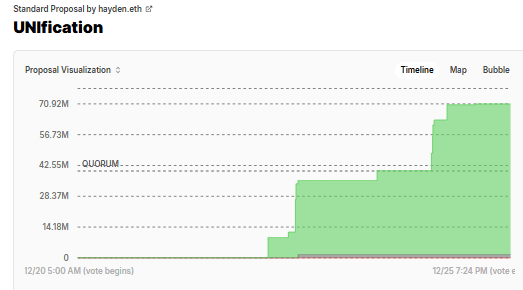
The latest UNIfication vote under Uniswap Governance marks a turning point for how the protocol links trading activity, token supply, and community control. The on-chain process runs from December 19 or 20 through December 25 and centers on a plan to burn 100 million UNI from the Uniswap Foundation treasury and activate long-discussed protocol fees on mainnet after a two-day timelock. More than 69 million UNI already support the proposal, well above the 40 million quorum requirement, with only a tiny fraction of votes in opposition and around 1.5 million UNI marked as abstentions. As the deadline approaches, markets, liquidity providers, and DeFi observers follow the outcome closely because it will define how UNI holders participate in protocol economics going forward.
Uniswap Governance and the UNIfication proposal
Uniswap Governance has debated the protocol fee switch for years, but the UNIfication package brings that discussion to a final, specific decision. The on-chain vote, submitted by Uniswap Labs founder Hayden Adams, opened around December 19–20 and is scheduled to close on December 25, with implementation subject to a two-day timelock if the proposal maintains its current support. At the core of UNIfication sits a simple pair of changes: the immediate burn of 100 million UNI held in the Uniswap Foundation’s treasury and the activation of fee switches on Uniswap v2 and selected v3 pools on Ethereum mainnet and Unichain. Early in the voting window, Uniswap Governance cleared the 40 million quorum threshold with ease. By late Sunday and into Monday, tallies showed roughly 62 million to more than 69 million UNI cast in favor, while only about 741 votes, or around 0.001% of the total, opposed the measure. Abstentions accounted for slightly over 1.5 million UNI, and on-chain data indicated participation from several thousand addresses, pointing to broad distribution rather than a narrow insider decision. Together these figures make UNIfication one of the most one-sided governance outcomes in the protocol’s history and highlight how Uniswap Governance can still coordinate around large changes when incentives align. Key delegates and well-known DeFi founders add further weight to the vote. Jesse Waldren, managing partner at Variant, Kain Warwick, who founded Synthetix and Infinex, and former Uniswap Labs engineer Ian Lapham all backed the proposal with sizable voting power. Their support signals confidence from experienced protocol builders that the updated economics and legal structure will not only adjust token supply but also make the fee system workable in practice. The 100 million UNI burn represents roughly one tenth of total supply and reduces the treasury’s holdings in a single step, rather than through a slow release. After the timelock expires, the protocol will start routing a share of ongoing fees into a permanent burn mechanism, setting a new baseline for how Uniswap Governance can influence supply over time without relying on one-off decisions.
Uniswap Governance, fee switch mechanics and token burn details
The fee switch under Uniswap Governance does not introduce an entirely new fee; it redirects a portion of existing trading fees toward the protocol while leaving most revenue with liquidity providers. On Uniswap v2, the change adjusts the classic 0.3% trading fee by allocating 0.25% to LPs and 0.05% to the protocol. That protocol share will fund a buy-and-burn mechanism for UNI, turning a slice of trading volume into direct supply reduction. On Uniswap v3, the plan routes between about 16% and 25% of LP fees to the protocol, depending on the fee tier of each pool, again with the goal of converting protocol income into UNI burns rather than diverting it to another treasury. This design places Uniswap Governance in a central role when it comes to protocol economics. The community has already approved the principle that protocol fees should exist and benefit the UNI supply.

Future parameter changes, such as adjusting how much of each pool’s fee goes to the burn mechanism or extending the model to more networks, will also pass through Uniswap Governance. Delegates and token holders therefore gain a clearer lever: they can modify how strongly protocol usage translates into supply reduction without changing the core trading experience for users. The one-time 100 million UNI burn sits alongside the ongoing fee-funded burns rather than replacing them. According to public statements, this burn targets UNI held by the Uniswap Foundation, immediately lowering the number of tokens that can later enter circulation and signaling a stronger long-term alignment with holders. Once the two-day timelock ends, the burn executes on-chain, while the activated fee switches begin collecting revenue from v2 and v3 pools. If trading volume stays near recent levels, the protocol can start lowering effective net issuance almost at once. Market observers note that this shift brings Uniswap closer to models where protocol tokens receive a more direct link to protocol activity, a frequent theme in recent DeFi debates. In earlier years, UNI mainly served as a governance right without a defined claim on cash flows; the new setup under Uniswap Governance does not create a formal dividend but uses fee-funded burns to connect token supply changes to real usage. The approach avoids many regulatory complications that explicit distributions might create while still tightening the relationship between trading behavior and token economics.
Market context and UNI reaction to the Uniswap Governance vote
The vote takes place against the backdrop of a protocol that has handled more than 4 trillion dollars in cumulative trading volume since its launch in November 2018 and remains the largest decentralized exchange by volume. UNI currently sits among the top forty crypto assets by market capitalization at roughly 3.8 billion dollars, so changes in how the token works have implications beyond a niche governance circle. Since the current voting window opened, UNI has climbed about 25%, trading close to 6.08 dollars after rebounding from a seven-month low around 4.88 dollars reached during a broader market pullback. Earlier signals in November that UNIfication would advance produced an even sharper move, with UNI rising from roughly 7 dollars to about 9.70 dollars around November 11 before momentum cooled. This pattern suggests that traders have watched Uniswap Governance closely, treating a credible path to fee activation and token burns as a meaningful change to the asset’s profile. Technical analysts also pay attention to UNI’s long-term chart as the governance process unfolds. Commentary highlights a multi-year ascending channel that has guided the token’s recovery since the post-2021 drawdown, with the recent bounce near 4.88 dollars lining up with the lower boundary of that structure. Previous retests of this area often preceded higher reaction highs, so some market participants see the current UNIfication decision as the possible catalyst for another leg within that pattern if broader conditions cooperate. For liquidity providers, the context looks more nuanced. The fee switch slightly lowers the gross fee share they receive on v2 pools and redirects a fraction of v3 revenue; however, proponents argue that deeper alignment between token holders and protocol usage can support long-term liquidity depth, which in turn may benefit LP returns. In that view, Uniswap Governance is not only adjusting tokenomics but also trying to keep incentives for LPs attractive enough to maintain the protocol’s dominant position.
Legal structure, Protocol Fee Discount Auctions
Beyond the token burn and fee switch, the UNIfication package rewires how Uniswap Governance interacts with the off-chain world. The proposal builds on an earlier plan to form “DUNI,” a Wyoming Decentralized Unincorporated Nonprofit Association under the state’s DUNA framework, and to place key protocol rights and relationships inside this structure. The goal is to give Uniswap Governance a legal wrapper that can sign contracts, hold certain intellectual property, and support front-end operations while preserving on-chain decision making as the source of authority. Under this model, Uniswap Labs, the Uniswap Foundation, and the on-chain community work within a coordinated legal arrangement. Governance decisions can instruct the association to enter agreements, manage trademarks, or support integrations in a way that regulators and counterparties can understand, while token holders still direct outcomes through the usual proposal and voting flow. Uniswap Governance therefore gains both a clearer route to express preferences on-chain and a practical means to execute them in the traditional legal environment. A central innovation inside UNIfication is the Protocol Fee Discount Auctions mechanism. The design auctions the right for a specific address to trade without paying protocol fees for a short period, with the winning bid going directly toward UNI burns. In effect, the system internalizes a portion of the MEV that would otherwise flow to searchers or validators, converts it into protocol revenue, and then uses that revenue to reduce supply. Liquidity providers may benefit because the auction can increase effective fee capture without raising headline trading fees, while Uniswap Governance gains a flexible tool to tune how aggressive the burn schedule becomes. Importantly, the shift under Uniswap Governance does not remove resources for builders. The Uniswap Foundation has stated that grant programs will continue and outlined a separate growth budget of up to 20 million UNI to fund development, ecosystem tools, and research. That commitment aims to reassure contributors who rely on grants that protocol fees will not simply replace existing funding streams, but instead create an additional economic layer focused on the token. Taken together, the legal framework, Protocol Fee Discount Auctions, growth budget, and fee switch form a coherent package rather than isolated changes. Uniswap Governance now sits at the center of these moving parts, with authority over protocol fees, supply dynamics, treasury policy, and off-chain coordination. How delegates use that authority in the next cycles will shape whether the new system delivers stable token economics or needs further adjustment.
Conclusion
The UNIfication vote shows Uniswap Governance operating at full scale, with tens of millions of UNI casting a clear decision on how the protocol should handle fees, burns, and legal structure. A 100 million UNI treasury burn, a two-day timelock before activation, fee switches on v2 and v3 pools, and a new auction system that channels MEV into supply reduction together redraw the token’s economic map. With UNI recovering from 4.88 dollars to around 6.08 dollars during the vote and earlier moving near 9.70 dollars when the proposal first surfaced, markets already treat the outcome as meaningful. As implementation begins, Uniswap Governance enters a new phase in which protocol usage, token supply, legal infrastructure, and community control align more closely than at any point since the exchange launched.
Disclaimer
The information provided in this article is for informational purposes only and should not be considered financial advice. The article does not offer sufficient information to make investment decisions, nor does it constitute an offer, recommendation, or solicitation to buy or sell any financial instrument. The content is opinion of the author and does not reflect any view or suggestion or any kind of advise from CryptoNewsBytes.com. The author declares he does not hold any of the above mentioned tokens or received any incentive from any company.
Featured image created by AI


Subscribe To Our Newsletter
Join our mailing list to receive the latest news and updates from our team.