
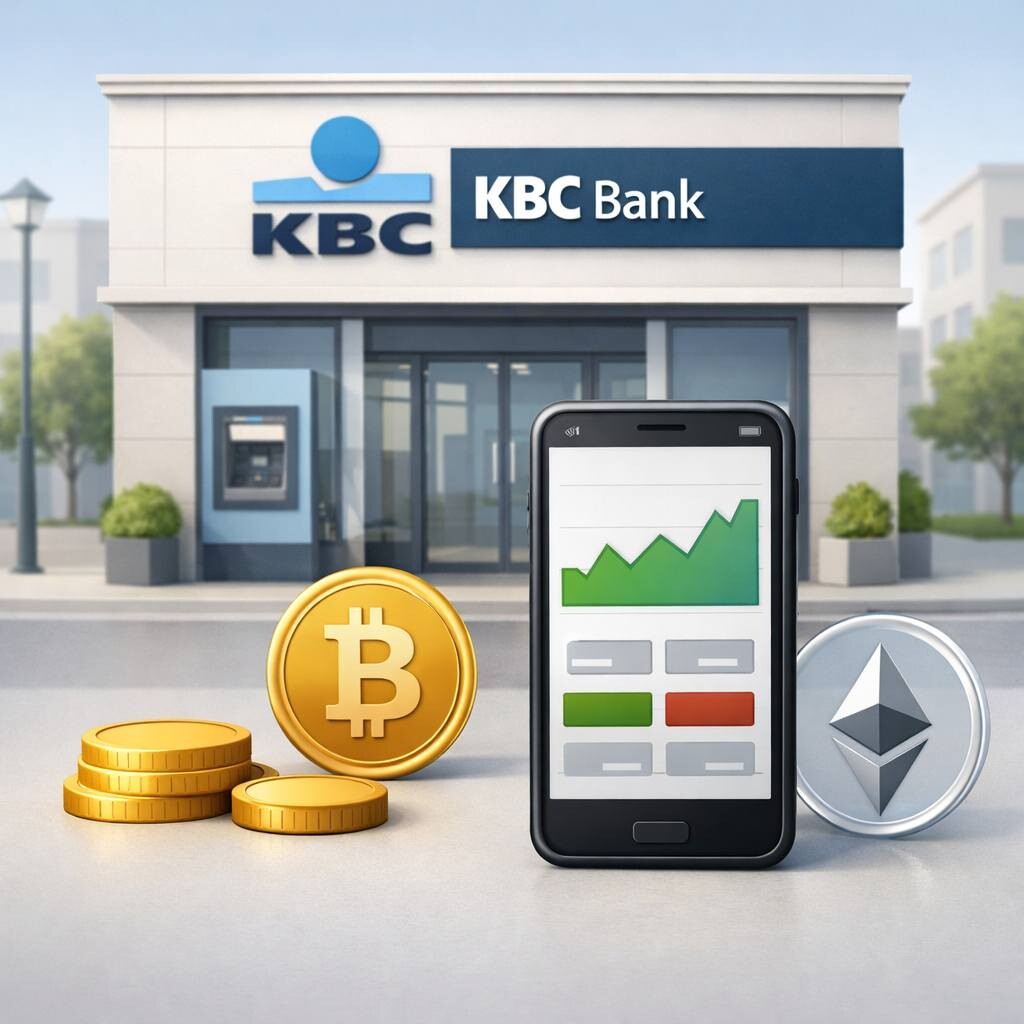
- KBC Bank will let retail clients trade Bitcoin and Ether on Bolero next month using its own custody, saying it is the first Belgian bank to do so.
- ESMA updated conflict-of-interest rules under MiCA, and the bank filed a full crypto asset service provider notification with Belgian authorities.
- Belgium adopted its MiCA law in December 2025, effective January 3, 2026, naming the FSMA and the National Bank of Belgium as crypto regulators.
KBC Bank is preparing to open a new chapter in Belgian retail investing by adding direct Bitcoin and Ether trading to its online investment platform Bolero, positioning itself as the first major bank in Belgium to offer this service. Starting next month, self-directed investors will gain the ability to buy and sell these two leading cryptocurrencies through a custodial solution managed entirely within the bank, which aims to combine digital asset access with the familiar structure of a regulated financial institution. The move comes as European regulators, led by the European Securities and Markets Authority and the Markets in Crypto-Assets Regulation framework, sharpen their focus on how banks and platforms handle crypto assets, conflicts of interest, and investor protection.
KBC Bank brings Bitcoin and Ether trading to Bolero
KBC Bank announced that from next month, retail clients who use its Bolero online investment platform will be able to trade Bitcoin and Ether directly, making the bank the first in Belgium to introduce such a feature as part of a mainstream brokerage service. This roll-out targets self-directed investors who already manage their own portfolios of shares, bonds, and funds through Bolero, and who now want access to the largest crypto assets without transferring funds to separate exchanges. Instead of relying on third-party custodians, KBC Bank will use its own custodial solution to hold client crypto positions, so customers can view and manage their digital assets within the same online and mobile environment they use for other investments. The bank describes this as a way for Belgian investors to engage with cryptocurrencies in a secure and fully regulated setting, aligning the new offering with its existing risk and compliance frameworks. By focusing initially on Bitcoin and Ether rather than a wider list of tokens, the bank signals a cautious entry that centers on the most established assets by market capitalization and liquidity, which also simplifies custody, reporting, and regulatory dialogue. Behind the scenes, KBC Bank has taken formal steps to operate as a crypto asset service provider under Belgian law. The group submitted a full notification to the relevant Belgian authority, positioning itself to comply with European-wide MiCA rules once national implementation and licensing catch up. Erik Luts, the KBC Group chief innovation officer, said that offering the ability to purchase and sell crypto within a regulated framework translates innovation into something concrete and accessible for customers.
The bank’s internal solution also reflects a broader push by traditional institutions to integrate digital assets into familiar channels rather than leave that activity solely to dedicated crypto exchanges. While many fintechs and specialized platforms already serve Belgian users, they often operate under different regulatory expectations, which KBC Bank appears keen to differentiate from by highlighting its fully regulated environment and long-standing presence in the country’s financial system.
KBC Bank move set against tightening EU crypto scrutiny
The timing of the KBC Bank initiative aligns with a period of rising regulatory attention in Europe, as the Markets in Crypto-Assets Regulation framework progresses from text to implementation across member states. ESMA recently updated its guidance on conflict-of-interest management for crypto-asset service providers, emphasizing that firms must manage situations where trading, custody, or advisory roles could create incentives that do not align with client interests. That development matters for a bank that now combines traditional investment products with crypto trading on a single platform, since it must show clear separation of duties, transparent pricing, and robust disclosure to maintain trust. KBC Bank’s choice to use in-house custody suggests a desire for direct control over how keys and assets are managed, which could simplify its compliance story, but it also places full responsibility for security and operational resilience on the institution rather than on external partners. Across the European Union, MiCA aims to create a uniform regulatory landscape for crypto services, but the pace of adoption varies by country, and Belgium offers a clear example of this uneven rollout. While MiCA entered into force across the EU in late 2025, Belgium only adopted its implementing law in December 2025 and brought it into effect on January 3, 2026. That law formally designated the Financial Services and Markets Authority and the National Bank of Belgium as the national regulators responsible for supervising crypto activities. Yet, according to the ESMA public register, Belgian authorities have not yet issued MiCA licenses, creating a gap between the legal framework and the licensing process in practice. KBC Bank is moving ahead within this transitional environment, using national notification channels and its existing oversight by banking supervisors while it prepares for a full MiCA license once the country starts to grant them. This interplay between early commercial moves and evolving regulation highlights how national champions in banking try to stay ahead of client demand without waiting for every detail of the new regime to settle.
KBC Bank step reflects Belgium and EU regulatory debate
The decision by KBC Bank to proceed with a crypto trading service as Belgium slowly activates its MiCA machinery also mirrors a larger debate within the EU about who should oversee major digital asset firms and how cross-border licenses should work. Belgium’s delayed implementation underscores friction between member states that favor stronger central control at the ESMA level and those that prefer to keep more authority at the national level. Some countries, such as France, argue that ESMA should have direct supervisory power over large crypto firms operating across multiple states, rather than relying solely on national regulators to apply common rules. France has also voiced concerns about passporting, where a firm licensed in one country can offer services throughout the bloc, and has indicated it might resist licenses from states perceived to have more lenient standards. Other jurisdictions, including Malta, take a different view and worry that too much centralization at ESMA could weaken their competitiveness and flexibility, especially for smaller economies that see digital assets as an area of opportunity. In this context, KBC Bank provides a case of a domestic champion working closely with national supervisors while aligning with EU-level expectations, showing how a large institution can adapt even when license issuance lags. The bank’s move may raise pressure on Belgian regulators to finalize their MiCA processes, since clients will expect clarity on how their new crypto services fit within both national and European rules. It also sends a signal to policymakers that traditional financial players no longer watch crypto from the sidelines but now integrate it into mainstream offerings, which may shift political discussions away from treating digital assets as a niche or fringe topic. From a client perspective, the presence of a household name like KBC Bank in crypto trading may reassure cautious investors who hesitated to use separate platforms with no direct link to their usual bank. With the law now in force since January 3, 2026, the FSMA and the National Bank of Belgium face the dual task of supervising new entrants like KBC Bank’s crypto services while also managing authorizations for existing specialized providers that want a MiCA license. This process will test how well the Belgian model balances investor protection, innovation, and competition in a field where other EU states sometimes move faster or in different directions.
What the crypto launch means for Belgian investors
For retail investors in Belgium, the introduction of Bitcoin and Ether trading through Bolero marks a shift in how they access digital assets, since they can now use a single login for shares, bonds, funds, and crypto. KBC Bank promises a secure and fully regulated environment, which contrasts with the sometimes opaque conditions on offshore platforms or lightly supervised exchanges. Investors who already hold accounts with the bank do not need to transfer funds outside the traditional banking perimeter, and they can rely on an institution they know for support and reporting. This arrangement may appeal to clients who view cryptocurrencies as a modest extension of their existing portfolios rather than a separate, speculative arena. At the same time, the bank’s focus on only two assets shows a careful approach that avoids the complexity and risk of listing hundreds of tokens with varying quality and regulatory status. The launch also arrives as global attention around crypto trading continues, with other developments such as Elon Musk’s X platform teasing in-app crypto trading and large financial groups testing tokenised deposits on public blockchains, as seen in Lloyds’ first UK deal. These international steps, while separate from KBC Bank, frame its move as part of a broader trend where mainstream institutions test how digital assets can fit into ordinary financial services. In Belgium, the combination of delayed MiCA license issuance, new national laws from December 2025 and January 2026, and fresh ESMA guidelines on conflicts of interest creates a complex backdrop for any bank entering this space. KBC Bank must show that its custodial solution, trading interface, and internal controls align with both local and EU standards, giving regulators confidence while still keeping the service straightforward for everyday users. Looking ahead, the success of this launch may influence how KBC Bank and its peers treat other digital assets, tokenised products, or blockchain-based services. If demand proves steady and regulators remain comfortable with the setup, the bank may consider expanding the range of supported cryptocurrencies or linking future tokenised instruments to the same infrastructure. Conversely, if regulatory pressure increases or MiCA creates heavier obligations than expected, KBC Bank might keep the scope limited or adjust pricing and features. For now, Belgian retail investors gain a new option that sits between pure crypto-native exchanges and traditional investment platforms, and their feedback and usage will help shape the next stage of digital asset integration into the country’s banking system.
Conclusion
The decision by KBC Bank to let retail clients trade Bitcoin and Ether through its Bolero platform marks a significant shift in how Belgian investors access crypto, anchoring digital assets inside a familiar banking environment rather than separate specialist venues. By using its own custodial solution and operating under a fully regulated framework, the bank aims to offer a blend of convenience and oversight while the national MiCA licensing process still waits to fully start. The move occurs as Belgium’s implementing law, adopted in December 2025 and effective since January 3, 2026, designates the FSMA and the National Bank of Belgium as crypto regulators, even though ESMA’s public register shows no MiCA licenses issued in the country yet. Against EU-wide debates about centralization, passporting, and the balance of power between ESMA and national supervisors, KBC Bank steps forward as a test case for how a large institution can adopt cryptocurrencies responsibly. For retail investors, this development offers a new avenue to add Bitcoin and Ether to portfolios under a single roof, while for regulators, it raises fresh questions about how to oversee banks that now bridge the gap between traditional finance and the growing crypto economy.
Disclaimer
The information provided in this article is for informational purposes only and should not be considered financial advice. The article does not offer sufficient information to make investment decisions, nor does it constitute an offer, recommendation, or solicitation to buy or sell any financial instrument. The content is opinion of the author and does not reflect any view or suggestion or any kind of advise from CryptoNewsBytes.com. The author declares he does not hold any of the above mentioned tokens or received any incentive from any company.
Featured image created by AI


Subscribe To Our Newsletter
Join our mailing list to receive the latest news and updates from our team.