

- Bitcoin and Ethereum ETF products see $582M in outflows in one trading day. Institutions reduce exposure while prices stay in recent ranges.
- Bitcoin spot ETFs record $357.6M in redemptions across several issuers. Ethereum ETFs lose nearly $225M, the largest daily move this month.
- December data show net Bitcoin ETF outflows of about $225M. Ethereum ETF flows stay close to flat with balanced in- and outflows.
On Monday, December 15, 2025, U.S. spot crypto ETFs went through one of their sharpest risk-off sessions of the month. Data from Farside Investors show that spot products linked to the two largest assets saw combined net outflows of about $582.4 million in a single trading day. The Bitcoin and Ethereum ETF complex just logged one of its heaviest selling days in roughly two weeks, even though prices stayed inside familiar ranges. For many portfolio managers, the Bitcoin and Ethereum ETF market now acts as a fast, transparent gauge of risk appetite across digital assets. Selling pressure spread across several major issuers rather than concentrating in one fund, which underlined how broad the de-risking move became during that session. This introduction places the latest Bitcoin and Ethereum ETF flows inside the wider December pattern of macro uncertainty, equity volatility, and shifting institutional positioning.
ETF flows show sharp risk reduction in December
Monday’s Bitcoin and Ethereum ETF outflows reached about $582.4 million in total, a level that marked the largest one-day net redemption in around two weeks. Within the Bitcoin and Ethereum ETF universe, spot Bitcoin products alone saw $357.6 million leave in a single session, the biggest daily pullback since early December. Selling pressure hit vehicles from Fidelity, Ark, and Bitwise, while BlackRock’s flagship fund finished the day close to unchanged, which suggests that this risk reduction came from a broad mix of vehicles rather than a single weak link.

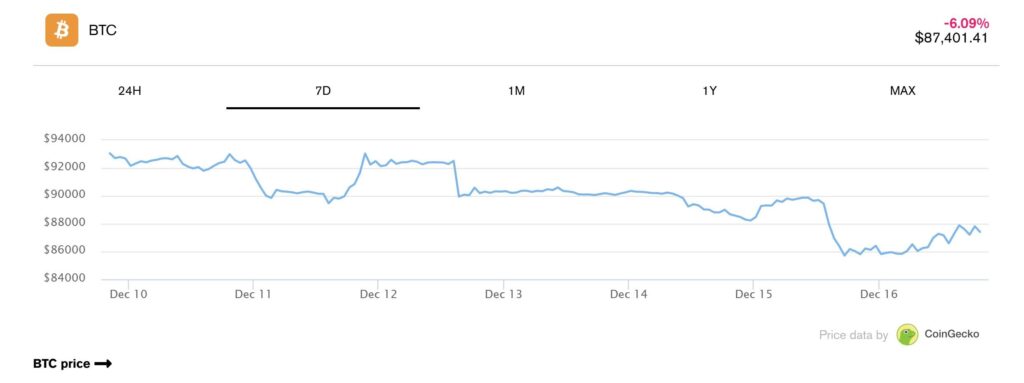
Ethereum funds in the same Bitcoin and Ethereum ETF category recorded almost $225 million of net outflows on the day, their largest daily redemption since the start of the month, confirming that both assets felt the same institutional chill. These moves arrived even as prices stayed bounded by recent ranges. Bitcoin dipped toward the mid-$80,000 area on Monday before stabilising near $87,000, while Ethereum fell below $3,000 and then hovered around $2,900. The price action looked choppy but not extreme compared with the size of the ETF redemptions, which highlights how flows rather than spot moves captured the main shift in sentiment. In the background, U.S. equity markets reacted to fresh labour data that showed the unemployment rate at 4.6 percent, the highest reading since 2021, and investors tried to read what that meant for the Federal Reserve’s rate-cut path in 2026. The combination of higher joblessness, lingering inflation questions, and a still-uncertain rate outlook encouraged many multi-asset desks to trim risk across technology stocks and related trades. The pattern underscored that Bitcoin and Ethereum ETF vehicles now give institutions a clean way to reduce or add crypto exposure as part of broader portfolio adjustments rather than purely crypto-specific trades.
Macro drivers behind Bitcoin and Ethereum ETF outflows
Market participants increasingly describe Bitcoin’s behaviour as similar to a leveraged play on major technology indices, especially during the fourth quarter. One prominent crypto trading executive pointed out that when the Nasdaq turns lower, Bitcoin usually reacts with even sharper downside moves, and that relationship has grown more visible in recent months. This behaviour explains why the Bitcoin and Ethereum ETF tape now mirrors swings in large-cap growth stocks as much as it reacts to on-chain or protocol news. When equities wobble, redemptions from each Bitcoin and Ethereum ETF often follow quickly, because large holders can offload exposure during normal market hours without touching underlying coins. Over the past six months, Bitcoin has trended lower even while major U.S. stock indices remained roughly flat, which shows that the asset has struggled to attract sustained new demand at current price levels. November stood out as its weakest month of the year, with persistent selling pressure and few lasting rallies, while December so far looks more like a drawn-out sideways phase with short bursts of strength that fade as soon as supply returns. For allocators, the Bitcoin and Ethereum ETF menu has become the default tool to rebalance digital assets as these macro shifts play out. Instead of moving funds through exchanges or over-the-counter desks, they can switch position sizes in regular brokerage accounts, align risk budgets with internal limits, and keep reporting simple. That shift means Bitcoin and Ethereum ETF flows now reveal as much about global risk appetite and interest-rate expectations as they do about any specific development in the crypto ecosystem.
How Bitcoin and Ethereum ETF flows compare across December
Across December, the Bitcoin and Ethereum ETF statistics paint a more nuanced picture than one heavy selling day might suggest. For spot Bitcoin products, month-to-date data show about $705 million in outflows offset by roughly $480 million in inflows, leaving a net drawdown near $225 million. That figure confirms a negative lean, yet it also shows that buying interest still appears on selected days, especially after periods of sharp price weakness. Spot Bitcoin products inside the broader Bitcoin and Ethereum ETF stack therefore reflect a tug-of-war between short-term traders locking in gains from earlier in the year and longer-term allocators who use dips to build positions. Ethereum funds show a slightly different profile. Over the same stretch, Ethereum-focused products attracted about $411 million in inflows while seeing around $403 million in outflows, leaving the segment close to flat overall. The near-zero net change suggests that investors remain more balanced on the second-largest asset, despite the single-day redemption of almost $225 million on Monday. That Monday figure looms large in the daily data but looks less alarming when stacked against the full month’s flows. At the same time, the current outflow wave follows an even larger redemption period earlier this quarter, when U.S. Bitcoin and Ethereum funds lost roughly $2.6 billion in assets over one week as investors rushed to de-risk during a steeper price slide. The wider Bitcoin and Ethereum ETF landscape still holds significant sticky capital, yet it clearly responds to macro shocks and rapid changes in equity sentiment.
Market implications as ETF flows decouple from spot prices
Another lesson from this episode is how the Bitcoin and Ethereum ETF tape can diverge from underlying spot prices over short periods. Monday’s heavy redemptions unfolded while Bitcoin and Ethereum traded inside a broad range that has contained both assets for much of December, which means flows signalled more stress than headline price charts. ETF investors appear to use these vehicles as a forward-looking risk expression rather than a simple mirror of intraday price changes. For traders who monitor sentiment across digital assets, that gap turns the Bitcoin and Ethereum ETF sector into a separate market to track, with its own rhythms and momentum. From a structural point of view, spot ETFs now sit at the centre of how traditional finance channels capital into and out of crypto. The ease of trading, the ability to integrate positions into existing risk systems, and the regulatory clarity around these vehicles have cemented their role. If macro conditions stabilise and equity volatility eases, the Bitcoin and Ethereum ETF flows could flip back to positive territory, especially if investors regain confidence in a path toward lower interest rates. On the other hand, any renewed equity sell-off, fresh labour-market weakness, or surprise hawkish signals from central banks may pull more money out of the Bitcoin and Ethereum ETF universe. In that scenario, net redemptions would likely continue to track periods when technology stocks and other growth assets come under pressure, highlighting again how tightly these instruments now link crypto to the broader risk cycle.
Conclusion
Recent numbers confirm that the Bitcoin and Ethereum ETF market now sits near the core of crypto’s connection to traditional finance. A single day with $582.4 million in combined outflows, including $357.6 million from Bitcoin funds and nearly $225 million from Ethereum products, showed how quickly institutions can move when macro conditions change and equity volatility rises. At the same time, month-to-date data reveal a more balanced picture, with Bitcoin ETFs posting a net drawdown of around $225 million and Ethereum ETFs finishing close to flat despite large individual sessions. How investors use these vehicles in the coming weeks will depend heavily on labour data, central-bank communication, and the path of major stock indices. In the near term, the direction of Bitcoin and Ethereum ETF flows will remain one of the clearest signals of institutional conviction toward digital assets as the year closes.
Disclaimer
The information provided in this article is for informational purposes only and should not be considered financial advice. The article does not offer sufficient information to make investment decisions, nor does it constitute an offer, recommendation, or solicitation to buy or sell any financial instrument. The content is opinion of the author and does not reflect any view or suggestion or any kind of advise from CryptoNewsBytes.com. The author declares he does not hold any of the above mentioned tokens or received any incentive from any company.
Featured image created by AI


Subscribe To Our Newsletter
Join our mailing list to receive the latest news and updates from our team.