

- Bitcoin stays around $102,000 after losing nearly 9% this week and about 20% since last month, showing weak momentum in the market.
- Around 400,000 BTC, worth nearly $45 billion, were sold by long-term holders, adding continuous pressure on the asset’s price.
- Derivative liquidations reached about $2 billion in 24 hours, and analysts point to $85,000 as a possible support before recovery.
Bitcoin slipped again as spot supply outweighed fresh demand, with price action reflecting steady selling from longer-term cohorts. At mid-day on November 5 (Africa/Casablanca), Bitcoin hovered near $102,000 after a brief rebound from sub-$100,000 prints, down about 1.37% on the day, roughly 9.2% on the week, and close to 20% beneath last month’s peak above $126,000. Analysts and on-chain data point to a rotation by wallets that held coins for six to twelve months, while derivatives liquidations added noise but did not define the move. Expectations now center on a period of digestion that could include a slide toward $85,000 if selling persists.

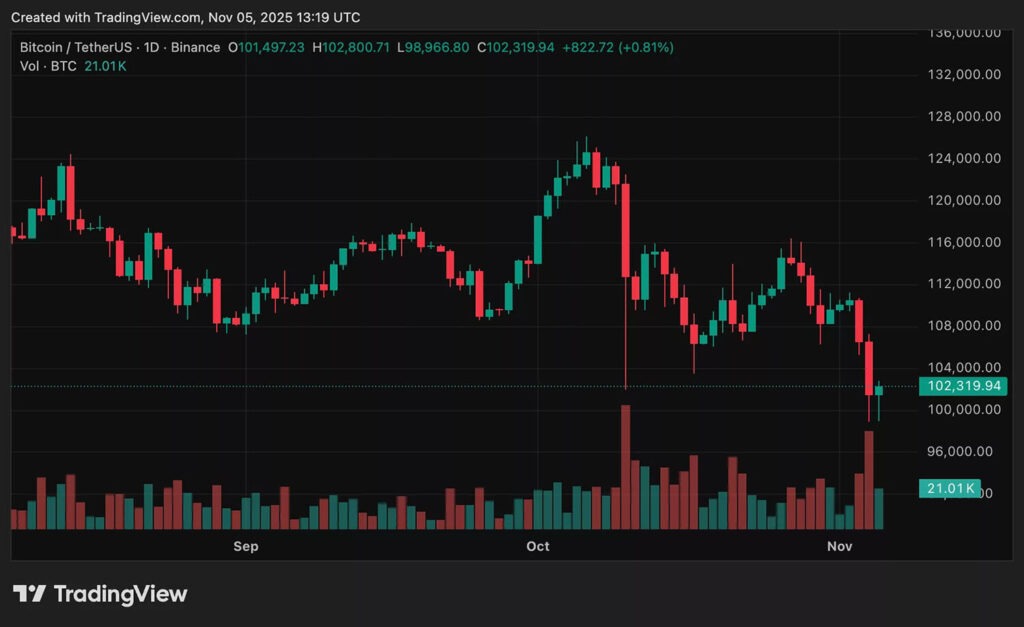
Bitcoin price action and weekly drawdown
Bitcoin crossed below the $100,000 threshold yesterday before bouncing, highlighting fragile support after October’s volatility reset. Spot quotes fluctuated around $101,000–$103,000 for much of the session, keeping weekly losses near 9% and leaving the coin almost one-fifth under its peak above $126,000 set last month. The tape shows quick moves through round numbers, then pauses as bids rebuild, suggesting thin liquidity pockets rather than a deep structural break. Several desks tied the latest leg to broader risk-off flows in tech and AI-linked equities, which pressured correlated assets and cooled speculative appetite. Price feeds and daily recaps from major outlets captured the sub-$100,000 print and the subsequent stabilization above $101,000.
Bitcoin long-term holders drive spot supply
A November 5 Bloomberg report detailed how conviction has faded among older coins, with an estimated 400,000 BTC sold over the past month, equal to about $45 billion at recent prices. Much of that flow came from wallets dormant for six to twelve months, a window that often aligns with profit-taking after strong rallies. Markus Thielen of 10x Research framed the process as spot-led, not leverage-led, noting whales with 1,000–10,000 BTC trimmed exposure since mid-year as new demand softened. K33 Research’s Vetle Lunde added that roughly 319,000 previously inactive coins reactivated in recent weeks, and that a meaningful portion represented actual sales rather than internal reshuffling. This pattern aligns with the current tape: steady distribution from seasoned holders, fewer aggressive dip bids, and a market that needs a new marginal buyer.
Market microstructure: liquidations, whales, and mid-tier wallets
Derivatives played a secondary role this time. Liquidations topped about $2 billion over the last 24 hours, sizable but far below the roughly $19 billion purge during October’s crash. Most forced exits hit long positions, which amplified the drop near round numbers but did not initiate it. That distinction matters because leverage events can reset quickly, while spot distribution can linger and shape price for weeks. Desk notes also flagged a slowdown in accumulation by mid-tier wallets holding 100–1,000 BTC, a cohort that helped absorb supply earlier in the year. When that group turns cautious, order books thin out, and price can travel farther on less volume. The October comparison shows the contrast well: an extreme derivatives washout then, a steadier spot bleed now, plus a modest leverage clean-up rather than a cascade.
Outlook and levels for Bitcoin
Bitcoin may trade in a choppy band while the market tests whether supply from older coins slows. If sellers keep pressure, $85,000 stands out as a risk marker mentioned by several analysts as a potential downside target before a more durable base forms. That level does not imply a forecast; it frames the area where bids could regroup if distribution persists into year-end. The bullish countercase needs tangible new demand: renewed ETF inflows, stronger cash bids from corporates or treasuries, or a shift in whale flows back to accumulation. Until then, traders will watch reactivation data from K33, spot-versus-futures balance, and the behavior of 100–1,000 BTC wallets for early signs of change. Near term, holding above the recent $100,000 breach matters for psychology, but the flow picture will set direction more than any single round number.
Conclusion
Bitcoin trades heavy because supply from long-term holders rose while new buyers hesitated, leaving price about 20% under its recent peak and vulnerable to further tests if distribution continues. The market handled a modest leverage flush, yet spot selling defined the move, supported by data on reactivated coins and reduced mid-tier accumulation. If flows stabilize and demand returns, consolidation could follow; if not, probes toward $85,000 remain possible before a sturdier floor forms.
Disclaimer
The information provided in this article is for informational purposes only and should not be considered financial advice. The article does not offer sufficient information to make investment decisions, nor does it constitute an offer, recommendation, or solicitation to buy or sell any financial instrument. The content is opinion of the author and does not reflect any view or suggestion or any kind of advise from CryptoNewsBytes.com. The author declares he does not hold any of the above mentioned tokens or received any incentive from any company.
Featured image created by AI


Subscribe To Our Newsletter
Join our mailing list to receive the latest news and updates from our team.