
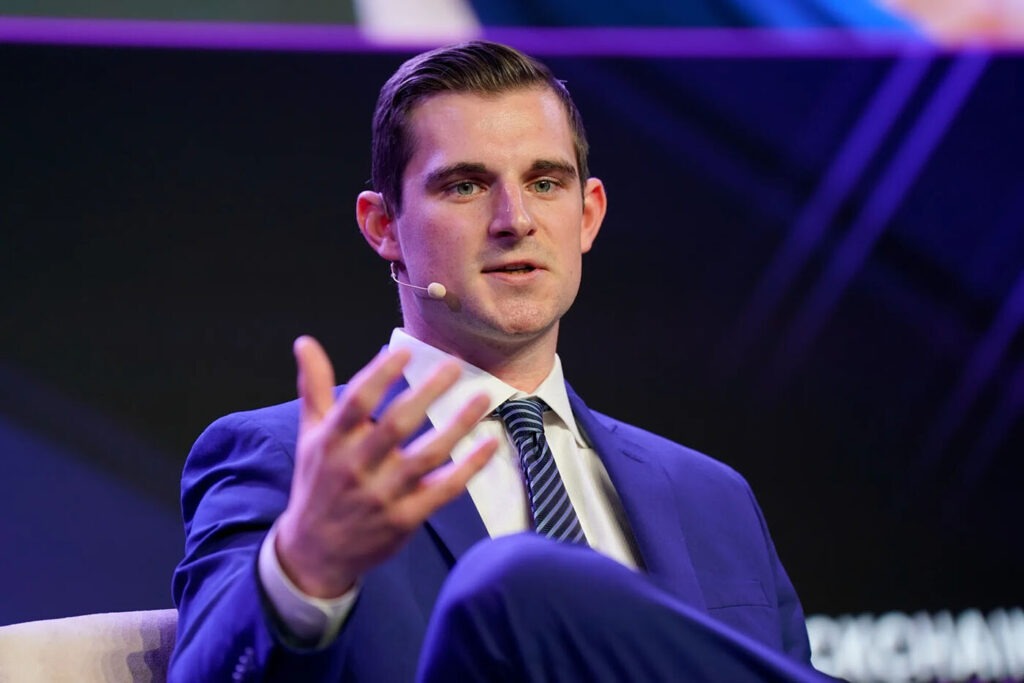
- Tether announces USAT stablecoin launch under the Genius Act
- Bo Hines named CEO of Tether’s U.S. expansion
- Anchorage Digital and Cantor Fitzgerald manage issuance and reserves
Tether announced the launch of its U.S. stablecoin, USAT, during an event in New York City, signaling a major shift for the firm after years of regulatory scrutiny. The new token will operate under the Genius Act, with Anchorage Digital handling issuance and Cantor Fitzgerald holding reserves. Former White House crypto official Bo Hines will serve as CEO, leading operations from Charlotte, North Carolina. With USDT already the largest stablecoin at nearly $170 billion in market cap, Tether now faces competition from Circle’s USDC and upcoming bank-backed tokens as it seeks adoption in the U.S. market.
Tether enters the U.S. market under the Genius Act
Tether framed the launch of USAT as a response to a maturing legal setting rather than a shift in its core model, and the company pointed to the Genius Act, which became law in July, as the framework that guides issuance, reserve management, and oversight in the United States. The announcement took place at a spy-themed museum in New York City and brought together lawmakers, venture investors, and industry executives, signaling that Tether aims to operate inside U.S. guardrails rather than around them. Anchorage Digital will support issuance in a manner the company says aligns with the statute, while longtime partner Cantor Fitzgerald will hold the reserves that back the new token, which mirrors the role it plays for the firm’s broader balance sheet. Tether CEO Paolo Ardoino told the audience that competitors tried to box the firm out of the U.S. market, and he argued that the product’s scale and liquidity would carry over to a domestic setting. The firm stated that USAT will target remittances, global payments, and online checkouts, and the plan is to go live before year-end with a headquarters in Charlotte, North Carolina, under CEO Bo Hines, who previously served as a senior crypto official in the Trump administration. The guest list underlined the shift in posture, with U.S. representatives Bryan Steil and Addison McDowell joining investors such as Matt Huang and Kyle Samani, which suggested that Tether intends to normalize its presence in Washington and New York rather than remain a distant offshore player.
USAT structure: Anchorage Digital, Cantor Fitzgerald, and reserve design
USAT relies on a separation of roles that Tether argues will ease audits, reduce operational risk, and simplify supervision under the Genius Act, and the company emphasized Anchorage Digital’s infrastructure for compliant issuance and lifecycle controls. Cantor Fitzgerald will serve as custodian for the reserves and maintain segregation of assets, and the firm linked that custody model to the processes already used for the larger reserve base that supports the flagship token. The company said USAT will not pass yield to users, because the law bars stablecoin issuers from sharing interest income with customers, and that design choice creates a common floor with banks and fintechs that choose the same path. The firm also noted that reserve construction will follow the rule set that U.S. supervisors apply to stablecoin issuers, which points to cash and short-duration instruments rather than higher-risk credit. Tether added that Anchorage Digital’s controls support sanctioned address screening and transaction monitoring, and the company positioned those features as critical to meeting U.S. standards while maintaining on-chain settlement speed. The website that accompanied the launch focused on checkout, cross-border transfers, and merchant payouts as near-term targets, and it presented a phased rollout that ends with public availability by the close of the year, subject to readiness checks and partner onboarding.
Political and market backdrop for Tether in 2025
Tether arrives at this point after a long run of growth that made USDT the largest stablecoin by far, with a market cap near $170 billion, and it enters a U.S. market where Circle’s USDC stands at roughly $72 billion. The firm operates with a staff of just under 300 people and reports billions of dollars in income from the yield on its holdings, which places it among the most profitable companies on a per-employee basis, according to unaudited figures it has shared. The company has also drawn criticism over the opacity of its reserves and the alleged role of its tokens in illicit finance, and it has dealt with actions such as a settlement with the New York attorney general and a reported inquiry by the U.S. Department of Justice. This backdrop adds stakes to a U.S. launch, because the Genius Act opens a channel for banks and new startups to issue competing tokens that fit within a common statutory framework. Support inside the administration also matters, and Cantor Fitzgerald’s Howard Lutnick has emerged as a leading advocate after the firm began managing a large share of the reserves, while Bo Hines moved from a senior crypto policy post to run the U.S. expansion and now leads USAT as CEO. Tether argued that the market’s focus should center on liquidity, uptime, and settlement certainty rather than the firm’s past disputes, and it suggested that the U.S. compliant design will address many of the concerns raised over the last cycle without changing the core utility that users value.
Adoption outlook, competition, and compliance limits for Tether
Adoption will depend on how quickly exchanges, wallets, and payment processors integrate USAT, and on whether merchants and remittance providers see enough value to justify onboarding, which can involve both legal and technical work. The Genius Act blocks issuers from sharing interest income with users, which means USAT must compete on liquidity, fees, and reliability rather than yield, and that rule levels the field for banks and fintechs that might otherwise face pressure to pass through a rate. Tether holds a clear lead on network reach, and network effects can drive early traction, but the U.S. lane will not mirror offshore demand because regulated alternatives can plug into existing bank rails and enjoy native distribution. Circle’s USDC maintains strong penetration in the United States and may benefit from a perception of early compliance, while banks that choose to issue tokens under the same law can bundle accounts, cards, and treasury tools in ways that appeal to corporate finance teams. The firm’s plan to base USAT in Charlotte suggests a strategy that targets payments, card programs, and banking partnerships that cluster in the Southeast and Mid-Atlantic, which could help with hiring and with regulator access. The guest list at the New York event pointed to a deliberate move to build bridges with Congress, and the company’s messaging aimed for predictability more than branding, which often matters more for institutional onboarding than for retail mindshare. Tether said it wants to dominate the market, but the framing stressed competing inside a U.S. rulebook and shipping a product that meets statutory controls rather than seeking exceptions, and the presence of lawmakers and investors underscored that shift in tone.
Conclusion
Tether’s decision to launch USAT under the Genius Act marks a turning point for the company after years of distance from U.S. regulation. By choosing Anchorage Digital as its issuance partner and Cantor Fitzgerald as custodian, the firm aims to present a compliant structure that aligns with statutory rules. The presence of lawmakers, venture capitalists, and industry executives at the launch event suggested a deliberate effort to establish credibility in the United States. With USDT already at a market cap near $170 billion and USDC at $72 billion, the U.S. stablecoin market is set for renewed competition. Tether will face challenges as banks and startups move into the field, but its scale and liquidity give it a distinct advantage. The appointment of Bo Hines as CEO of USAT, along with the decision to base operations in Charlotte, reflects a strategy focused on political alignment and payment industry access. Whether USAT can replicate Tether’s global success in a regulated environment will define its next chapter.
Disclaimer
The information provided in this article is for informational purposes only and should not be considered financial advice. The article does not offer sufficient information to make investment decisions, nor does it constitute an offer, recommendation, or solicitation to buy or sell any financial instrument. The content is opinion of the author and does not reflect any view or suggestion or any kind of advise from CryptoNewsBytes.com. The author declares he does not hold any of the above mentioned tokens or received any incentive from any company.
image source


Subscribe To Our Newsletter
Join our mailing list to receive the latest news and updates from our team.