
- XRP ETFs launch as Bitcoin and Ether see modest gains and sentiment stays cautious
- Cardano chain split and Etherscan API limits show ongoing DeFi infrastructure issues
- Banks shift exposure to miners while index changes may affect crypto treasury stocks
The Crypto Market entered Monday’s session in a cautious mood, even as major coins showed a mild rebound after last week’s sharp drop. By 9:00 p.m. UTC on November 24, Bitcoin had recovered part of its recent loss, Ether outpaced it with stronger intraday gains, and select altcoins moved higher on fresh ETF news and stock market signals. The Crypto Market still reflected fear in sentiment indices and a heavy focus on derivatives positioning, yet it also revealed pockets of renewed interest in XRP, Solana and mining stocks linked to high-performance computing and cloud deals.
Crypto Market overview: Bitcoin and Ether regain their footing
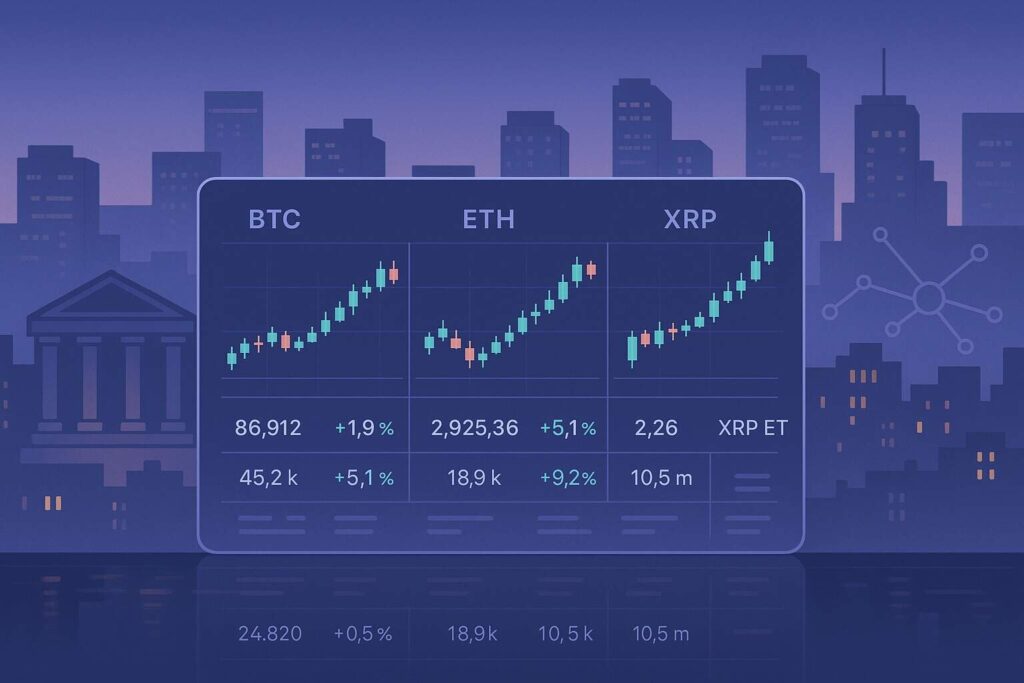
Bitcoin traded at US$89,102.53 at 9:00 p.m. UTC, up 1.9 percent over 24 hours and attempting to stabilize after a heavy rout driven by spot ETF outflows. During the previous week, spot Bitcoin ETFs recorded more than US$1.2 billion in outflows, marking the third week in a row with over US$1 billion leaving those products, a sequence that placed clear pressure on the broader Crypto Market. Despite the modest rebound, sentiment stayed weak, with the Fear and Greed Index closing near 12, deep in the “fear” zone and far from the euphoria seen earlier in the year. On the derivatives side, traders still leaned to the bearish side, but the balance started to shift. A negative funding rate around -0.005 showed that short positions remained slightly more expensive to hold, yet large short liquidations began to push prices upward and hinted at a potential short-term squeeze across the Crypto Market. Open interest stayed elevated, and that combination of high leverage and forced covering left room for sharper moves in either direction. Bitcoin’s relative strength index stood at 58.52, a level that pointed to moderate bullish momentum while staying well below classic overbought territory, giving room for further upside if demand improved. Macro expectations added another important layer. Market odds for a central bank rate cut in December climbed into a range of roughly 70 to 79 percent according to several rate trackers, and those expectations helped to support risk assets. If incoming economic data during the week confirms cooling inflation without a strong growth shock, liquidity conditions may offer a modest tailwind to the Crypto Market into year end. However, the same scenario could reverse quickly if data undermines the case for near-term easing, which would leave leveraged positions vulnerable after the recent bounce. Ether moved more decisively. The coin traded at US$2,973.36, up 5.1 percent over the last 24 hours and outperformed Bitcoin during the same window. Liquidations of about US$39.75 million, mainly from short positions, amplified the move and created a textbook short squeeze, since forced buying to cover shorts added to natural spot demand. Open interest in Ether derivatives increased by 3.07 percent to US$35.93 billion, a sign that traders added fresh positions rather than simply closing risk. A funding rate around zero showed that long and short positions sat in rough balance at this stage, which often precedes the next directional shift in the Crypto Market when new information arrives. Altcoin price action followed this pattern of selective strength. XRP traded at US$2.26, up 9.2 percent over 24 hours, while Solana reached about US$138.82, an increase of 4.7 percent during the same period. These moves reflected both asset-specific catalysts and broader interest in higher-beta coins after the initial Bitcoin and Ether recovery, as traders looked beyond the largest pair to assets that might respond faster to improving conditions in the Crypto Market.
XRP ETFs reshape Crypto Market access for traditional investors
The launch of two new XRP exchange-traded products brought a fresh narrative to the session and helped to explain part of the XRP rally. The Franklin XRP ETF and the Grayscale XRP Trust ETF both began trading on NYSE Arca, giving investors additional regulated tools to gain exposure to XRP without direct custody of the token. Early trading showed firm volumes and narrow spreads, which pointed to reasonable demand from market participants who prefer securities wrappers over direct spot positions when they engage with the Crypto Market. The price of XRP near US$2.26, combined with a 9.2 percent daily gain, reflected that improved access. For many institutional investors, ETFs and trust structures fit more easily into existing mandates and compliance frameworks than spot holdings on exchanges. As the Franklin and Grayscale products built their order books, they also supported liquidity in the underlying token because market makers needed to hedge creations and redemptions by buying and selling XRP on spot venues. This mechanical link between ETF flows and spot depth forms a key bridge between traditional markets and the Crypto Market. Commentary from Ray Youssef, the chief executive of peer-to-peer app NoOnes, highlighted the more structural implications of this wave of products. He noted that previous ETF launches often coincided with increased inflows and better liquidity, but he also underlined that this round arrives in an environment of tight liquidity, low investor confidence and noticeable underperformance across many coins. That combination makes the current series of altcoin ETFs a kind of test for risk appetite, because investors now must decide whether new listings alone justify higher exposure to the Crypto Market while macro conditions remain uncertain and benchmark coins trade below their recent highs. Youssef also stressed that sentiment has been subdued for a long period, which means ETF launches occurring now might have more impact than if they appeared during an already euphoric phase. As capital trickles into these altcoin funds, it can create a continuous flow into the digital asset space rather than just a one-off spike. That steady buying acts as a modest liquidity buffer for the Crypto Market, especially in coins such as Ether, XRP and Solana that sit at the center of many portfolios. If flows persist into the final weeks of the year, the incremental demand could support a year-end rally, though any such move would still depend on macro data, regulation and the stability of core market infrastructure.
DeFi infrastructure strains and banking pressure on digital assets
While prices and ETFs drew attention, the underlying infrastructure and banking backdrop raised new concerns. On Friday, November 21, the Cardano network experienced an accidental chain split after a malformed transaction triggered a divergence in block production. For a period, the chain operated in two competing versions, and stake pools had to manage inconsistent views of the ledger. That episode exposed gaps in resilience for parts of the network and led to lost block rewards as well as irregular behavior in decentralized applications that rely on timely and accurate state updates. For participants in the Crypto Market who depend on stable staking income and reliable execution, the incident served as a reminder that protocol-level issues still matter even when headlines focus on prices. Shortly after, Etherscan restricted API access for roughly 10 percent of the blockchains and networks it tracks. The outage arrived during the DevConnect conference, a moment when many developers expected to test contracts and tools in real time. Because a large number of wallets, portfolio tools and automation services route their calls through Etherscan’s endpoints, the sudden change disrupted daily operations and revealed how dependent on a few data providers much of the DeFi environment has become. The Crypto Market often appears decentralized at the consensus layer, yet key services such as explorers, analytics platforms and indexing infrastructure still introduce central points of failure that can affect trading, risk management and monitoring. Tensions involving JPMorgan Chase added another layer of complexity at the intersection of banking and digital assets. Research from the bank raised the possibility that MSCI might exclude companies that hold more than 50 percent of their assets in cryptocurrencies from certain indices. JPMorgan estimated that such an exclusion could drive forced sell-offs of up to US$8.8 billion if index-tracking funds adjust their holdings, with MicroStrategy alone potentially facing US$2.8 billion in outflows due to its large Bitcoin treasury. The final decision is due on January 15, with any index changes set to take effect in February, a timetable that gives the Crypto Market several weeks to digest potential implications for listed firms that hold large digital asset reserves. At the same time, JPMorgan upgraded its views on specific Bitcoin mining companies. The bank raised Cipher Mining and CleanSpark from neutral to overweight, citing strong momentum in high-performance computing partnerships along with long-term cloud and colocation contracts that improve visibility on future revenue. These upgrades underscored a nuanced message: while some areas of traditional finance push for tighter treatment of companies whose balance sheets lean heavily on cryptocurrencies, other divisions recognize the role miners and infrastructure providers play in the broader digital economy and, by extension, in the Crypto Market.
Macro signals, miner stocks and sentiment across digital assets
Macroeconomic expectations continued to shape risk appetite, since the cost of capital remains a critical input for valuations of both technology stocks and digital assets. With futures markets assigning a 70 to 79 percent probability to a rate cut in December, traders viewed incoming economic data as a key driver for the next leg in the Crypto Market. Softer inflation and stable employment data would support the case for easier policy, which in turn lowers discount rates used in valuation models and improves the appeal of longer-duration assets, including coins that depend heavily on growth narratives. On the other hand, any surprise that pushes central banks toward a more restrictive stance would pressure leveraged positions across exchanges and may undo part of the recent recovery. Investor attitudes toward speculative themes also drew attention, particularly after Michael Burry shifted his public presence. Burry, known for his successful bet against the US housing market before the 2008 crisis, closed Scion Asset Management and launched a paid Substack newsletter priced at US$39 per month. In his introductory note, he stressed that this move does not represent retirement but rather a change in how he shares his analysis, now free from the regulatory constraints linked to running client money. More than 21,000 subscribers joined rapidly, indicating strong interest in his views on markets that directly and indirectly influence the Crypto Market. Early essays on the newsletter revisited his trading history during the dot-com era and described how he sees the current wave of artificial intelligence-linked stocks as a supply-glutted bubble that could face a correction. That perspective matters for digital asset participants because many investors treat high-growth technology and cryptocurrencies as part of a broader risk cluster. If a sharp adjustment occurs in crowded AI trades, it could reduce overall risk tolerance, pull liquidity from leveraged strategies and limit flows into the Crypto Market, even if blockchain fundamentals remain unchanged in the short term. Conversely, a controlled cooling in stretched equity valuations might encourage investors to diversify across other growth themes, including leading coins and infrastructure tokens. Interactions between mining equities and digital assets also remained in focus. The upgrades for Cipher Mining and CleanSpark showed how shares of listed miners can benefit from long-term hosting and cloud agreements even when spot coin prices move sideways. These firms secure revenue streams that rely not only on block rewards but also on providing computing power to third parties, including clients in the high-performance computing sector. That diversification matters to the Crypto Market because it influences how sensitive miners are to halving events and difficulty adjustments, which in turn affects selling pressure from block rewards and the stability of hash rate over time.
Conclusion
Monday’s session illustrated a Crypto Market defined by partial recovery rather than broad strength. Bitcoin moved back above US$89,000 with a 1.9 percent daily gain, Ether advanced more than 5 percent to just under US$3,000, and leading altcoins such as XRP and Solana posted solid rises helped by new ETF launches and improved liquidity. At the same time, fear remained visible in sentiment indices, ETF outflows from the prior week still weighed on positioning, and funding metrics signaled that leverage could amplify both rebounds and renewed declines across the Crypto Market. Events away from price charts carried equal weight. The accidental Cardano chain split and the Etherscan API outage revealed how much DeFi activity depends on resilient core protocols and reliable data infrastructure. JPMorgan’s mixed stance, combining concerns about digital asset treasury exposures with upgrades for selected mining stocks, underlined the complex relationship between banks and digital assets. Michael Burry’s new newsletter added a cautious macro voice that many traders follow when they think about bubbles and cross-asset risk. Taken together, these signals show a Crypto Market that sits between caution and opportunity, with near-term direction likely to hinge on economic data, regulatory decisions and the ability of infrastructure and ETF flows to support demand through the final weeks of the year.
Disclaimer
The information provided in this article is for informational purposes only and should not be considered financial advice. The article does not offer sufficient information to make investment decisions, nor does it constitute an offer, recommendation, or solicitation to buy or sell any financial instrument. The content is opinion of the author and does not reflect any view or suggestion or any kind of advise from CryptoNewsBytes.com. The author declares he does not hold any of the above mentioned tokens or received any incentive from any company.
Featured image created by AI


Subscribe To Our Newsletter
Join our mailing list to receive the latest news and updates from our team.