
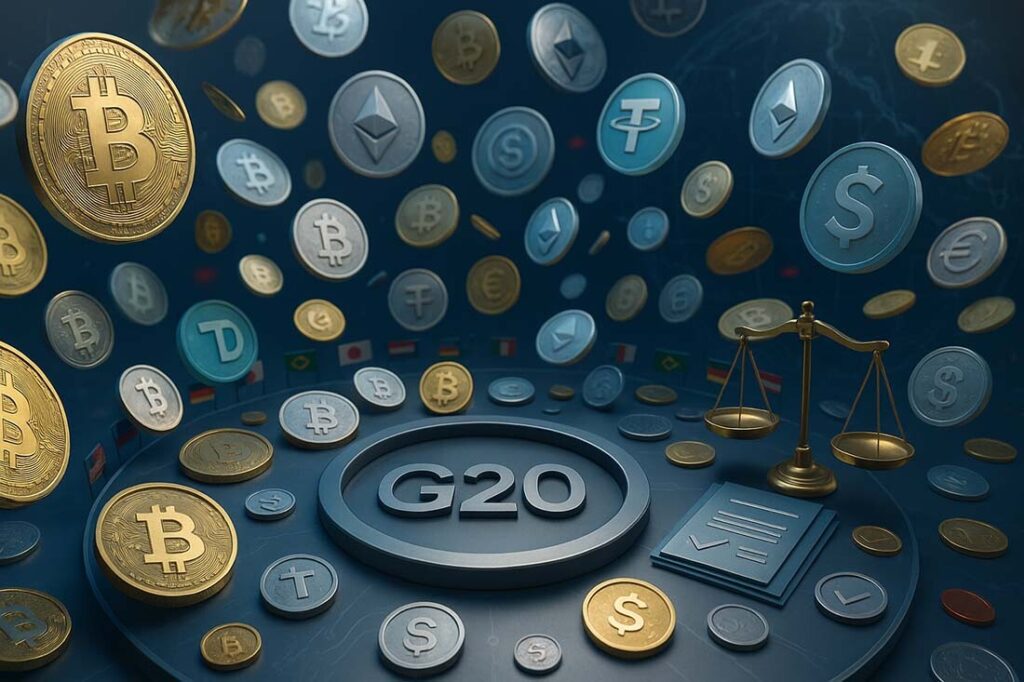
- G20 watchdog finds crypto oversight still fragmented across 29 jurisdictions, with eight priority actions urged to align rules and improve cross-border cooperation.
- Stablecoins grew to nearly $290 billion while few countries have complete frameworks, raising concerns about spillovers between crypto platforms and traditional finance.
- Crypto market value roughly doubled to about $4 trillion this year; risks remain limited but are rising as assets move easily across borders and policy signals shift.
The G20’s Financial Stability Board has renewed its warning that global regulation of the crypto market remains far too uneven, leaving potential cracks in the world’s financial system as digital assets expand at record speed. In its latest review, the board found that while progress has been made since its 2023 recommendations, the actual enforcement of rules across borders is still fragmented and inconsistent. This comes as the total value of cryptocurrencies has nearly doubled within a year, pushing the global market close to $4 trillion. The watchdog cautioned that the risks, though limited at present, are increasing alongside the rapid growth of Bitcoin, Ethereum, and other major tokens. It also highlighted that the cross‑border nature of crypto assets makes coordination among G20 members and other jurisdictions more urgent than ever.
G20 warning on fragmented crypto oversight
The Financial Stability Board, created after the global financial crisis, says many jurisdictions advanced parts of its 2023 crypto rulebook, yet the overall approach remains fragmented, inconsistent, and insufficient for markets that move across borders in seconds. John Schindler calls the situation consequential and stresses that crypto assets travel more easily than most financial instruments, which demands faster rulemaking and stronger coordination across supervisors. The latest review points to eight priority actions that speed up implementation and deepen cross-border cooperation so national regimes do not become isolated islands. European supervisors raised similar worries earlier this year, noting how small markets can spark broader stress if oversight stays patchy.
Stablecoins: rules lag as usage expands
The report flags stablecoins as the most urgent gap, since hardly any countries run a complete, enforceable framework even as adoption grows. Stablecoin capitalization climbed by almost three-quarters in twelve months to just under $290 billion, and regulators expect further growth with U.S. rules now in place. The review assessed 29 jurisdictions including the U.S., EU, Hong Kong, and the UK; the U.S. joined only the stablecoin portion, while El Salvador did not participate even though the largest stablecoin issuer is based there. These uneven regimes raise the risk of regulatory arbitrage and opaque transmission channels between crypto platforms and traditional finance.
G20 coordination gaps and cross-border spillovers
The G20 spotlight falls on the need to align supervision so offshore entities cannot export risk back into regulated markets. The FSB warns that domestic rules still face leakage when major firms book activities abroad, which leaves data gaps, weak leverage oversight, and slow responses during stress. The board links today’s momentum to politics and policy as well, noting that the current U.S. administration’s pro-crypto stance coincides with rapid market growth, which makes coordinated standards and information-sharing even more important to avoid uneven outcomes.
Market volatility and regulatory timelines
Recent market swings underscore why supervisors push for faster, consistent rulemaking. After a record one-day crash last week, analysts tallied roughly $19–$20 billion in liquidations as leveraged bets unwound, which refocused attention on the quality of exchange risk controls and the resilience of settlement rails. The memory of 2022 remains fresh as well, when FTX collapsed and TerraUSD/Luna failed, which already jolted global rulemakers into action before this year’s surge. The FSB’s peer-review process slated for October 2025 set expectations for this update, and today’s findings make the case for moving from principles to enforcement with clearer timelines.
Conclusion
The G20’s latest assessment reveals that while progress has been made, crypto regulation remains too fragmented to address the global nature of digital asset markets. The rapid growth in both crypto and stablecoins, with values now nearing $4 trillion and $290 billion respectively, highlights the urgency of implementing unified, enforceable frameworks across jurisdictions. Without strong cross-border cooperation, national efforts risk becoming ineffective as crypto assets easily bypass traditional financial borders. The FSB’s emphasis on stablecoins, political influences, and rising market linkages with traditional finance shows why global regulators must move from discussion to action. Delays in coordination could leave markets exposed to the same vulnerabilities that triggered past crises.
Disclaimer
The information provided in this article is for informational purposes only and should not be considered financial advice. The article does not offer sufficient information to make investment decisions, nor does it constitute an offer, recommendation, or solicitation to buy or sell any financial instrument. The content is opinion of the author and does not reflect any view or suggestion or any kind of advise from CryptoNewsBytes.com. The author declares he does not hold any of the above mentioned tokens or received any incentive from any company.
Featured image created by AI


Subscribe To Our Newsletter
Join our mailing list to receive the latest news and updates from our team.