
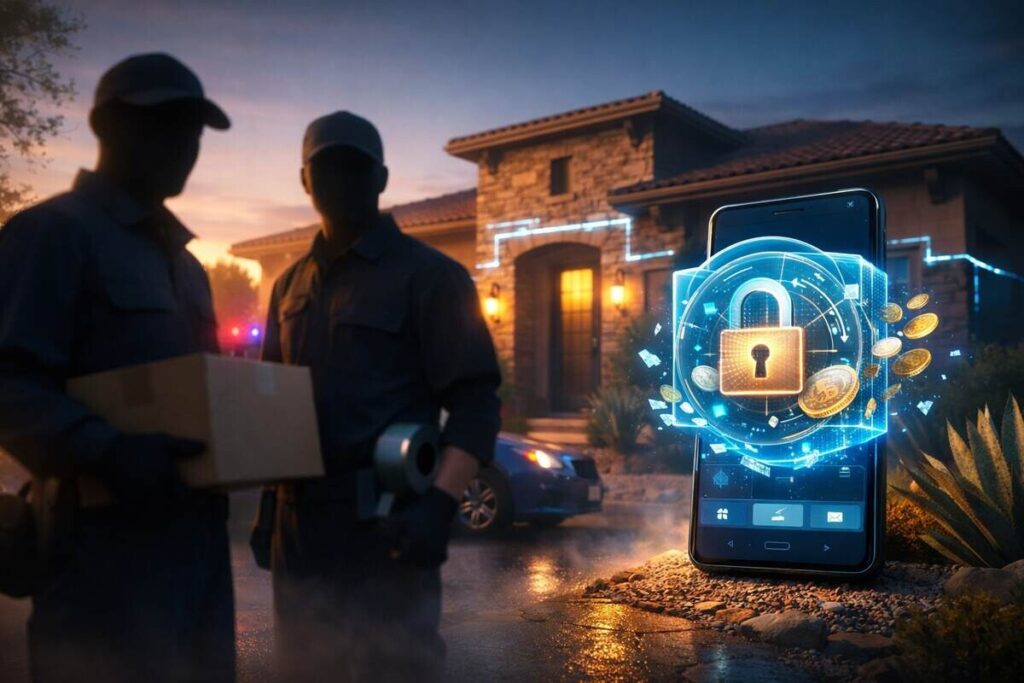
- Two California teens allegedly drove over 600 miles to carry out a Scottsdale home invasion, targeting a family they believed held $66 million in crypto.
- The case fits a wider pattern of crypto theft in which teens are recruited via encrypted apps, as recorded wrench attacks continue to rise worldwide.
A recent violent home invasion in Arizona highlights how crypto theft is moving from online exploits to physical attacks. Two high school students from California now face felony charges after allegedly traveling hundreds of miles to target a Scottsdale family they believed held tens of millions of dollars in digital assets, according to court records and local news reports.
Alleged 600-Mile Journey for Violent Crypto Theft Plot
According to court documents first detailed by FOX 10 Phoenix, two teenagers from San Luis Obispo County, aged 16 and 17, allegedly drove more than 600 miles to Scottsdale, Arizona, to rob a family of what they believed was $66 million in cryptocurrency. The incident took place on the morning of Jan. 31 in the Sweetwater Ranch neighborhood.
The Tribune reported that the teens arrived at the residence wearing outfits resembling FedEx uniforms. After approaching the house, they allegedly forced their way inside and subdued two adults using duct tape. While restraining the victims, the suspects reportedly assaulted them and demanded access to cryptocurrency holdings. When one of the victims denied having any crypto, the attackers allegedly escalated the violence, according to the court filings.
An adult son inside the home, but in another part of the property, managed to contact 911. Police officers arriving on the scene found a woman screaming and a man in a physical struggle with one of the alleged assailants. The teens then fled in a blue Subaru, but officers pursued and intercepted them at a nearby dead end shortly afterward.
Investigators reported recovering clothing resembling UPS uniforms, zip ties, duct tape, and a 3D-printed firearm. The weapon did not contain ammunition, and authorities have not determined whether it was functional. Both suspects were taken into custody and initially placed in a Maricopa County juvenile detention center, but prosecutors intend to try them as adults.
Charges, Alleged Encrypted Messaging, and Failed Parental Warning
Each of the two teenagers faces eight counts, including kidnapping, aggravated assault, and second-degree burglary. The 17-year-old has an additional charge of unlawful flight from law enforcement. FOX 10 reported that the court released both on $50,000 bail, with each teen ordered to wear an ankle monitor.
In a post-arrest interview cited in court documents, the younger suspect told police he and his co-defendant had only recently met. He claimed they were pressured into the scheme by people they knew only by the aliases “Red” and “8” on the encrypted messaging app Signal. According to the filing, he said the older teen asked if he wanted to go to Scottsdale to “tie people up to get $66 million in cryptocurrency,” describing the plan as driven by these pseudonymous online contacts.
The Signal users allegedly supplied the Scottsdale address and transferred $1,000 for equipment. Court documents state that the teens spent the funds on disguises and restraints at Target and Home Depot. They also allegedly stole a license plate from a similar vehicle before the break-in to conceal their car’s identity.
One of the teens’ mothers discovered text messages about the planned attack on her son’s phone, according to Fox News. She contacted law enforcement in California, who relayed the information to police in Scottsdale. Officers responded, but the home invasion was already underway by the time they arrived, and the crime had largely unfolded.
Rising Pattern of Violent Crypto Theft and Wrench Attacks
Security researchers and law enforcement observers see the Scottsdale case as part of a broader pattern of crypto theft moving into the physical world. The incident shares features with other crimes in which anonymous figures recruit teenagers through encrypted communication tools to carry out robberies aimed at digital assets.
In May, two 16-year-olds from Florida were charged with 22 felonies after allegedly kidnapping a man at gunpoint following a crypto event in Las Vegas. Authorities say the teens drove the victim to a remote part of the Arizona desert and took $4 million in digital assets. Prosecutors in that case said a fourth participant appeared to guide the operation via speakerphone, illustrating how orchestrators can stay distant while directing on-the-ground violence.
The Scottsdale home invasion is listed as the first wrench attack of 2026 in a public database that tracks physical assaults on cryptocurrency holders, maintained by security researcher Jameson Lopp. The term “wrench attack” is commonly used for situations where assailants use or threaten physical force to obtain private keys or transfers. According to Lopp’s data, all 10 earlier wrench attacks recorded in 2026 happened in France, Belgium, and the Philippines. For the previous year, he logged about 70 such incidents in 2025, up from roughly 41 in 2024, indicating a sharp rise in this form of crypto theft.
Analysts have linked this increase partly to large-scale corporate data breaches that expose personal information of crypto users. In a year-end review, The Block reported that the 2025 Coinbase breach, in which rogue customer service staff accessed know-your-customer data for numerous clients, has been cited by security experts as increasing the pool of identifiable targets. TRM Labs’ Ari Redbord told The Block in January that the real number of wrench attacks is “likely significantly higher” than known cases, because many incidents are categorized as conventional robberies and never publicly associated with cryptocurrency.
Separate Crypto-Linked Ransom Note in Arizona
The Scottsdale home invasion took place the same day another high-profile Arizona case with a crypto angle emerged. On that day, 84-year-old Nancy Guthrie, mother of NBC “Today” co-host Savannah Guthrie, was last seen at her home in Tucson, about two hours from Scottsdale. TMZ reported receiving a ransom note demanding that millions in cryptocurrency be transferred to a Bitcoin address in connection with her disappearance.
Authorities have not established any link between the Guthrie case and the Scottsdale robbery. Law enforcement has since arrested a man from California, accusing him of sending fraudulent Bitcoin ransom messages to the Guthrie family. Officials described that scheme as an unrelated effort to exploit public concern around her disappearance, according to Fox News.
Conclusion
The Scottsdale incident shows how crypto theft increasingly intersects with violent crime, with suspects allegedly traveling long distances, using disguises, and coordinating via encrypted apps to target supposed digital fortunes. With recorded wrench attacks rising from 41 in 2024 to around 70 in 2025 and continuing into 2026, security researchers and prosecutors are documenting a shift from purely online crypto crime to physical coercion, often involving young recruits and remote organizers who remain in the background.
Disclaimer
The information provided in this article is for informational purposes only and should not be considered financial advice. The article does not offer sufficient information to make investment decisions, nor does it constitute an offer, recommendation, or solicitation to buy or sell any financial instrument. The content is opinion of the author and does not reflect any view or suggestion or any kind of advise from CryptoNewsBytes.com. The author declares he does not hold any of the above mentioned tokens or received any incentive from any company.
Featured image created by AI



Subscribe To Our Newsletter
Join our mailing list to receive the latest news and updates from our team.