
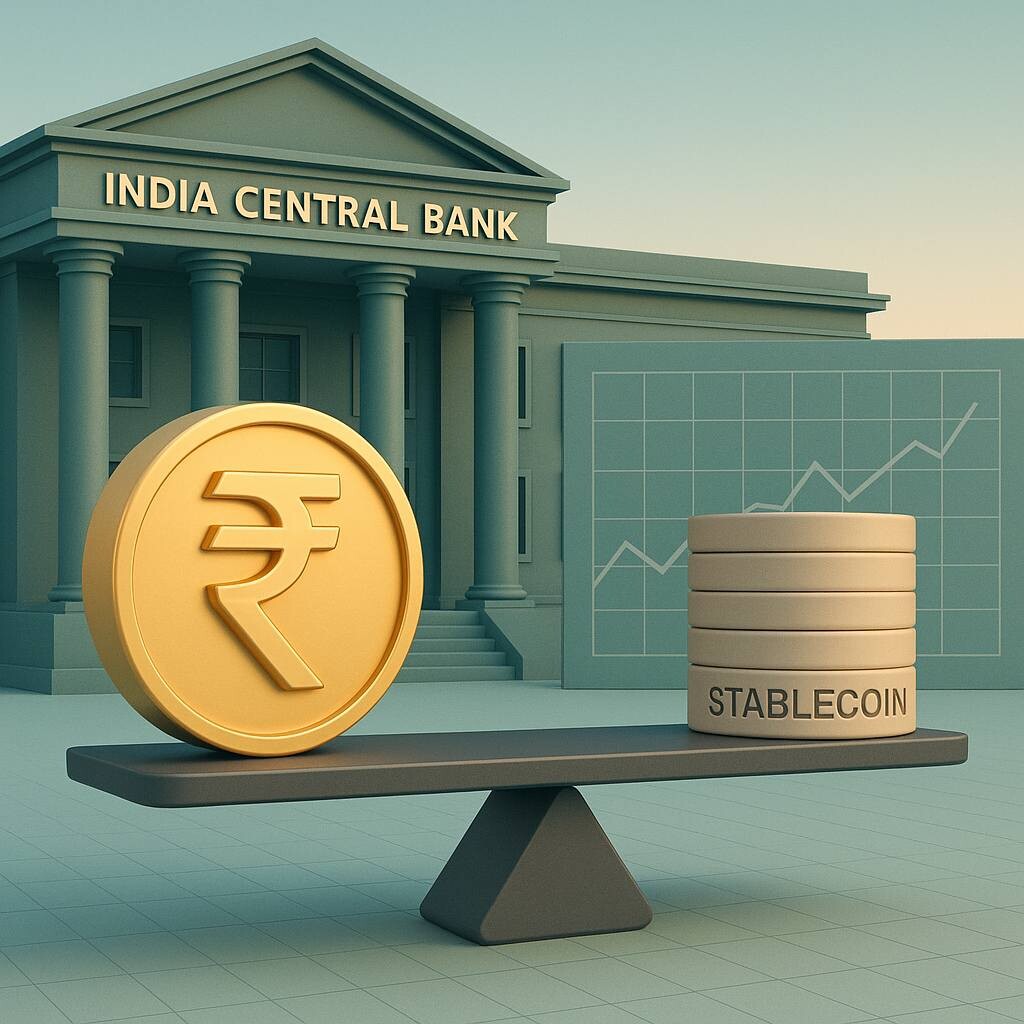
- India central bank deputy says stablecoins pose macro risks
- CBDC pilot reaches about 7 million retail users
- Crypto trading grows in India under tax and registration rules
India central bank officials sharpened their stance on stablecoins on Friday, when Deputy Governor T. Rabi Sankar said these tokens can carry meaningful macroeconomic risk while adding no function that fiat money cannot already deliver. Speaking in Mumbai, he framed stablecoins as a policy issue that touches monetary stability, fiscal policy, banking intermediation, and systemic resilience, not only payments. India central bank policy has already diverged from several major jurisdictions in how it approaches crypto activity, and Sankar’s remarks reinforced that cautious line at a moment when stablecoins keep growing worldwide and draw fresh attention after U.S. legislation set a clearer framework for dollar-pegged tokens.
India central bank warns on stablecoins and macroeconomic risk
India central bank leadership linked stablecoins to several pressure points that matter for a large, open economy with capital management tools and a bank-led credit system. Sankar said stablecoins can facilitate illicit payments and can help users bypass capital measures, but he placed broader risks at the center of his message. He pointed to concerns around monetary stability, where privately issued tokens can weaken transmission if adoption expands in settlement or savings behavior. He also flagged fiscal policy risks, since large-scale token use can change how people hold money and how governments collect and time revenues. In the banking channel, he described a threat to intermediation, because stablecoins can pull activity away from regulated deposits and payment rails that anchor liquidity management. India central bank officials also tied stablecoins to systemic resilience, where runs, concentration in issuers, and operational disruptions can transmit stress quickly across users and platforms. Sankar’s core claim stayed simple and direct: stablecoins still have not proved the benefits their supporters promise, and they remain inferior to fiat money in the functions they claim to replicate. India central bank messaging in this speech treated stablecoins as a net risk item until evidence changes, rather than as a neutral innovation that only needs technical rules.
Stablecoin market passes $300 billion after US law
Stablecoins gained wider prominence as the United States passed a law that created a regulatory framework for dollar-pegged crypto tokens, a move that helped push popularity higher and lifted global market capitalization above $300 billion. That growth matters because stablecoins often act as the base currency inside crypto venues, and they also serve as a bridge for moving value across exchanges, wallets, and chains. The same scale also increases policy sensitivity, because large token supplies can concentrate in a few issuers and a few reserve structures, even when tokens circulate across many apps. India central bank observers watch this expansion with a different lens than jurisdictions that integrate stablecoins into payment pilots or regulated settlement experiments. India’s approach has not followed Japan or the European Union in the way it frames laws around crypto assets, and officials have repeatedly signaled concern that formal integration into the mainstream financial system could raise systemic risks. With the stablecoin market now past $300 billion, India central bank statements like Sankar’s put emphasis on macro links, not only on user convenience claims, and they also aim to shape expectations about the speed and direction of domestic policy.
India central bank pushes CBDC pilot with about 7 million users
India central bank policy in Sankar’s remarks also elevated central bank digital currency as the preferred route for digitizing money without outsourcing core monetary functions to private issuers. He argued that cryptocurrencies lack intrinsic value and do not produce underlying cash flows, and he used that framing to separate speculative crypto assets from state-issued digital money. In the same speech, he described CBDCs as inherently superior to stablecoins, a position that places sovereign digital cash inside the existing policy perimeter by design. India central bank pilots already run in both retail and wholesale formats, and the retail pilot has about 7 million users, which gives officials a live testing base for distribution, usage patterns, and operational readiness. That user count also provides a counterpoint to claims that stablecoins are the only practical route to modern digital payments, because India central bank can point to an expanding CBDC footprint while it maintains skepticism toward privately issued pegs. Sankar’s message kept focus on controlled innovation, where the issuer, settlement finality, and policy controls remain aligned with domestic monetary goals and financial stability standards.
Crypto rules in India: registration, taxes, and open policy questions
India central bank caution does not mean India blocks all crypto activity today, and the current framework allows exchanges to operate after they register locally with a government agency that performs due diligence focused on money-laundering risks. India also imposes taxes on gains from cryptocurrencies, which keeps activity within a taxable perimeter even as authorities debate broader treatment. Despite that caution, crypto trading has grown more popular in India, and exchanges have reported increased participation from users outside major urban centers, a trend that can widen the policy audience beyond metro-based early adopters. Sankar addressed the recurring question of why India does not simply ban trading outright, and he pointed to the need to take account of different stakeholders before finalizing an approach. He said the issue remains under consideration and that authorities will align actions with whatever final decision emerges. For now, India central bank messaging holds a line that combines a live, regulated doorway for exchange operations with a more conservative view of what belongs inside the core financial system, especially when stablecoins touch payments, savings behavior, and cross-border flows.
Conclusion
India central bank commentary from Deputy Governor T. Rabi Sankar on Friday set a clear tone: stablecoins, in his view, raise macroeconomic and financial stability concerns that extend beyond crime and compliance, and they have not shown benefits that justify those risks when fiat money already performs the same functions. The timing also matters, with stablecoins above $300 billion in global market cap after U.S. legislation boosted their regulatory clarity and popularity. India central bank positioning remains distinct from Japan and the European Union in how it frames crypto integration, while India continues to run retail and wholesale CBDC pilots and points to about 7 million retail users as evidence of a sovereign digital alternative. With exchanges operating under local registration and taxes applying to crypto gains, India central bank policy keeps crypto activity visible and bounded, while it signals that stablecoins will face persistent skepticism until their claimed utility becomes measurable and their systemic impact becomes easier to contain.
Disclaimer
The information provided in this article is for informational purposes only and should not be considered financial advice. The article does not offer sufficient information to make investment decisions, nor does it constitute an offer, recommendation, or solicitation to buy or sell any financial instrument. The content is opinion of the author and does not reflect any view or suggestion or any kind of advise from CryptoNewsBytes.com. The author declares he does not hold any of the above mentioned tokens or received any incentive from any company.
Featured image created by AI


Subscribe To Our Newsletter
Join our mailing list to receive the latest news and updates from our team.