
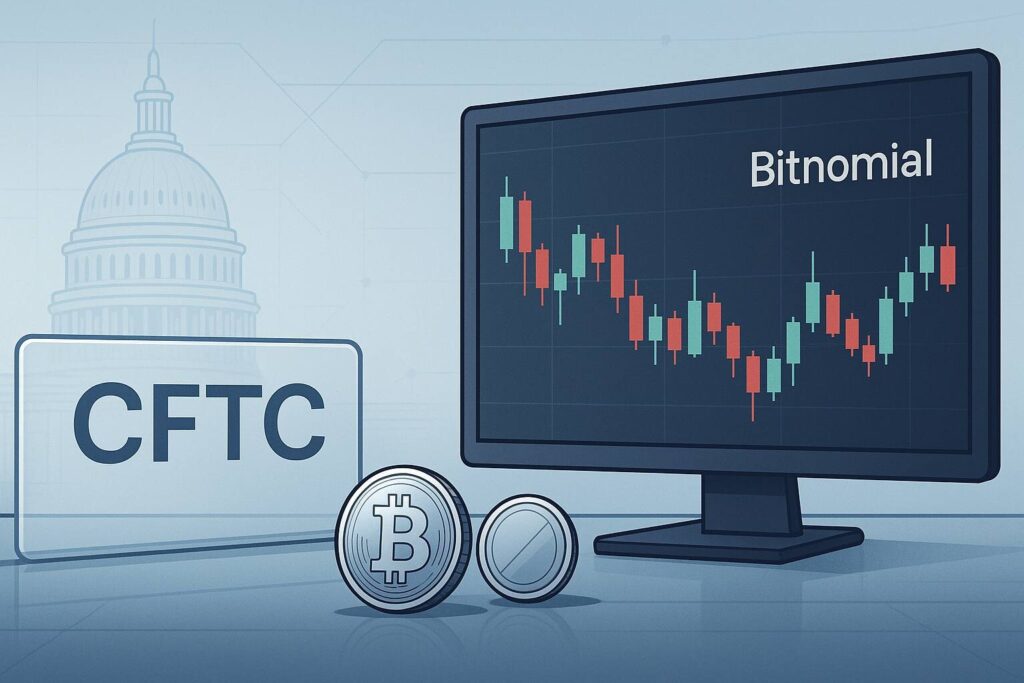
- CFTC permits leveraged spot crypto products on regulated exchanges
- Bitnomial prepares first leveraged spot crypto launch
- Plan includes tokenized collateral and rule updates for futures markets
The U.S. Commodity Futures Trading Commission (CFTC) has taken a concrete step that reshapes how digital assets trade on regulated American venues. On Thursday, the agency announced that it will allow leveraged spot crypto products to list on the futures exchanges it supervises, creating a new form of federally regulated crypto trading that sits alongside derivatives rather than offshore platforms. The first exchange to use this framework is Bitnomial, a Chicago-based derivatives marketplace registered with the CFTC as a Designated Contract Market, which plans to launch its initial Leveraged Spot Digital Asset product next week. Acting Chairman Caroline Pham framed the decision as a historic milestone that relies on long-standing statutory powers, not new legislation, and as a response to years of demand for safer, U.S.-based venues for leveraged retail crypto trading. By tying this move to the President’s Working Group on Digital Asset Markets and the agency’s own “Crypto Sprint,” the CFTC has also signaled that spot trading, tokenized collateral and blockchain-based market infrastructure are now central to its broader strategy for digital assets.
CFTC move opens federally regulated leveraged spot crypto trading
The new framework centers on one clear directive from the CFTC to the exchanges it oversees: they may now list Leveraged Spot Digital Asset products that qualify as retail commodity transactions and bring them inside existing futures-style rules. For years, leveraged retail trading in commodities technically belonged on futures exchanges under reforms adopted after the financial crisis roughly fifteen years ago, yet the agency did not define a path for exchange-traded crypto spot products. Instead, retail traders often relied on offshore venues that combined high leverage, opaque risk controls and uneven customer protections. With this decision, the CFTC uses that earlier mandate to give exchanges a way to list spot contracts with leverage under its direct oversight, rather than leaving traders to platforms that operate outside U.S. market infrastructure. Bitnomial’s launch illustrates how the model works in practice. The exchange already operates as a CFTC-regulated DCM and clears through Bitnomial Clearinghouse, a Derivatives Clearing Organization also supervised by the agency. Under the new rules, the first Leveraged Spot Digital Asset product on Bitnomial will trade next week, with spot crypto transactions executed on the exchange and cleared through the DCO, just like Bitcoin futures or options. Orders from retail and institutional participants enter the same central order book, receive the same matching priority and settle through a clearinghouse that handles netting and margin across the portfolio. The CFTC framework therefore inserts leverage, spot exposure and risk management into one regulated stack, rather than fragmenting them across multiple venues and bilateral lending agreements. Caroline Pham linked this redesign of leveraged spot trading to recent disruptions on foreign exchanges, arguing that Americans should not have to choose between access to digital assets and basic safeguards. She emphasized that the CFTC is now applying its “decades-long existing authority” to create a rule-based environment for products that many traders already use, but often without clear recourse if something goes wrong. By calling the move a “historic milestone,” she underscored how unusual it is for spot crypto trading, not just derivatives, to sit entirely inside a CFTC regime that has governed U.S. futures markets for nearly a century. For market participants, that means leverage levels, margin models, disclosures and risk controls must meet the same core principles that apply to U.S. perpetuals, futures and options, rather than ad hoc standards set by individual platforms.
How CFTC-backed Bitnomial launch changes U.S. crypto market structure
By launching the first leveraged retail spot crypto exchange under the direct supervision of the CFTC, Bitnomial changes the practical options available to traders who want both leverage and regulated infrastructure. The platform already lists U.S. perpetuals, physically settled futures and options on products such as the Bitcoin Complex, Hashrate contracts and a wider Crypto Complex that includes XRP, ADA and USDC futures. With the week-of-December-8 launch of leveraged spot, those products will sit alongside cash-settled and physically delivered spot trades on the same exchange and clearinghouse, allowing traders to manage positions in one consolidated risk environment. Under this structure, broker intermediation and clearinghouse net settlement play a central role. Bitnomial’s model routes trading through intermediaries, which collect margin from clients and pass it to the DCO, where all exposures net at the portfolio level. A trader who holds a long leveraged spot position and a short perpetual or futures contract does not need to maintain full collateral on both sides at separate venues; the risk offsets within the CFTC-regulated clearinghouse reduce the overall margin requirement. This design aims to keep counterparty risk within a framework that U.S. derivatives markets have used for decades, rather than relying on direct borrowing from unregulated lenders or cross-margining arrangements that lack transparent rules. The CFTC decision also affects other registered exchanges. Bitnomial is one of several DCMs that already hold CFTC approval, alongside platforms such as Coinbase, Kalshi and Polymarket. Now that the agency has clarified how leveraged spot can list on a DCM and clear through a DCO under section 2(c)(2)(D) of the Commodity Exchange Act, those venues may study similar products. The step does not give the CFTC blanket authority over all spot markets, but it shows that the agency can use existing law to supervise specific categories of leveraged retail commodity trading even while Congress debates broader market structure legislation. As a result, U.S. crypto market structure may see a gradual shift from offshore balance sheets toward domestic exchanges that combine spot, futures and options in one regulated environment.
Tokenized collateral, stablecoins and CFTC crypto sprint roadmap
The announcement about Leveraged Spot Digital Asset products forms only one part of a wider roadmap that the CFTC calls its “Crypto Sprint.” That program implements recommendations from the President’s Working Group on Digital Asset Markets, which urged federal regulators to address not only trading venues but also the role of stablecoins and other tokenized instruments in financial markets. In earlier stages of the sprint, the agency opened consultations on how tokenized collateral, including stablecoins, could function inside derivatives markets, and how existing rules on retail commodity transactions interact with that technology. Next steps go deeper into market plumbing. The CFTC has signaled that it plans rulemakings on collateral, margin, clearing, settlement, reporting and recordkeeping to ensure its regulations accommodate blockchain-based infrastructure and tokenization in the markets it oversees. That means a futures commission merchant that posts stablecoins or other tokenized assets as collateral will need clear guidance on eligibility, haircuts, concentration limits and operational controls around on-chain transfers. A derivatives clearing organization that supports tokenized margin will also need procedures for handling smart-contract failures, network congestion and on-chain forks without compromising the integrity of daily settlement and default management. By placing these topics inside a structured rulemaking agenda, the CFTC moves them from informal experimentation to a process with public comments, staff analysis and formal amendments to its rulebook. Coordination with the Securities and Exchange Commission sits at the center of this roadmap. The CFTC has repeatedly described the Leveraged Spot Digital Asset initiative and the broader sprint as joint efforts with the SEC, especially where spot crypto commodities and securities-related products intersect. The two agencies already collaborate on areas such as tokenized securities, prediction markets and cross-margining that involve both derivatives and securities law. As the CFTC develops its own rules around tokenized collateral and spot trading on DCMs, it must align with the SEC’s approach to custody, broker-dealer requirements and exchange registration to avoid conflicting obligations. That shared work will influence how quickly other exchanges follow Bitnomial in listing leveraged spot products and how far tokenization extends into core U.S. market infrastructure.
Regulatory context and industry impact
The CFTC decision arrives during a broader shift in U.S. digital asset policy. Under the current administration, federal agencies have moved from a mainly enforcement-driven posture toward a more defined framework that includes congressional proposals like the GENIUS Act and the CLARITY Act, both aimed at giving tailored rules to crypto markets. While those bills address topics such as market structure and asset classification, the Leveraged Spot Digital Asset framework shows that the agency can already act inside its mandate, even before lawmakers finalize new statutes. In effect, the CFTC now treats certain leveraged retail spot transactions as products that belong on properly supervised futures exchanges, rather than leaving them in legal grey areas. For market participants, this integration of spot and derivatives on a CFTC-regulated platform may change how they manage liquidity, risk and capital. A firm that once split positions across an offshore spot exchange and a U.S. futures venue can now consider routing both through a single marketplace that offers unified portfolio margining, net settlement and consistent rules around leverage. Retail traders gain access to spot markets that share the same surveillance, reporting and compliance obligations that apply to traditional futures, though they also face stricter margin and leverage conditions than some foreign platforms provide. Institutional traders obtain deeper insight into order books where both spot and derivatives interact inside one transparent framework, which can improve hedging and reduce basis risk between cash and futures markets. The decision also carries implications for offshore exchanges and for the ongoing debate over regulatory jurisdiction. If leveraged spot crypto migrates into CFTC-regulated venues, some offshore platforms may lose part of their U.S. customer base, especially clients that value strong clearing and legal certainty. At the same time, the move could increase pressure on Congress to clarify where unleveraged spot trading in digital commodities belongs, since the new framework does not automatically cover every form of cash trading. As discussions continue in Washington over whether the CFTC, the SEC or a new structure should supervise broader spot markets, the agency’s decision to embrace leveraged spot on existing futures exchanges offers a practical example of how digital assets can fit into current law without waiting for a complete rewrite of the regulatory map.
Conclusion
The announcement that leveraged spot crypto products may now trade on CFTC-regulated futures exchanges marks a notable change in how U.S. regulators approach digital assets. Bitnomial’s launch next week as the first leveraged retail spot crypto exchange under this framework turns a policy outline into a working market, with spot, futures, options and perpetuals all clearing through the same DCO and following the same core principles. Linked to the President’s Working Group on Digital Asset Markets and the ongoing Crypto Sprint, the step also sets up a path for tokenized collateral, including stablecoins, to enter futures markets through clear rules on margin, settlement and recordkeeping. As other designated contract markets review the new guidance, the CFTC has begun to integrate spot trading and tokenization into the center of its mandate, while offering traders an alternative to offshore venues that lack the customer protections of U.S. derivatives infrastructure.
Disclaimer
The information provided in this article is for informational purposes only and should not be considered financial advice. The article does not offer sufficient information to make investment decisions, nor does it constitute an offer, recommendation, or solicitation to buy or sell any financial instrument. The content is opinion of the author and does not reflect any view or suggestion or any kind of advise from CryptoNewsBytes.com. The author declares he does not hold any of the above mentioned tokens or received any incentive from any company.
Featured image created by AI


Subscribe To Our Newsletter
Join our mailing list to receive the latest news and updates from our team.