
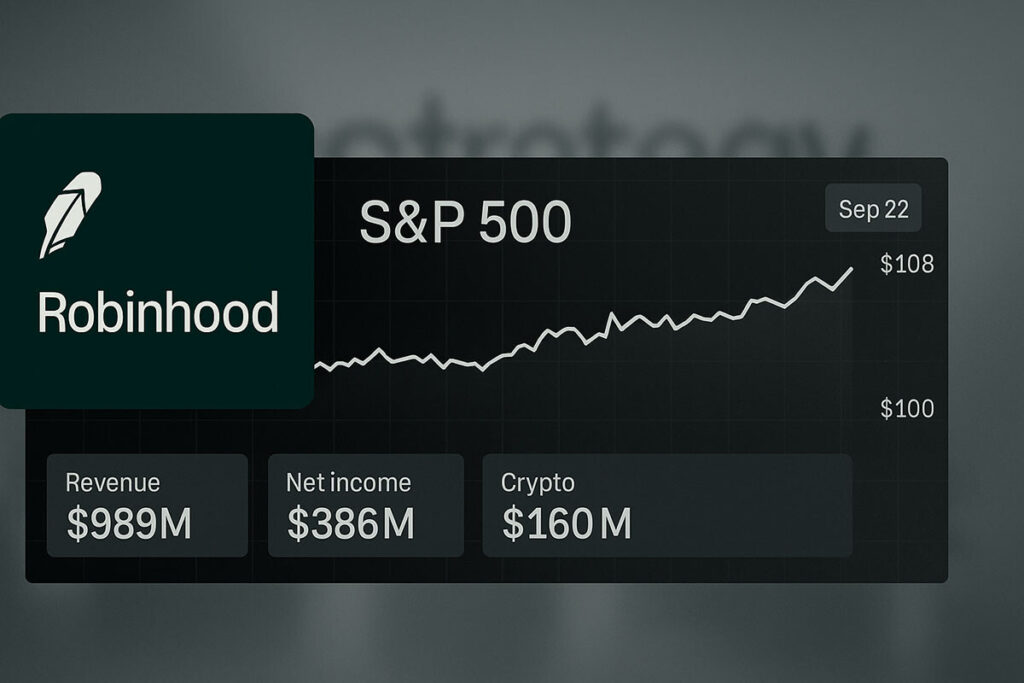
- Robinhood enters S&P 500 on September 22; shares moved from $101 to $108 after hours
- Q2 revenue $989M, net income $386M; options $265M, crypto $160M, equities $66M
- Strategy not added; Robinhood faces state suits and EU review of stock tokens
Robinhood closed just above $101 and then moved past $108 in extended trading after the index committee announcement, a move that arrived on the same day its addition to the S&P 500 was set for September 22 alongside AppLovin. The stock’s gain caps a year-to-date climb of more than 150% that has aligned with stronger quarterly results and renewed retail participation across equities and crypto. The calendar date matters because index trackers will rebalance near the effective time, and because the firm’s recent revenue and income figures provide a clear baseline for how the business is performing going into the change. In Q2, reported revenue reached $989 million, up 45% year over year, while net income was $386 million and earnings per share stood at $0.42, each above consensus expectations, setting the stage for how portfolio managers will frame the company’s current run rate.
Robinhood S&P 500 inclusion on September 22
The scheduled inclusion on September 22 places Robinhood among large-cap peers tracked by passive and benchmark-aware funds, and it arrives in a period when crypto-linked platforms have begun to appear in mainstream indices. The firm enters the list with AppLovin, and the timing suggests an end-of-day liquidity event as index funds match additions and deletions at the closing auction. For a brokerage and trading platform that earns across options, equities, and crypto, the index adds visibility and a more diverse shareholder base, which can influence how spreads, volumes, and volatility cluster around the effective date. Because the committee used the current financials to guide the decision, the recent quarter’s $989 million in revenue and $386 million in net income serve as reference points for how the company is meeting profitability screens that are often considered alongside market capitalization and liquidity.
Market reaction to Robinhood announcement
The immediate reaction—closing just above $101 and moving through $108 after hours—reflects the way index changes can shift the near-term supply and demand balance for a name. Traders positioned ahead of the announcement focused on the year-to-date gain of more than 150%, the depth of daily turnover, and how market makers might hedge into the close on the effective date. The extension in the post-market session also underscored how message-board and options activity can magnify moves around corporate milestones, though the core driver remained the S&P 500 decision and the known mechanics that follow it. As the date approaches, the tape will likely show clustered prints near the close as passive flows line up with counterparties seeking to provide liquidity.
Earnings profile supporting Robinhood rally
The earnings profile offers the context behind the rally. Quarterly revenue rose 45% year over year to $989 million, while net income of $386 million and EPS of $0.42 marked a clear shift from earlier periods when scale and operating leverage were still building. The segment details matter: options produced $265 million, equities delivered $66 million, and crypto added $160 million. The crypto figure nearly doubled from the prior year but was down from $252 million in Q1, a swing that captures the sensitivity to asset-price ranges and retail turnover. Even so, the mix shows the business is not tied to a single product cycle, and the options line again ranked as the top revenue driver, giving analysts a path to model contribution margins as market activity moves between asset classes over the rest of the year.
Index flows and what it means for Robinhood
Index flows typically come from funds that replicate the S&P 500, with purchases keyed to free-float share counts and sector weights. For Robinhood, the practical effect will show up in the closing auction on September 22, where liquidity providers tend to concentrate activity to minimize tracking error for passive investors. Active managers who compare performance to the index may also rebalance to avoid off-benchmark risk, adding another source of demand. The ultimate magnitude will depend on index weight, shares available, and concurrent deletions that free up capital. Because the shares already advanced more than 150% year to date before the announcement, some of this adjustment may have been anticipated, but the mechanical nature of index tracking still introduces dated, quantifiable buying that can influence short-term price behavior.
Strategy exclusion versus Robinhood inclusion
In the same sweep, Strategy—the Bitcoin treasury firm formerly known as MicroStrategy—was not selected despite meeting the S&P’s $20 billion market-cap threshold and reporting profitability that many observers believed would satisfy committee criteria. The stock eased by about 3% in after-hours trading when the omission became known, a modest reaction considering its valuation near $95 billion and the attention on its balance-sheet Bitcoin position. The contrast with Robinhood clarifies how committee decisions can weigh liquidity, sector distribution, earnings quality, and corporate structure together rather than focusing only on absolute size. It also leaves the door open for future reviews should the mix of factors shift in a way that aligns more closely with the index’s construction goals.
Strategy Bitcoin exposure and market stance
Strategy’s footprint remains large, with more than $70 billion in Bitcoin and a base in Tysons Corner, Virginia, where the company has become a stand-in for corporate crypto adoption. The equity’s behavior often trails Bitcoin’s direction because the asset anchors the balance sheet and narrative, which can be helpful for investors seeking a high-beta proxy but can also complicate index inclusion where committee members may prefer a more diversified earnings base. The 3% after-hours slide after the reshuffle notice was less about near-term operations and more about recalibrating expectations for when, or whether, the name might be evaluated again under future rebalances.
Coinbase precedent and index trends
Earlier this year, Coinbase was added to the S&P 500, setting a reference for how digital-asset infrastructure companies might qualify. That precedent and the present decision to add Robinhood signal gradual integration of trading and crypto-adjacent platforms into the most watched U.S. equity benchmark. The broader backdrop includes rising institutional interest in digital assets and a policy setting that has turned more receptive, factors that translate into clearer revenue paths for exchanges, brokerages, and market-access providers. For research models, the precedent gives a template to estimate free-float, sector assignment, and eventual weight for firms that match profitability and liquidity norms.
Robinhood revenue mix across options equities and crypto
A closer look at the lines shows the platform’s engine. Options revenue at $265 million reflects steady customer engagement with contracts across single-names and indices, while $66 million from equities underscores how cash trading contributes even in quieter tape conditions. Crypto revenue of $160 million nearly doubled year over year but declined from the first quarter’s $252 million as spot ranges narrowed. That pattern is common for throughput-driven businesses that monetize volume rather than directional bets, and it indicates how diversified product sets can smooth results across quarters. For valuation, the presence of $386 million in net income and $0.42 EPS provides a straightforward way to anchor multiples, with sensitivity to how each segment expands or contracts as markets rotate.
Robinhood legal filings in Nevada and New Jersey
Legal posture matters for product scope, and Robinhood Derivatives filed suits against regulators in Nevada and New Jersey after beginning to offer sports event contracts in those states. The filings reference federal court rulings earlier this year that held the states could not enforce bans against Kalshi, which offers CFTC-regulated contracts. The company’s argument is that continued threats of state enforcement create an uneven field by allowing a competitor to operate while limiting its own access to the same market. The claim is that such asymmetry would cause the firm to lose out in sports event contracts unless the courts align state practice with the federal decisions. The outcome will clarify where prediction-style products sit within the boundary between gaming oversight and commodities regulation.
EU review of Robinhood Stock Tokens
Across the Atlantic, the Bank of Lithuania opened an inquiry into blockchain-based “Stock Tokens” linked to private companies such as OpenAI and SpaceX that launched on June 30. The review concerns legality and investor disclosures, with a focus on the way tokenized instruments reference issuers that are not public and therefore lack standardized reporting. OpenAI publicly stated it did not approve any such tokens and advised caution, which brought extra attention to how the offer was marketed and what risk factors were made available to buyers. For Robinhood, the process adds a European regulatory dimension that runs in parallel with U.S. efforts to define where event-based contracts and asset-linked tokens fit in existing rule sets.
Why the S&P reshuffle matters for digital assets
The reshuffle lands at a time of rising institutional interest in digital assets, more established custody pathways, and improved clarity from courts on the scope of federal versus state authority in certain markets. Adding a name like Robinhood to the index extends exposure for retirement plans and advisory strategies that follow the S&P 500, broadening the investor base beyond short-term traders and specialist funds. It also encourages closer attention to disclosures around payment for order flow, margin practices, and crypto trading, since index inclusion often increases the cadence of coverage from generalist analysts. The parallel development—Strategy’s omission despite meeting market-cap screens—shows how committee decisions still move on a multi-factor basis that weighs stability and representation within sectors.
Valuation liquidity and risk for Robinhood
Valuation work now intersects with the year-to-date performance and the new demand expected near September 22. With a close just above $101 and an after-hours print above $108, the market already priced in stronger fundamentals and a portion of index-related flows. Analysts will stress-test how the $265 million options line behaves across volatility regimes, how the $66 million equities line scales with cash volume, and how the $160 million crypto line responds if ranges widen again after a quieter quarter. The change from $252 million in crypto revenue in Q1 to $160 million in Q2 is a useful case study in elasticity, and it supports conservative modeling that allows for quarter-to-quarter variance. At the same time, net income of $386 million and EPS of $0.42 provide the necessary anchors to evaluate sustainability.
Outlook into September 22 for Robinhood
The period leading up to September 22 will feature positioning by passive vehicles and benchmark-aware funds, matched by market makers that facilitate the closing cross. For the business, the next checkpoints include any updates on product expansion, the status of litigation in Nevada and New Jersey, and developments in the Bank of Lithuania review of Stock Tokens that launched on June 30. The earlier addition of Coinbase provides a roadmap for how coverage and ownership can change post-inclusion, while the contrast with Strategy keeps attention on how profitability, diversification, and liquidity shape future index decisions. For Robinhood, the mix of options, equities, and crypto revenues together with the measured growth in earnings sets a clear base from which to judge execution after the index effective date.
Conclusion
Robinhood joins the S&P 500 on September 22 after a year that saw the share price close just above $101 and then move beyond $108 in the post-market session on the announcement, rounding out a gain of more than 150% year to date. Quarterly revenue reached $989 million, up 45% from a year earlier, with net income at $386 million and EPS at $0.42, and the revenue mix showed $265 million from options, $66 million from equities, and $160 million from crypto, the latter down from $252 million in the prior quarter yet nearly doubled versus last year. Strategy was left out despite a valuation near $95 billion and more than $70 billion in Bitcoin, and it slipped about 3% after hours, a reminder that committee reviews extend beyond market cap alone. Ongoing legal actions in Nevada and New Jersey over event contracts and a Bank of Lithuania inquiry into Stock Tokens linked to private issuers, including OpenAI and SpaceX with a June 30 launch date, frame the regulatory backdrop as index inclusion takes effect.
Disclaimer
The information provided in this article is for informational purposes only and should not be considered financial advice. The article does not offer sufficient information to make investment decisions, nor does it constitute an offer, recommendation, or solicitation to buy or sell any financial instrument. The content is opinion of the author and does not reflect any view or suggestion or any kind of advise from CryptoNewsBytes.com. The author declares he does not hold any of the above mentioned tokens or received any incentive from any company.
Featured image created by AI


Subscribe To Our Newsletter
Join our mailing list to receive the latest news and updates from our team.