

- Spot crypto ETF trading in the US has passed $2 trillion in volume
- Bitcoin and Ethereum ETFs saw strong inflows at the start of 2026
- New ETFs for assets like XRP and Solana are widening market access
U.S. regulators and asset managers have turned spot crypto ETF trading into a core channel for institutional access to digital assets. In less than two years since the first spot Bitcoin ETFs launched in January 2024, U.S. products have already processed more than $2 trillion in cumulative trading volume, a pace that underlines how quickly mainstream investors adopted this structure for Bitcoin, Ethereum, and now several large-cap altcoins.
$2 trillion reshapes the U.S. ETF crypto market

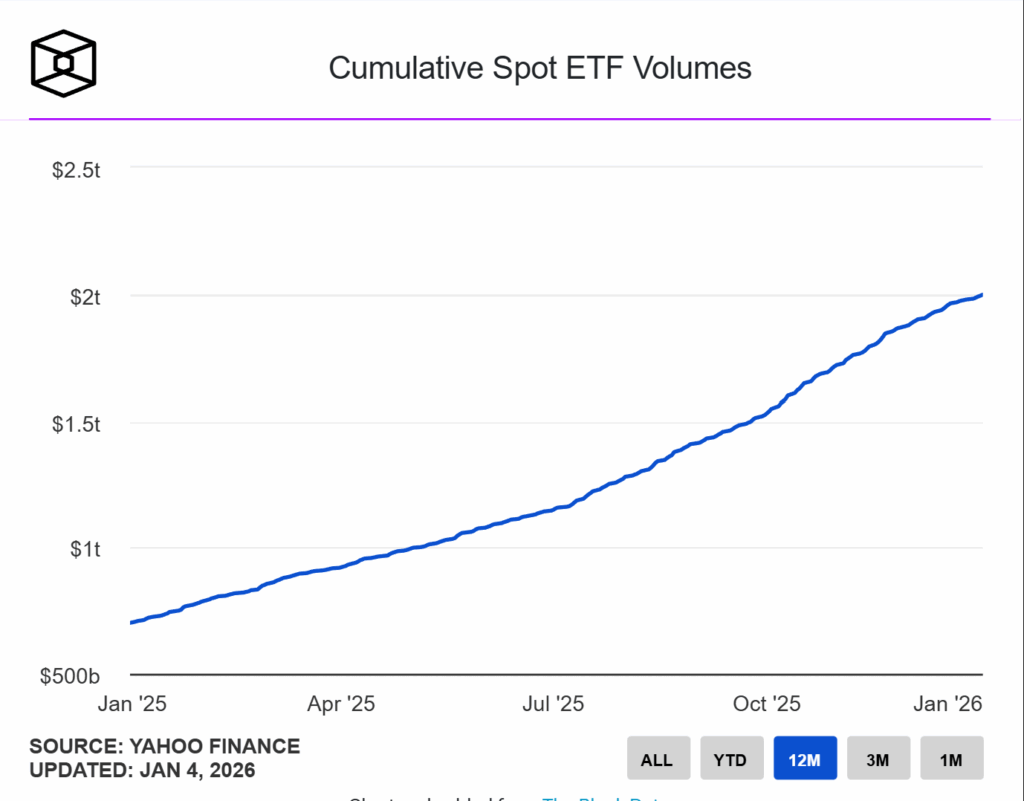
The market crossed the $2 trillion cumulative volume mark on January 2, 2026, according to The Block’s data dashboard, after taking only eight months to move from $1 trillion to $2 trillion. The first trillion in trading volume needed about sixteen months from the January 2024 debut, which shows how the second phase of spot crypto ETF trading accelerated as more products came to market and secondary liquidity deepened. This expansion also reflects steady primary flows. By the end of 2025, Bitcoin ETFs had drawn about $21.8 billion in net inflows, while Ethereum ETFs added roughly $9.8 billion, even though the final two months of the year saw record redemptions of about $4.57 billion from Bitcoin products. Investors reduced risk into year-end but kept using spot crypto ETF trading as their main regulated gateway, which set the stage for a strong shift back into net inflows at the very start of 2026. On December 31, Bitcoin ETFs saw outflows of around $348 million; only two trading days later, the tone changed completely. On January 2, the first trading day of 2026, U.S. Bitcoin and Ethereum spot ETFs together attracted about $645.6 million in net inflows, reversing the late-December retreat and confirming that institutions still rely on these products for directional exposure and balance-sheet positioning. That single day of activity illustrates how quickly capital can move through spot crypto ETF trading when sentiment stabilises after a period of pressure.
Accelerating growth in spot crypto ETF trading after SEC reforms
The growth spurt from mid-2025 onward sits closely linked to a key regulatory change. In September 2025, the U.S. Securities and Exchange Commission approved generic listing standards for commodity-based trust shares, which cover many crypto products. The new framework allows exchanges to list qualifying spot ETFs without the lengthy 19b-4 process, cutting the maximum timeline from around 240 days to as little as about 75 days in some cases. That decision opened the door to a broader second wave of spot crypto ETF trading and reduced the uncertainty that previously surrounded each filing. After the rule change, issuers launched new spot ETFs tracking Solana, XRP, Dogecoin, Litecoin, Hedera and Chainlink, expanding the menu beyond Bitcoin and Ethereum. XRP products have stood out inside this new group. Since their November 13 launch, U.S. spot XRP ETFs have attracted roughly $1.2 billion in net inflows and have so far avoided any day of net outflows, a pattern that shows how investors now treat altcoin exposure inside the same regulated wrapper that Bitcoin pioneered. As more tickers join the market, spot crypto ETF trading no longer describes a niche around one or two assets; it now spans a small but growing basket of large-cap tokens that meet the SEC’s criteria. Bloomberg Intelligence analyst James Seyffart notes that at least 126 additional crypto ETF filings are pending, covering new single-asset products and more complex baskets. If only a portion of these reach the market, competition for volume and assets will intensify, and the structure of spot crypto ETF trading may move from a Bitcoin-centric landscape to a more diversified mix in which liquidity fragments across several chains. At the same time, Seyffart warns that the end of 2026 could bring closures for under-subscribed funds that fail to gather durable assets, which would represent the first real consolidation phase for this segment.
Bitcoin and Ethereum flows highlight spot crypto ETF trading demand
The early-2026 flow picture shows how central these vehicles have become for Bitcoin and Ethereum price discovery. On January 2, spot Bitcoin ETFs recorded about $471.1 million in net inflows, with all twelve listed funds posting positive numbers. BlackRock’s iShares Bitcoin Trust, IBIT, led with around $287.4 million, followed by Fidelity’s FBTC at about $88.1 million and Bitwise’s BITB at roughly $41.5 million. Total Bitcoin ETF assets now sit near $117 billion, which represents about 6.53% of Bitcoin’s market capitalisation, giving spot crypto ETF trading a visible influence on circulating supply and secondary liquidity. IBIT remains the dominant player, with more than $66 billion in assets under management and around 70% of trading volume, down from about 80% at its mid-2025 peak but still a clear lead over rivals. Such concentration means that a handful of large funds currently anchor most spot crypto ETF trading in Bitcoin, although smaller issuers still benefit from the shared ecosystem of authorised participants, market makers and arbitrage strategies that operate across the whole group. Ethereum’s ETF complex has begun to close some of the gap. On the same January 2 session, spot Ethereum ETFs added about $174.4 million in net inflows. Grayscale’s ETHE drew roughly $53.7 million, the Grayscale Ethereum Mini Trust took in $50 million, and BlackRock’s ETHA collected about $47.2 million. Combined Ethereum ETF assets now total around $19.1 billion, or about 5.06% of Ethereum’s market cap, which signals that spot crypto ETF trading already channels a meaningful share of institutional demand for ETH, even though Bitcoin still takes the larger share of flows. The combined $645.6 million in first-day inflows for Bitcoin and Ethereum funds stands out not only for its size but also because it followed a period of stress. On December 31, Bitcoin ETFs saw about $348 million in outflows, and the final two months of 2025 together produced a record $4.57 billion in redemptions. The sharp swing back into net buying at the start of 2026 shows that institutions still view these products as tactical tools rather than as one-way trades, and that spot crypto ETF trading can move quickly from defence to accumulation when market conditions change.
Altcoin ETF expansion and the next phase of the market
Beyond Bitcoin and Ethereum, the arrival of Solana, XRP, Dogecoin, Litecoin, Hedera and Chainlink ETFs points toward a gradual widening of the investable universe inside U.S. brokerage accounts. Early data suggests that XRP products lead this altcoin cohort so far, yet even modest volumes in Solana or Chainlink funds matter because they build price histories, support new derivatives, and encourage research coverage. Each new listing adds another strand to spot crypto ETF trading and helps move more of the digital-asset cycle into regulated venues where traditional risk systems can track exposure. At the same time, the wave of pending filings means the market may soon test its capacity to absorb so many tickers. Analysts expect some overlap between proposed products, especially where issuers target similar baskets or themes, and investors will likely concentrate activity in a limited set of liquid names. Over the next eighteen to twenty-four months, spot crypto ETF trading may divide into a core layer of high-volume Bitcoin and Ethereum funds, a second layer of selective altcoin products that gain scale, and a long tail of smaller ETFs that will need either strong differentiation or patient sponsors to survive.
Conclusion
The passage from zero to $2 trillion in cumulative volume in under two years shows how deeply U.S. investors have integrated spot crypto ETF trading into their normal toolkit. Bitcoin and Ethereum still anchor the space, drawing tens of billions of dollars in annual net inflows and controlling most assets, while a new generation of altcoin ETFs tests how far regulated demand can spread beyond the two largest chains. Regulatory reforms that shortened approval windows, together with a dense pipeline of more than one hundred pending filings, suggest that the product set will continue to expand before it eventually consolidates. As that process unfolds, the structure and scale of spot crypto ETF trading will remain one of the clearest indicators of how digital assets fit into the wider capital markets.
Disclaimer
The information provided in this article is for informational purposes only and should not be considered financial advice. The article does not offer sufficient information to make investment decisions, nor does it constitute an offer, recommendation, or solicitation to buy or sell any financial instrument. The content is opinion of the author and does not reflect any view or suggestion or any kind of advise from CryptoNewsBytes.com. The author declares he does not hold any of the above mentioned tokens or received any incentive from any company.
Featured image created by AI


Subscribe To Our Newsletter
Join our mailing list to receive the latest news and updates from our team.