
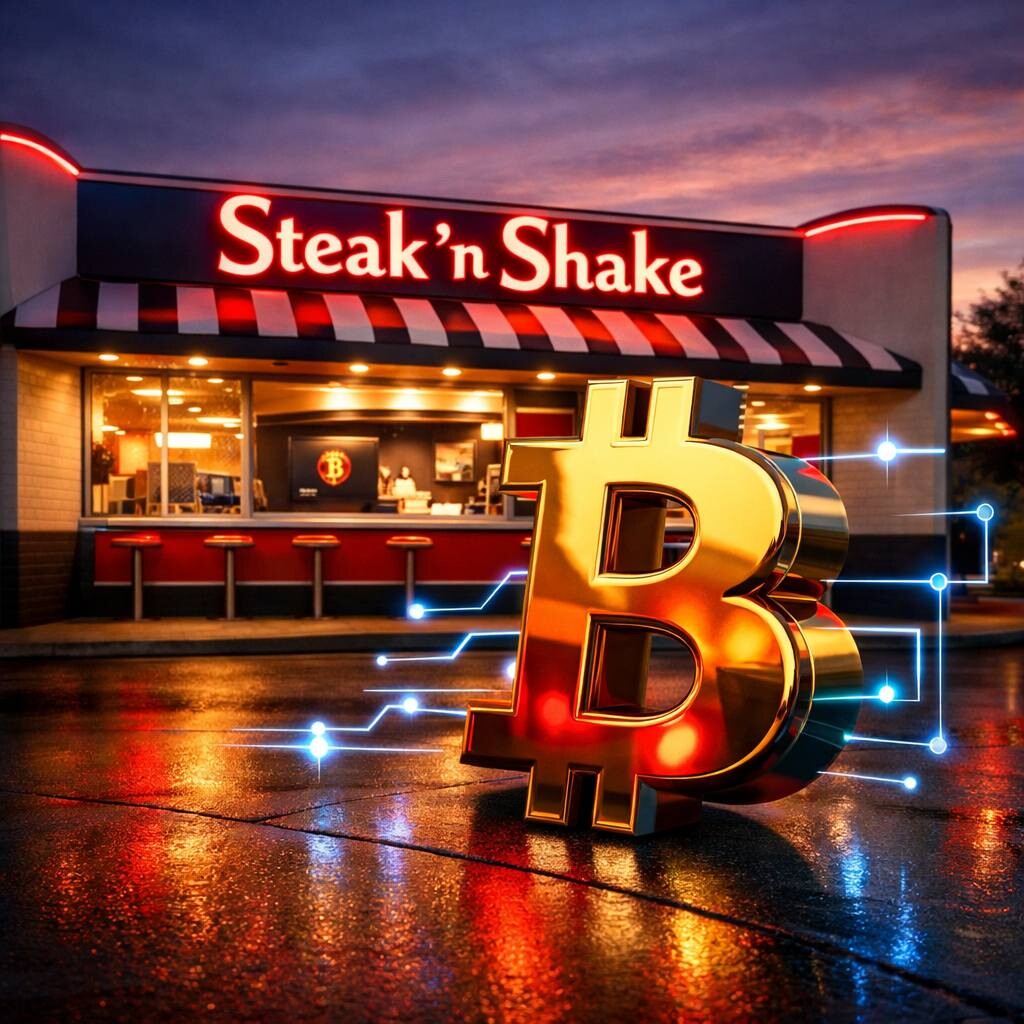
- Steak ‘n Shake invested $10 million in Bitcoin for its reserve, began Lightning payments in May 2025, and reports same-store sales rose over the last eight months.
- Digital asset treasuries reached 263 companies in 2025; Steak ‘n Shake keeps customer-paid BTC on its balance sheet and links reserve growth to same-store sales.
Steak ‘n Shake has stepped into the center of the digital asset conversation after revealing a fresh $10 million allocation to Bitcoin as part of its growing strategic reserve, signaling a clear shift in how the burger chain approaches both treasury management and customer payments in 2025. The move follows a broader transformation that began when the company started accepting Bitcoin through the Lightning Network, tying its restaurant operations to the evolving digital asset treasuries trend and reshaping how a traditional US burger franchise positions itself in a changing financial and technology landscape.
Steak ‘n Shake Bitcoin reserve strategy and 2025 treasury pivot
In early 2025, Steak ‘n Shake began reshaping its balance sheet by adding Bitcoin to a strategic reserve that now includes a fresh $10 million allocation, turning what was once a conventional restaurant treasury into a hybrid model that blends cash flows from burger sales with digital asset exposure. The company described this approach as a “self-sustaining system,” linking growing same-store sales directly to growth in its Bitcoin reserve and implying that every increase in restaurant performance now carries a parallel financial impact on its digital holdings. By making this explicit connection between operational success and crypto accumulation, the franchise framed its treasury not only as a storage of value but as an active extension of its restaurant business model. The chain, based in Indianapolis, Indiana, presented this pivot as part of a broader quality and brand upgrade, noting that improvements in food quality expand the reach of Steak ‘n Shake while Bitcoin adds a new financial dimension to that reach.
The implication is that the restaurant does not treat cryptocurrency as a passing experiment or marketing stunt but as a structural change in how it stores and potentially grows the value generated by burgers, fries, and shakes. This strategy mirrors a growing list of companies that now hold Bitcoin on their books, but it carries a distinct twist by tying the reserve directly to same-store sales performance rather than just surplus corporate cash. Friday’s disclosure of the $10 million buy marks the first time Steak ‘n Shake publicly confirmed a direct Bitcoin acquisition since it embraced a more comprehensive crypto strategy in 2025, differentiating this announcement from prior payment-related updates. The company previously stated that any Bitcoin it received through customer payments would remain on the balance sheet, but until now it had not detailed a discrete treasury purchase on this scale, placing the number in clear view for both customers and observers tracking corporate crypto exposure. By anchoring the announcement to a specific figure, the franchise signals an intent to be taken seriously among businesses with digital asset treasuries while still operating firmly within the restaurant sector.
Steak ‘n Shake Lightning Network adoption and Bitcoin payment growth
Steak ‘n Shake first integrated Bitcoin payments into its operations in May 2025, using the Lightning Network as the core technology layer to enable fast, low-cost digital transactions for in-store and possibly online orders. The Lightning Network, which sits on top of the main Bitcoin blockchain, allows customers to pay for meals in seconds while avoiding the higher fees and slower confirmation times associated with on-chain transactions, making it more suitable for everyday purchases like burgers and shakes. This technical choice demonstrates that the franchise did not simply enable basic wallet payments but instead selected an infrastructure specifically designed for small, frequent purchases that match the restaurant’s business model. Eight months after launching this Bitcoin payment option, Steak ‘n Shake reported that same-store sales had risen dramatically, suggesting that the crypto integration may have contributed to stronger performance, although the company did not break down the exact share of revenue coming from digital asset payments. The chain framed the period from May 2025 to the present as a “burger-to-Bitcoin transformation,” presenting the change as an ongoing shift rather than a one-time upgrade, and linking operational metrics like sales directly with innovation initiatives like Lightning-based payments. While some of that sales growth could overlap with broader economic or brand trends, the company’s own messaging highlights Bitcoin acceptance as a key part of the story. Despite its emphasis on rapid growth, Steak ‘n Shake has not publicly disclosed how much Bitcoin it has collected from customers since May 2025, leaving the total volume of payment-derived holdings unknown even as it confirms a distinct $10 million treasury purchase. This lack of detail creates a separation between two types of exposure: one from direct purchases on the open market and another from ongoing payment flows settling in Bitcoin and held on the balance sheet. By committing to store all payment-derived Bitcoin instead of immediately converting it to cash, the chain effectively turns every customer who pays with crypto into a small contributor to its digital treasury, with Lightning acting as the conduit between point-of-sale activity and long-term reserves.
Digital asset treasuries (DATs), corporate adoption, and Steak ‘n Shake position
The 2025 restaurant pivot at Steak ‘n Shake did not occur in isolation, because that same year digital asset treasuries became a mainstream concept across public and private companies seeking alternatives to traditional cash-heavy balance sheets. According to data from BitcoinTreasories.net, there are currently 263 companies holding Bitcoin in their treasuries, reflecting a clear shift in how corporate leaders think about inflation, currency risk, and long-term asset allocation. While software firms, fintech groups, and investment entities dominate much of the conversation, the entrance of a US burger restaurant franchise into this space signals that the idea has moved beyond purely technology-focused sectors. The digital asset treasury model gained prominence after Michael Saylor, co-founder of Strategy (formerly MicroStrategy), converted his then relatively quiet Nasdaq-listed software business into one of the largest corporate Bitcoin holders beginning in 2020, turning a niche strategy into a widely discussed corporate playbook. Under this approach, a company allocates part of its cash reserves to Bitcoin or other digital assets with the goal of delivering better long-term value to shareholders than it might achieve by holding depreciating fiat currency, especially in periods of elevated inflation or low yield on cash instruments. Proponents argue that when a business continues to generate operating cash flow while its digital holdings potentially appreciate over time, the net effect can amplify overall equity value beyond what a traditional cash-based treasury could deliver. Steak ‘n Shake, as a private company, adapts this framework by applying it to restaurant cash flows rather than software licensing or technology services, holding Bitcoin with the expectation that it will appreciate over time compared with dollars kept in traditional bank accounts. This introduces new opportunities and new risks, because the restaurant’s performance now connects not just to food costs, labor, and customer demand, but also to the volatility of Bitcoin’s market price. Critics of the digital asset treasury model warn that when Bitcoin’s price falls sharply, companies may face balance sheet hits that overshadow any theoretical inflation hedge, raising questions about whether such strategies remain sustainable across full market cycles. Supporters counter that firms like Steak ‘n Shake are not speculating blindly but integrating Bitcoin into a broader operational narrative that includes payment acceptance, brand positioning, and a message targeted at customers who follow digital assets closely. In this view, the burger chain stands at the intersection of everyday consumer spending and emerging financial infrastructure, using its strategic Bitcoin reserve to send a signal about long-term conviction while also experimenting with new ways to attract and retain customers. The combination of a $10 million allocation, ongoing Lightning Network payments, and a public commitment to hold received Bitcoin on the balance sheet creates a coherent structure that aligns with the wider 2025 trend of companies building explicit digital asset treasuries.
Bitcoin as everyday money, and the broader payment landscape
Bitcoin originally emerged in 2009 as a peer-to-peer electronic cash system designed to remove intermediaries like banks from online payments, yet after more than a decade, relatively few retailers have adopted it as a regular payment method. Against that backdrop, Steak ‘n Shake stands out as a rare US restaurant chain that not only accepts Bitcoin but also integrates it into long-term treasury planning, making the link between the original vision of everyday crypto payments and modern corporate strategies. By handling orders over the Lightning Network, the chain attempts to address one of the key obstacles that long limited Bitcoin’s use at the point of sale: slow settlement and high on-chain fees that did not fit low-margin, high-volume businesses such as fast-casual restaurants. This approach aligns with the broader argument advanced by figures like Jack Dorsey, co-founder of Twitter and CEO of Block, whose Square and Cash App products support Bitcoin-related features and emphasize the importance of using the cryptocurrency in real transactions rather than holding it solely as a store of value. Dorsey has repeatedly stated that for Bitcoin to succeed in the long run, people need to use it like cash, and each restaurant or merchant that accepts it brings the network one small step closer to that goal. Steak ‘n Shake, by tying its same-store sales narrative to its burger-to-Bitcoin transformation, becomes a concrete example of how a traditional consumer brand can participate in this effort while still focusing on everyday meals and service quality. At the same time, the company’s strategy raises practical questions about customer demand, regulatory oversight, and long-term price volatility, because Bitcoin payments and holdings must operate within tax rules, accounting standards, and evolving policy frameworks that differ across jurisdictions. The chain has not published detailed breakdowns of how many customers choose to pay with Bitcoin, how that payment mix compares with card or cash transactions, or how it hedges against short-term price swings in its reserves. Nevertheless, the decision to add a clear $10 million allocation to its strategic Bitcoin reserve while publicly linking sales performance to digital asset growth suggests that Steak ‘n Shake intends to remain visible in this space and continue exploring how a restaurant can integrate cryptocurrency into both daily operations and long-horizon balance sheet planning.
Conclusion
Steak ‘n Shake has moved beyond simple experimentation by combining a $10 million Bitcoin purchase, ongoing Lightning Network payment acceptance since May 2025, and a policy of keeping received Bitcoin on its balance sheet, weaving digital assets into both its operational story and its treasury strategy. The company’s claim that same-store sales have risen dramatically over the eight months since it embraced its burger-to-Bitcoin transformation connects customer demand, menu quality, and digital asset accumulation in a single narrative that fits within the wider 2025 boom in digital asset treasuries, where 263 companies already hold Bitcoin according to public data. Although critics highlight the risks of relying on a volatile asset and question the long-term sustainability of such models when Bitcoin prices drop, the Indy-based chain continues to position itself as a visible example of how a traditional restaurant can join the evolving conversation about Bitcoin as everyday money and as a component of corporate reserves.
Disclaimer
The information provided in this article is for informational purposes only and should not be considered financial advice. The article does not offer sufficient information to make investment decisions, nor does it constitute an offer, recommendation, or solicitation to buy or sell any financial instrument. The content is opinion of the author and does not reflect any view or suggestion or any kind of advise from CryptoNewsBytes.com. The author declares he does not hold any of the above mentioned tokens or received any incentive from any company.
Featured image created by AI


Subscribe To Our Newsletter
Join our mailing list to receive the latest news and updates from our team.