

During its infancy, Bitcoin’s price action did not follow traditional markets. However, the increased interest from investors has paved the way for an apparent correlation between Bitcoin (BTC) and stocks. This has led to a situation where Bitcoin and other cryptocurrencies have become more closely tied to the fluctuations of the broader economy, although the extent of this correlation is still a matter of debate among investors and analysts.
But there is a theory that BTC will eventually decouple from traditional markets. Some analysts are even saying that is it underway. The top crypto asset’s decoupling from traditional markets is significant news because it suggests that Bitcoin is becoming a more mature and independent asset class that is less affected by external economic factors.
The SPX and Bitcoin Correlation
The Bitcoin price chart is usually compared with the Standard and Poor’s 500 (S&P 500) or SPX. It is a stock market index that tracks the performance of the 500 largest publicly traded companies in the United States. It is a barometer of the overall health of the US economy and is closely monitored by investors and analysts. The SPX is calculated using a market capitalization-weighted methodology, which means that companies with a larger market capitalization have a greater impact on the index’s performance.
Bitcoin is also often compared to the NASDAQ, DXY (US Dollar Index), and sometimes to Gold, but this article will concentrate on the S&P 500.
How do we track the Correlation Between Assets?
The correlation between two assets can be measured. This article will stick to the correlation coefficient method. The correlation coefficient is a statistical measure that shows how closely two variables are related to each other. It ranges from -1 to 1, with -1 indicating a perfect negative correlation, 0 indicating no correlation, and 1 indicating a perfect positive correlation. In simple words, the nearer the value is to 1, the more correlated the two different assets are, which in our case are Bitcoin and SPX.

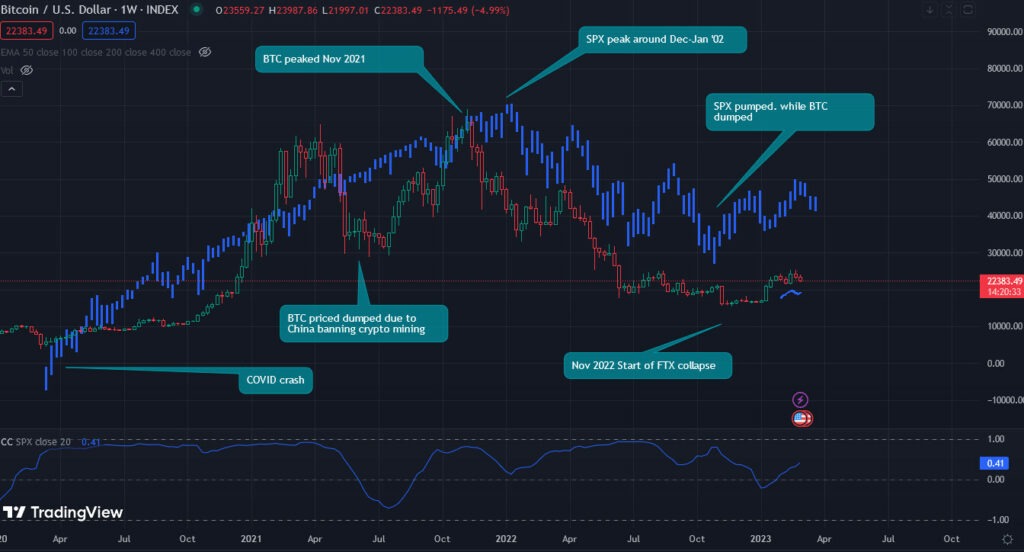
The chart above might be a little bit overwhelming at first, but let us enumerate the components.
- It shows a weekly Bitcoin candle chart.
- The blue candles are the superimposed weekly SPX chart.
- The indicator at the bottom is the correlation coefficient
- The chart has several comments explaining certain price actions.
- The chart only shows a fraction of the BTC and SPX timeline. It is only showing the beginning of the COVID crash up to the time of writing.
Let us look at the correlation coefficient first. Upon closer inspection, there are only two instances wherein BTC deviated strongly from the SPX chart. The first is the 4th week of July 2021. During this time, BTC went down due to China banning crypto mining. The SPX rallied during the same period. The correlation coefficient was -0.72, which indicates a strong negative correlation.
The second deviation happened in the first week of January. It had a correlation coefficient of -0.22. This period marks the tail end of the FTX collapse and the start of the Silvergate FUD. The SPX also rallied while BTC and the crypto market dumped.
What Affects Bitcoin’s Price?
It is easy to say that Bitcoin follows the price of traditional markets like stocks, but what is behind this correlation? The table below is from Investopedia. It shows factors that affect the prices of assets.

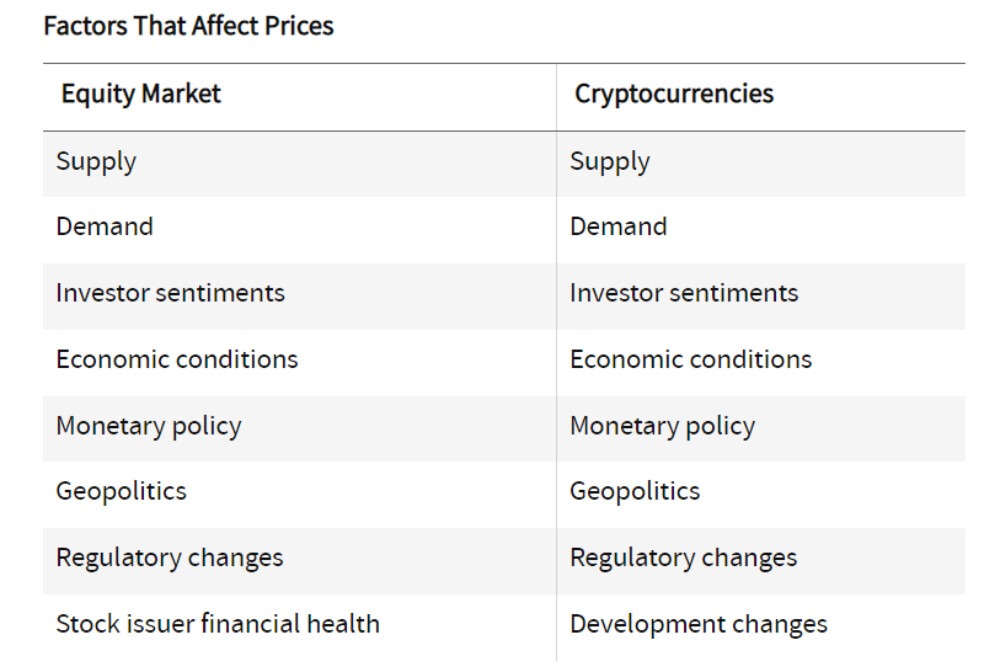
- The first factor is the supply or scarcity of the asset. Bitcoin has a maximum supply of 21 million. Minting will stop once this number is reached. This puts BTC as a scarce asset.
- Demand refers to the amount of a particular asset that buyers are willing and able to purchase at a given price, based on factors such as the asset’s perceived value, availability, and market conditions. Bitcoin is seen as a store of value similar to gold. The demand is driven by investors betting that it will increase its value as time goes by.
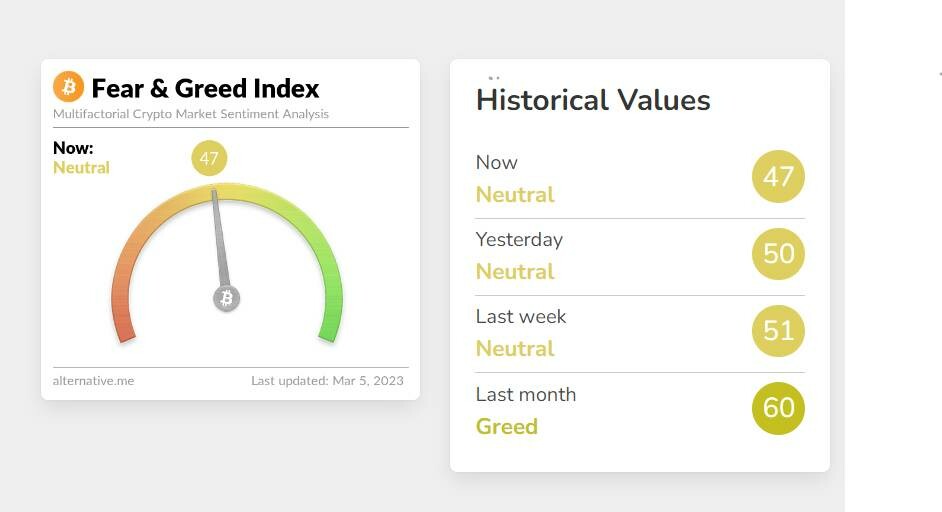
- Sentiment is the overall attitude investors have toward a particular asset or market, which can influence their buying and selling decisions. This is usually measured by the fear and greed index. BTC and Traditional markets have separate fear and greed indexes. The Relative Strength Index (RSI) is also used to gauge market sentiment.

- Economic conditions such as interest rates, inflation, and GDP growth affect market prices by influencing investors’ perception of the future of assets like stocks, crypto, and commodities. The expected economic slowdown caused by the COVID pandemic harmed market prices.
- Monetary policy refers to the actions taken by central banks to manage the supply of money and interest rates. When central banks lower interest rates, it becomes easier and cheaper for individuals and businesses to borrow money, leading to increased spending and investment. This will translate to an increase in the value of stocks and other assets. Higher interest rates will have the opposite effect, leading to less money being spent on investments and assets.
- Geopolitical events such as wars and trade conflicts can affect the supply and demand of certain assets, which can impact their prices. For example, the war in Ukraine affected the prices of several commodities. War can also increase the demand for digital assets like Bitcoin because it cannot be confiscated and is portable.
- Bitcoin and the whole crypto is no stranger to regulations. Prices of digital assets dive whenever stricter rules are to be implemented. China’s ban on crypto mining had a negative effect on BTC’s price.
- At its core blockchain is software. Any change in development will have an impact on its price. Hard forks and upgrades are usually monitored closely by investors since they could cause price volatility.
Is Bitcoin Following SPX or Something Else?
The charts are showing that there is indeed some correlation between BTC’s and SPX’s price movement. The correlation is not 100% but close enough to see that they follow the same path most of the time. But is this correlation caused by Bitcoin being led by the traditional markets or something bigger? Let us analyze the BTC-SPX above.
- Both BTC and SPX dropped in value during the beginning of the COVID Pandemic in March 2020. This event is considered to be a black swan event.
- BTC and SPX steadily gained value until China announced regulatory and mining restrictions for crypto. The middle part of 2021 saw BTC saw a 50% retracement from a local high of around 65k. The SPX was unaffected and continued its rise. The correlation coefficient for the two reached a low of -0.72, which indicates that their price movements are going in opposite directions.
- BTC reached its 69k all-time high on November 2021. The SPX reached its peak about a month later.
- FTX started its implosion in November 2022. This started a chain of events that affected the crypto industry. Silvergate, considered to be the bank of crypto institutions, was eventually dragged into the mess by January 2023. The FUD surrounding the crypto market plunged Bitcoin’s price to below 16k. The SPX, seemingly unaffected, had a mini-rally. The correlation coefficient wasn’t too low but still registered a negative 0.22.
With the information above, we can see that Bitcoin’s price is greatly affected by non-SPX factors, which include investor sentiments, economic conditions, and regulations. So instead of saying that Bitcoin follows the SPX, it might be more accurate to say that both BTC and SPX follow broader economic conditions; they are both affected by government policies and general market sentiments, which are influenced by geopolitics, monetary policies, and other economic conditions. Bitcoin deviates from the correlation whenever there is a crypto-specific event.
Follow the Money
The market is a game of observing where the money is going. The direction is usually dictated by monetary policies as a response to several factors. A geopolitical event like a war usually results in disruption to the supply chain of several commodities. A disruption in the supply of oil and gas alone is enough to affect other products since everything relies on energy.
When the supply of goods is interrupted, it is expected that the demand will outstrip the demand which will result in inflation or higher prices. Inflation is controlled by increasing interest rates to prevent the economy from overheating. Higher interest makes borrowing expensive which in turn slows down economic activities. This in turn will leave lesser money flowing to stocks and to riskier assets like crypto.
When interest rates are higher, it becomes more attractive for investors to hold government securities, bonds, and cash, because they can earn a higher return on their investment compared to other options, such as stocks or real estate.
Will Bitcoin Decouple from the Traditional Market?
Bitcoin and the SPX correlation is due to broader economic factors that both markets follow. While crypto-specific events can impact Bitcoin alone, the two markets are largely influenced by regulatory policies, general market sentiment, geopolitics, and other economic conditions.
There is a possibility of decoupling between BTC and traditional markets, where the digital asset becomes a hedge against market volatility, similar to gold and bonds. This has been the prediction of the crypto community for the longest time. Nobody knows when this will happen, however, it would represent a significant shift in how Bitcoin is perceived by investors and the general public.
If Bitcoin becomes more widely accepted as a hedge against market volatility, it could lead to increased investment and adoption. On the other hand, if Bitcoin fails to establish itself as a viable hedge against market volatility, it could face increased instability as investors shift their attention elsewhere. Ultimately, the relationship between Bitcoin and the broader market is complex and dynamic and will continue to be shaped by a range of economic, political, and social factors.
_____
Featured Image from Unplash / Chart made with TradingView


Subscribe To Our Newsletter
Join our mailing list to receive the latest news and updates from our team.