
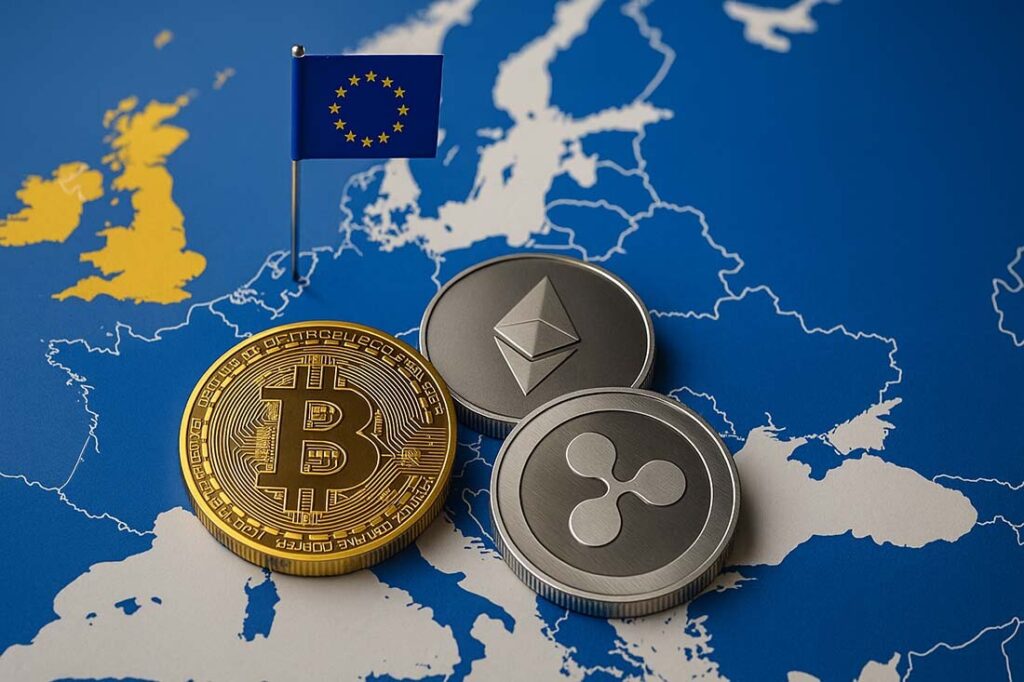
- EU may shift oversight of exchanges, crypto, and clearing to ESMA
- Smaller states object over loss of national control
- MiCA alignment and new roles on tapes and ESG ratings
The European Union is preparing a shift in how it supervises financial markets, with ESMA crypto supervision expected to play a larger role. Under new proposals, oversight of exchanges, crypto companies, and clearing houses could move from national regulators to ESMA. This change aims to streamline rules, improve cross-border efficiency, and address the uneven implementation of crypto regulation. While countries like Malta and Luxembourg oppose the plan, EU leaders say the move is necessary to reduce fragmentation and support Europe’s capital goals. ESMA’s evolving mandate now includes key roles in crypto, ESG ratings, and market data infrastructure.
ESMA crypto supervision and the case for a single center
Verena Ross has outlined a plan in which the Commission would reassign supervision of key cross-border entities to ESMA, aiming to lift market consistency and cut duplicated effort across 27 national authorities. ESMA began operations in 2011, and many core market activities still sit with national supervisors, so centralizing tasks that operate across borders is presented as a pragmatic next step rather than a wholesale power grab. The policy logic rests on speed, clarity, and costs: one team at EU level can set expectations once, gather the right specialists once, and monitor risks with one lens, instead of rebuilding the same capabilities 27 times.
A major driver behind ESMA crypto supervision is the uneven rollout of the Markets in Crypto-Assets framework. MiCA entered into force with phased application, and national authorities began licensing crypto-asset service providers under the new regime from late 2024. ESMA’s July peer review of Malta’s first authorisations found that some risk areas were not fully assessed during the licensing process, which highlighted passporting risks when one member state’s decision opens access across the bloc. The findings did not brand Malta inadequate, yet they underscored gaps that a central supervisor could close more quickly.
Mario Draghi’s 2024 report framed this shift in broader capital-markets terms, recommending that ESMA evolve from a coordinator into a common supervisor for the bloc’s securities markets, similar in scope to the U.S. SEC. That recommendation places crypto oversight within a coherent strategy to grow Europe’s capital base, simplify cross-border issuance, and improve the supervision of infrastructure that already operates beyond national lines.
Fragmentation, 27 supervisors, and the MiCA test
The EU has long sought deeper capital-markets union, yet divergent market structures and national preferences have slowed progress. Under MiCA’s phased application, national competent authorities have issued early licences at different speeds, which created a practical test for consistency and a real-world stress-check for ESMA crypto supervision. ESMA’s review work and Q&A output aim to align approaches, but the agency itself has argued that duplicating new crypto expertise across every national supervisor is inefficient when the market for services and risks is borderless by design.
The Commission has signalled openness to centralising supervision for the most significant cross-border entities, and the new Commissioner for Financial Services, Maria Luís Albuquerque, has discussed governance changes that would be needed if powers shift. Those remarks indicate that the institutional groundwork is in motion rather than hypothetical. The policy line is straightforward: start with the largest, most cross-border actors, where divergence bites hardest and economies of scale in supervision are clearest.
Pushback from smaller states and licensing realities
Centralisation meets resistance. Smaller financial centres argue that removing primary oversight from national agencies would add bureaucracy and reduce responsiveness to local market specifics. Luxembourg’s supervisor, Claude Marx, warned that turning ESMA into the main supervisor for all EU funds would create a “monster,” capturing the fear that large, distant oversight could become blunt. Malta’s authority has also opposed centralising crypto supervision under ESMA, even as it engages with MiCA alignment efforts at home. These objections ensure that negotiations will likely focus on scope boundaries, phasing, and clear lines between ESMA’s direct remit and national roles.
ESMA crypto supervision remains linked to the passporting mechanics that sit at the heart of EU financial law. When one authority authorises a firm, access expands across the single market. If initial checks vary, trust across borders can erode. ESMA’s Malta review, prompted after national licences began on 30 December 2024, illustrated how a single outlier can raise questions for all. The review recommended tighter assessments of governance, conflicts, IT, and unregulated activities that firms promote alongside regulated services. National agencies keep their frontline role under MiCA today, but pressure is building to concentrate supervision where divergence creates the greatest spillovers.
ESMA crypto supervision in a wider mandate: tapes, ratings, and third-party risks
The conversation does not end at crypto. ESMA’s mandate is already expanding in ways that illustrate how central supervision can work for cross-border infrastructure. From mid-2026, ESMA will authorise and supervise Consolidated Tape Providers for shares, ETFs, and bonds, and it will also oversee ESG rating providers and external reviewers under the European Green Bond framework. These duties build a spine of EU-level oversight for data, ratings, and core plumbing that serve every market. The bond tape timeline may slip toward late 2026 or 2027 due to complex authorisation steps, but the supervisory direction is set. ESMA and fellow EU authorities will also, for the first time, jointly oversee critical third-party providers under the Digital Operational Resilience Act.
Policy signals from Brussels track that same logic. The Commission has floated transferring supervisory powers to ESMA for the most significant cross-border entities, explicitly including stock exchanges, crypto companies, and central counterparties, while also noting that ESMA’s governance and decision-making would need to adapt. That message aligns with Draghi’s blueprint and with the lived challenges of MiCA’s first year of application, where national processes sometimes move at different speeds and apply different risk lenses. ESMA crypto supervision would slot into this broader package so that markets which operate cross-border get supervision on the same plane.
Conclusion
The near-term path points to a staged approach, with ESMA crypto supervision focusing first on the most cross-border and systemically important players while national authorities continue day-to-day licensing under MiCA. The case for centralisation cites 27 separate build-outs of new teams, the July review of Malta’s authorisation practices, and the need to create a results-based framework that does not fragment risk controls across the single market. Resistance from smaller states will shape the scope and phasing, yet the EU has already handed ESMA direct roles on consolidated tapes, ESG ratings, and third-party risk oversight, which shows how EU-level supervision can work when activity spans borders. If the Commission’s proposal advances, expect a focused package that targets exchanges, central counterparties, and large crypto groups first, with clear governance adjustments and measured timelines that respect national input while reducing divergence where it matters most.
Disclaimer
The information provided in this article is for informational purposes only and should not be considered financial advice. The article does not offer sufficient information to make investment decisions, nor does it constitute an offer, recommendation, or solicitation to buy or sell any financial instrument. The content is opinion of the author and does not reflect any view or suggestion or any kind of advise from CryptoNewsBytes.com. The author declares he does not hold any of the above mentioned tokens or received any incentive from any company.
featured image created by AI


Subscribe To Our Newsletter
Join our mailing list to receive the latest news and updates from our team.