
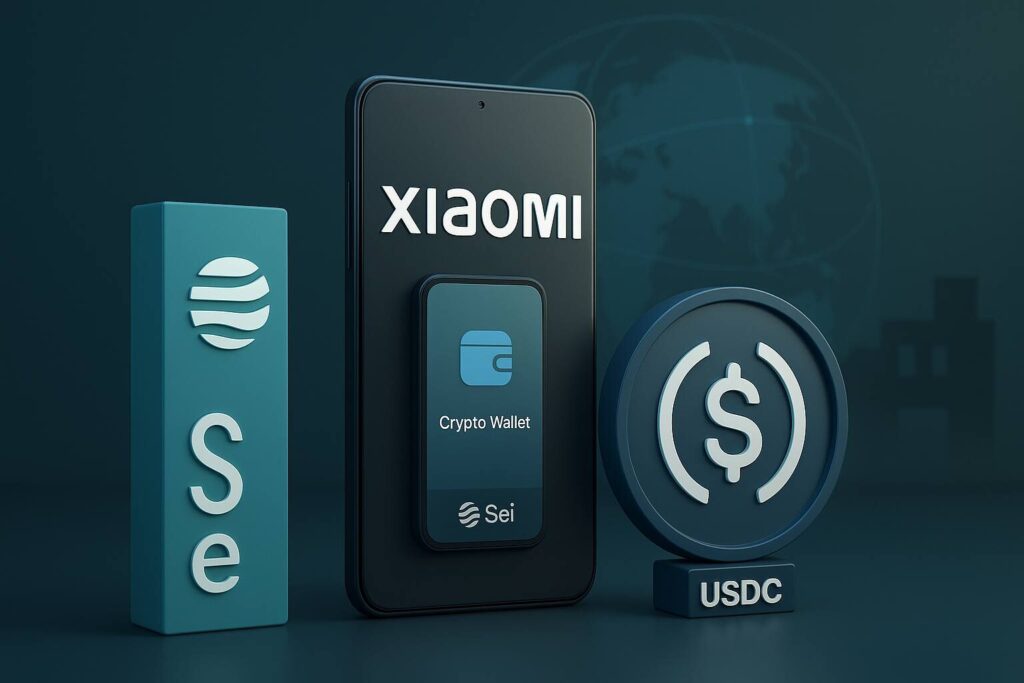
- Xiaomi works with Sei to add a crypto wallet on new phones
- Users can send transfers and access selected decentralized apps
- Stablecoin payments in Xiaomi stores are planned from 2026
Xiaomi and high performance blockchain Sei have set out a plan to ship a pre installed crypto wallet and discovery application on new smartphones sold across major markets outside mainland China and the United States, positioning the handset maker as a direct entry point to digital assets for millions of users. The rollout leans on annual sales of 168 million smartphones in 2024 and a 13 percent global market share, rankings that keep Xiaomi among the top three manufacturers worldwide by volume.By combining that scale with Sei’s infrastructure, which settles transactions in under 400 milliseconds and can process thousands of transfers per second, the partners aim to make on chain activity feel like any other mobile service rather than a specialist tool.
Xiaomi partnership with Sei brings pre installed wallet to global smartphones
The agreement between the consumer electronics group and Sei covers all new smartphones shipped outside mainland China and the United States, so a buyer in Europe, Latin America, Southeast Asia or Africa will find a next generation crypto wallet and Web3 discovery app already installed when the device first powers on. Instead of asking new users to search an app store, decide which wallet to trust and then manage seed phrases, the software sits inside the Xiaomi environment from day one and integrates with existing Google and Xiaomi ID accounts to streamline onboarding. Sei supplies the underlying blockchain layer with sub 400 millisecond finality, meaning most payments and transfers should confirm in a time frame that feels similar to a conventional mobile payment, while throughput in the thousands of transactions per second leaves headroom for retail scale usage rather than niche trading volumes. The wallet will not only hold balances but also function as a discovery surface for decentralised applications, presenting a curated set of services rather than a raw protocol list, so the user sees something closer to a familiar app hub than a developer dashboard. Within that single entry point, people can send peer to peer transfers, pay merchants in supported regions and connect to DeFi or other on chain tools, while benefiting from multi party computation based wallet security that spreads signing authority across multiple components and reduces single device risk, an approach designed to meet mainstream expectations of safety on a Xiaomi handset. For Sei, the pre installation model bypasses the usual bottleneck of attracting crypto native users and instead links to a global smartphone base where Xiaomi already holds leadership positions in several markets and reaches households that may never have tried a blockchain product before.
How the Xiaomi wallet integration reaches key regional markets
The first phase of the initiative focuses on regions where both smartphone adoption and interest in digital assets already run high, including Europe, Latin America, Southeast Asia and Africa, areas where Xiaomi has developed strong distribution networks and local partner channels over the past decade. In Greece, the brand holds about 36.9 percent of the handset market, while in India its share stands near 24.2 percent, so a large part of the installed base in those countries could gain access to the Sei wallet through either new devices or promotional pushes to existing phones. The companies plan not only to bundle the app on fresh inventory but also to promote it to owners of earlier models via Xiaomi advertising channels, which include system notifications and in device banners, extending the reach of the rollout beyond future sales alone. Once installed, the wallet uses familiar sign in flows, so someone who already uses a Google account or a Xiaomi ID for cloud backup and theme purchases can reuse that identity instead of maintaining separate credentials for blockchain activity, which lowers friction compared with traditional seed phrase based setups that often discourage first time users. Multi party computation underpins the security architecture, splitting key material so that no single component holds the full signing power, a design that aims to keep private information off the device while still allowing fast approvals for everyday payments inside the Xiaomi interface. For users, the experience should feel similar to any other native service on the phone, with a single tap opening a screen that shows balances, transaction history and shortcuts into selected decentralised applications suited to that region, which might include remittance tools in Latin America, savings products in parts of Africa or trading venues in Southeast Asia, all running against Sei infrastructure in the background.
Stablecoin payments in a global smartphone retail network by 2026
Alongside the wallet deployment, the partners have outlined a payment roadmap that brings stablecoin usage to more than 20,000 Xiaomi stores and authorised outlets worldwide, transforming the blockchain connection from a purely digital service into a means of paying for physical goods such as smartphones, smart home devices and, in time, electric vehicles. The plan starts with Hong Kong and the European Union, where the target is to enable stablecoin payments at the point of sale by the second quarter of 2026, subject to local regulatory approvals and compliance work, before extending to other markets where requirements allow. Customers in those jurisdictions would have the option to settle purchases using stablecoins native to the Sei blockchain, including USDC, with payments routed over Sei’s high performance network rather than through card schemes, while merchants see funds arrive in a form that can be converted into local currency or held in digital form depending on policy and regulation. This approach aligns with a wider trend in which stablecoins have emerged as one of the most used crypto instruments for payments and transfers, with total supply growing by more than 18 percent during the fourth quarter of 2024 and trading volume reaching around 30 trillion dollars over that year, according to market data from Coinbase. In that context, the retail network of Xiaomi becomes a large potential venue for everyday stablecoin spending rather than speculative trading, since the stores already process regular flows of handset upgrades and accessory sales and can integrate the new option alongside familiar payment methods. The same infrastructure could later support refunds, warranty service payments or even in store financing flows, creating a loop in which funds move on chain between customers, the Xiaomi retail organisation and financial partners without leaving the digital asset environment, though those extensions still depend on local law and risk rules.
Why the Xiaomi and Sei program matters for mobile blockchain adoption
The decision to integrate Sei at the operating system level marks a shift from earlier phases of blockchain growth, where users had to discover wallets, exchanges and decentralised applications on their own and often faced long onboarding journeys before they could complete a transaction. With Xiaomi embedding a wallet and discovery layer into every new device covered by the agreement, the starting point changes from optional download to default presence, so the barrier to trying a first transfer or exploring a dApp drops to a single tap. Mobile crypto usage already shows strong momentum, with active mobile wallets reaching about 36 million by the end of 2024, yet that figure remains small compared with more than 560 million global crypto holders, which suggests a large group of people still hold assets passively rather than using them in applications; giving that population a built in wallet on a Xiaomi phone could encourage more regular interaction. The partnership also includes a five million dollar Global Mobile Innovation Program dedicated to developers who want to build consumer facing services that leverage Sei on smartphones and other connected devices, which may lead to new payment, savings, gaming or ticketing applications tuned specifically for the constraints and features of mobile hardware. For Sei, tapping into 168 million annual smartphone sales and the wider ecosystem of IoT products around each Xiaomi account means direct distribution to households rather than specialised crypto communities, helping the network compete in a crowded landscape of high throughput chains that aim to serve financial and consumer workloads. For the handset maker, the cooperation adds another element to a portfolio that already spans phones, wearables, home appliances and electric vehicles, giving users a consistent way to handle digital value across that range and opening a path for service revenues linked to blockchain activity without requiring customers to leave the familiar Xiaomi environment.
Conclusion
The collaboration between Xiaomi and Sei brings a pre installed crypto wallet and discovery app to new smartphones in markets outside mainland China and the United States, backed by a blockchain network that offers sub 400 millisecond finality and support for thousands of transactions per second. With 168 million handsets sold in 2024 and a 13 percent global market share, the handset maker provides a large distribution channel for on chain services, especially in countries such as Greece and India where its market share reaches 36.9 percent and 24.2 percent respectively. The roadmap extends beyond digital wallets to stablecoin payments across more than 20,000 retail locations, beginning in Hong Kong and the European Union around the second quarter of 2026 and widening as regulators allow, so customers could eventually buy smartphones, smart home devices and electric vehicles using stablecoins native to Sei, including USDC. Combined with a five million dollar innovation fund focused on mobile applications, the package positions the partnership as a significant experiment in delivering blockchain functionality through the everyday devices and retail networks that users of Xiaomi already rely on.
Disclaimer
The information provided in this article is for informational purposes only and should not be considered financial advice. The article does not offer sufficient information to make investment decisions, nor does it constitute an offer, recommendation, or solicitation to buy or sell any financial instrument. The content is opinion of the author and does not reflect any view or suggestion or any kind of advise from CryptoNewsBytes.com. The author declares he does not hold any of the above mentioned tokens or received any incentive from any company.
Featured image created by AI


Subscribe To Our Newsletter
Join our mailing list to receive the latest news and updates from our team.