
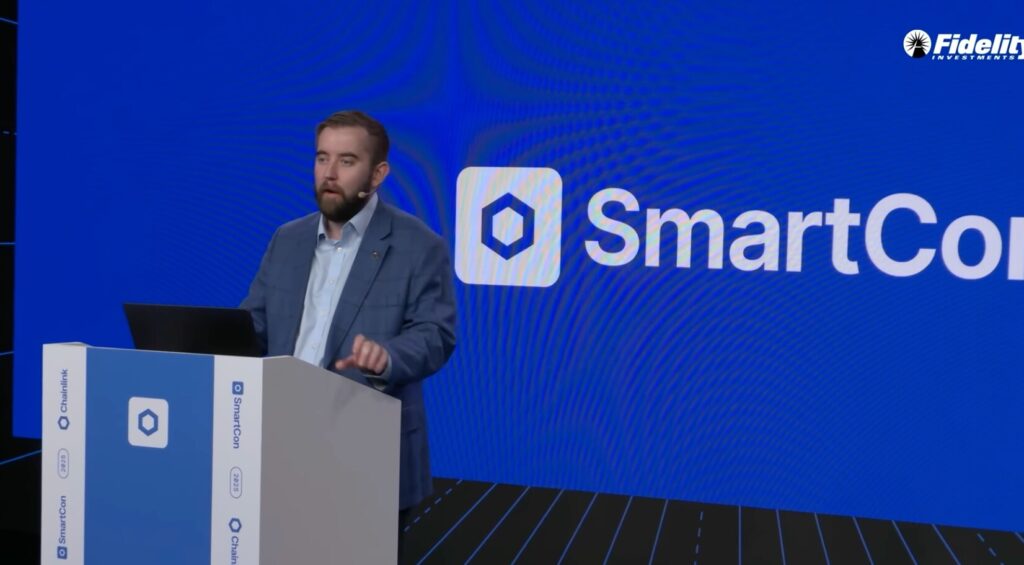
- Chainlink Unveils Runtime Environment & Confidential Compute at SmartCon 2025
- Sergey Nazarov Announces New Institutional Blockchain Infrastructure
During SmartCon 2025, Chainlink Co-Founder Sergey Nazarov delivered one of the most important keynotes in the project’s history, revealing major upgrades to the Chainlink platform designed to accelerate institutional adoption and unlock a new generation of secure, compliant, and privacy-preserving blockchain applications.
The two major announcements were:
✅ Chainlink Runtime Environment (CRE/CRA) — a production-ready orchestration layer that allows developers to build advanced multi-chain applications using modular workflows.
✅ Chainlink Confidential Compute — technology enabling privacy-preserving computation for enterprises and regulators, removing one of the last blockers to institutional adoption.
These innovations expand Chainlink’s position as the industry-standard oracle network powering the majority of DeFi, while now enabling real-world financial infrastructure to run on-chain.
Bringing Capital Markets On-Chain
Chainlink already secures tens of trillions in transaction value and is trusted by global giants including:
- Swift
- Euroclear
- UBS
- Mastercard
- Fidelity International
- ANZ
Nazarov emphasized a mission that goes beyond DeFi speculation:
“Mainstream adoption requires collaboration between DeFi and TradFi. Value systems must work in a mathematically guaranteed way.”
By enabling institutions to tokenize assets, manage compliance, and interact across chains, Chainlink aims to bring capital markets onto public blockchains — safely.
Why Chainlink’s Reliability Matters
Nazarov highlighted real-world reliability events, including a recent AWS outage that took down many “decentralized” systems — while Chainlink remained fully operational.
Reliability remains a cornerstone of Chainlink’s adoption, particularly as institutional money demands guarantees, not best-effort uptime.
The Expanding Definition of Smart Contracts
Smart contracts are no longer:
- one chain
- one token
- one ledger
They now depend on:
- multiple blockchains
- regulatory compliance
- identity verification
- data oracles
- cross-chain messaging
- privacy requirements
This complexity required a new coordination layer — the Chainlink Runtime Environment (CRA).
Introducing the Chainlink Runtime Environment (CRA)
CRA allows developers to orchestrate:
- cross-chain transfers (via CCIP)
- identity proofs
- data feeds
- compliance checks
- API calls
- secret management
…all through structured workflows.
Previously, building these systems required months. With CRA, developers can deploy in hours.
Example use cases:
✅ Proof-of-Reserves Workflows
Preventing over-minting of stablecoins by verifying custodian data on-chain.
✅ Automated Compliance Engine (ACE)
Institutions can enforce regulatory policies on-chain — a crucial barrier to enterprise adoption.
✅ Cross-Chain Transfers
Seamlessly move regulated assets across chains using CCIP.
All of this is executed through one transparent, auditable workflow.
Digital Transfer Agent Standard Goes Live
Chainlink also introduced a new standard enabling tokenized fund management.
Benefits:
- reduced operational costs
- real-time transparency
- faster settlement
- composability with DeFi
UBS is already live in production using Chainlink infrastructure to tokenize funds — a milestone moment for real-world assets (RWAs).
Institutional Adoption Momentum
Major institutions and networks are now using CRA, CCIP, and Chainlink standards, including:
- Central banks (Brazil, Hong Kong)
- Fidelity International
- ANZ
- JPMorgan’s private chain (Kexus)
Chainlink’s orchestration allows private institutional blockchains to safely interact with public chains, finally bridging the long-anticipated TradFi-DeFi divide.
Why It Matters
More institutional assets on-chain means:
- deeper liquidity
- new yield opportunities
- greater transparency
- higher security guarantees
Nazarov argued that cryptographic guarantees offer a superior model to discretionary financial promises — eliminating failure modes like Lehman Brothers and Silicon Valley Bank.
Chainlink Fee Model & LINK Value
Chainlink uses a novel model:
- Enterprise & on-chain revenue flows into LINK
- Converted fees are stored in the Chainlink Strategic Reserve
This aligns enterprise adoption with LINK token value accrual long-term.
The Road Ahead
Chainlink is focused on three goals:
- Grow DeFi with reliable infrastructure
- Enable institutional adoption through compliance & privacy
- Make collaboration between DeFi and TradFi frictionless
With:
- the Runtime Environment
- Confidential Compute
- CCIP
- Automated Compliance Engine
- Digital Transfer Agent standard
…Chainlink is evolving from an oracle network into a global coordination layer for the tokenized economy.
Conclusion
SmartCon 2025 marks a turning point. Chainlink is no longer just the backbone of DeFi — it’s becoming the technological foundation for global capital markets.
As regulators, banks, and enterprises enter blockchain ecosystems, the demand for secure, compliant, privacy-preserving infrastructure is exploding.
Chainlink is positioning itself at the center of that transformation.


Subscribe To Our Newsletter
Join our mailing list to receive the latest news and updates from our team.