- Chainlink Unveils Runtime Environment & Confidential Compute at SmartCon 2025
- Sergey Nazarov Announces New Institutional Blockchain Infrastructure
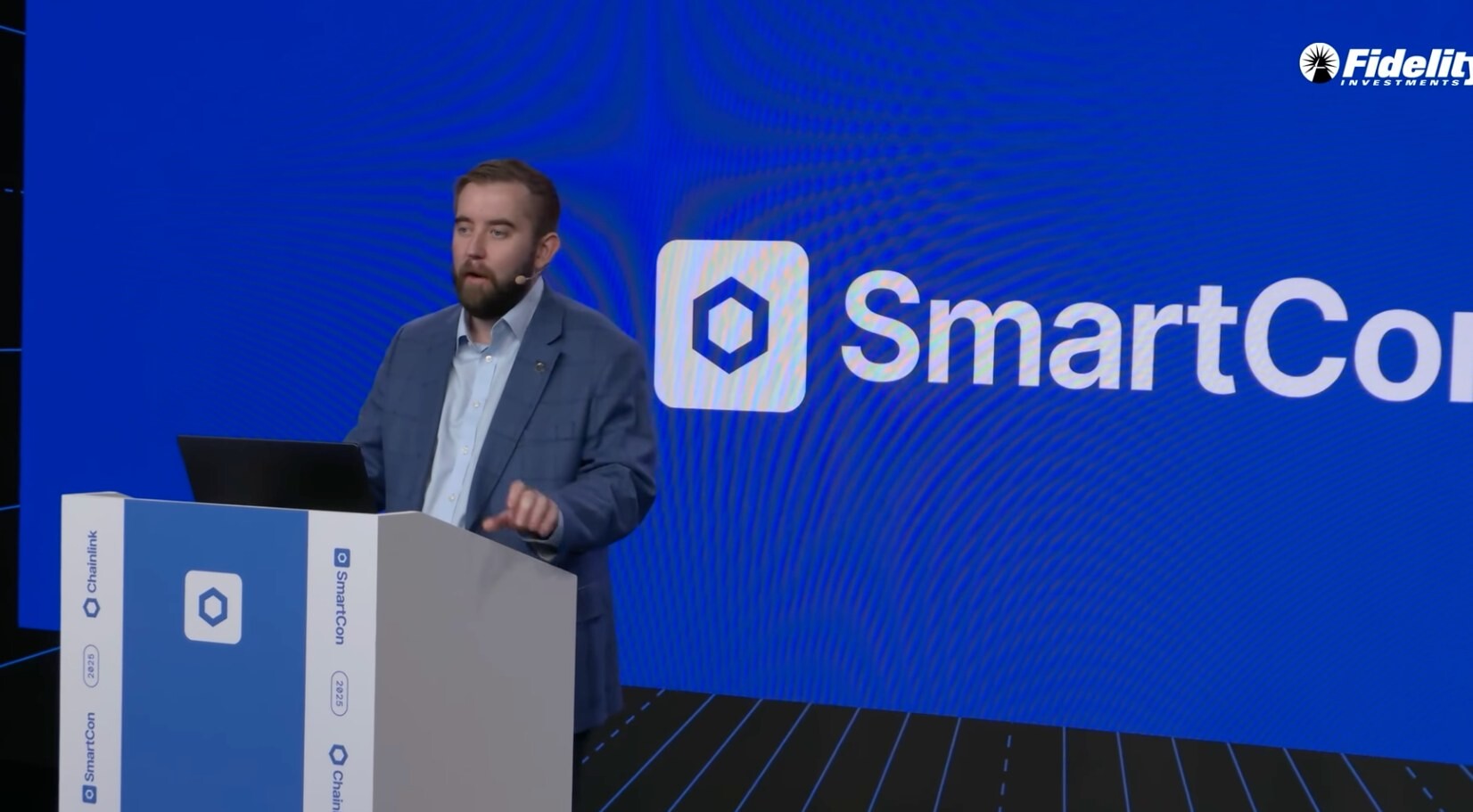
During SmartCon 2025, Chainlink Co-Founder Sergey Nazarov delivered one of the most important keynotes in the project’s history, revealing major upgrades to the Chainlink platform designed to accelerate institutional adoption and unlock a new generation of secure, compliant, and privacy-preserving blockchain applications.
The two major announcements were:
✅ Chainlink Runtime Environment (CRE/CRA) — a production-ready orchestration layer that allows developers to build advanced multi-chain applications using modular workflows.
✅ Chainlink Confidential Compute — technology enabling privacy-preserving computation for enterprises and regulators, removing one of the last blockers to institutional adoption.
These innovations expand Chainlink’s position as the industry-standard oracle network powering the majority of DeFi, while now enabling real-world financial infrastructure to run on-chain.
Bringing Capital Markets On-Chain
Chainlink already secures tens of trillions in transaction value and is trusted by global giants including:
- Swift
- Euroclear
- UBS
- Mastercard
- Fidelity International
- ANZ
Nazarov emphasized a mission that goes beyond DeFi speculation:
“Mainstream adoption requires collaboration between DeFi and TradFi. Value systems must work in a mathematically guaranteed way.”
By enabling institutions to tokenize assets, manage compliance, and interact across chains, Chainlink aims to bring capital markets onto public blockchains — safely.
Why Chainlink’s Reliability Matters
Nazarov highlighted real-world reliability events, including a recent AWS outage that took down many “decentralized” systems — while Chainlink remained fully operational.
Reliability remains a cornerstone of Chainlink’s adoption, particularly as institutional money demands guarantees, not best-effort uptime.
The Expanding Definition of Smart Contracts
Smart contracts are no longer:
- one chain
- one token
- one ledger
They now depend on:
- multiple blockchains
- regulatory compliance
- identity verification
- data oracles
- cross-chain messaging
- privacy requirements
This complexity required a new coordination layer — the Chainlink Runtime Environment (CRA).
Introducing the Chainlink Runtime Environment (CRA)
CRA allows developers to orchestrate:
- cross-chain transfers (via CCIP)
- identity proofs
- data feeds
- compliance checks
- API calls
- secret management
…all through structured workflows.
Previously, building these systems required months. With CRA, developers can deploy in hours.
Example use cases:
✅ Proof-of-Reserves Workflows
Preventing over-minting of stablecoins by verifying custodian data on-chain.
✅ Automated Compliance Engine (ACE)
Institutions can enforce regulatory policies on-chain — a crucial barrier to enterprise adoption.
✅ Cross-Chain Transfers
Seamlessly move regulated assets across chains using CCIP.
All of this is executed through one transparent, auditable workflow.
Digital Transfer Agent Standard Goes Live
Chainlink also introduced a new standard enabling tokenized fund management.
Benefits:
- reduced operational costs
- real-time transparency
- faster settlement
- composability with DeFi
UBS is already live in production using Chainlink infrastructure to tokenize funds — a milestone moment for real-world assets (RWAs).
Institutional Adoption Momentum
Major institutions and networks are now using CRA, CCIP, and Chainlink standards, including:
- Central banks (Brazil, Hong Kong)
- Fidelity International
- ANZ
- JPMorgan’s private chain (Kexus)
Chainlink’s orchestration allows private institutional blockchains to safely interact with public chains, finally bridging the long-anticipated TradFi-DeFi divide.
Why It Matters
More institutional assets on-chain means:
- deeper liquidity
- new yield opportunities
- greater transparency
- higher security guarantees
Nazarov argued that cryptographic guarantees offer a superior model to discretionary financial promises — eliminating failure modes like Lehman Brothers and Silicon Valley Bank.
Chainlink Fee Model & LINK Value
Chainlink uses a novel model:
- Enterprise & on-chain revenue flows into LINK
- Converted fees are stored in the Chainlink Strategic Reserve
This aligns enterprise adoption with LINK token value accrual long-term.
The Road Ahead
Chainlink is focused on three goals:
- Grow DeFi with reliable infrastructure
- Enable institutional adoption through compliance & privacy
- Make collaboration between DeFi and TradFi frictionless
With:
- the Runtime Environment
- Confidential Compute
- CCIP
- Automated Compliance Engine
- Digital Transfer Agent standard
…Chainlink is evolving from an oracle network into a global coordination layer for the tokenized economy.
Conclusion
SmartCon 2025 marks a turning point. Chainlink is no longer just the backbone of DeFi — it’s becoming the technological foundation for global capital markets.
As regulators, banks, and enterprises enter blockchain ecosystems, the demand for secure, compliant, privacy-preserving infrastructure is exploding.
Chainlink is positioning itself at the center of that transformation.