

- The article explains how the GENIUS Act created federal rules for dollar stablecoins and set conditions for banks and non-bank issuers.
- It also covers updated ETF standards, changes at the SEC, and what these steps may mean for crypto use in 2026.
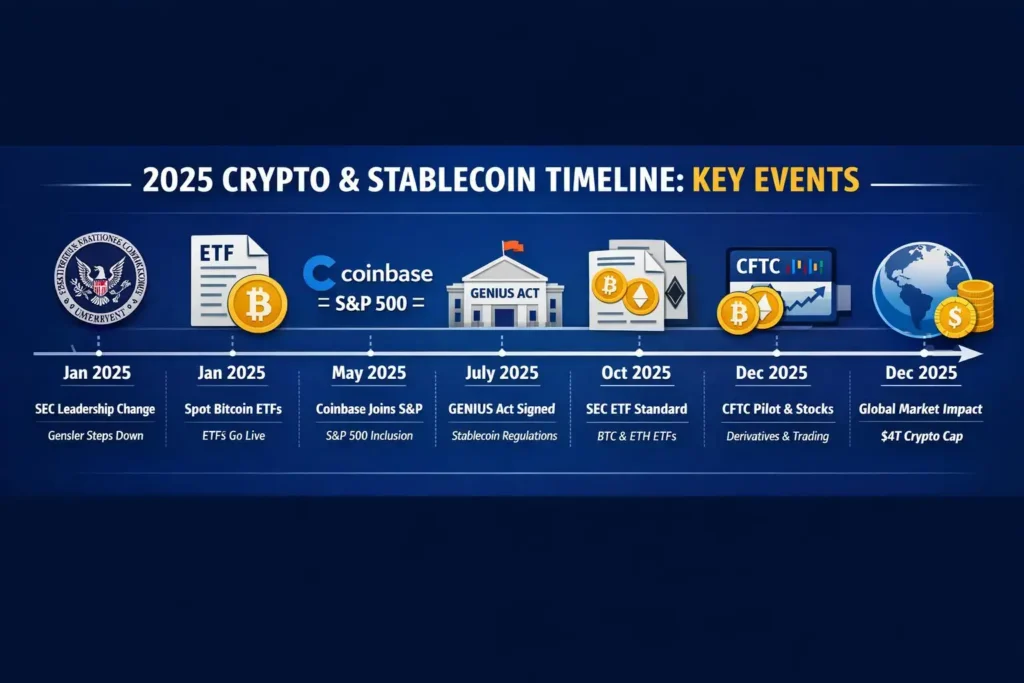
US Crypto Regulation entered a new phase in 2025, when lawmakers finally moved from vague guidance to a concrete rulebook that targeted stablecoins, market structure, and exchange-traded products. For years, the United States relied on enforcement and speeches, while capital and developers experimented in a gray zone that mixed banking, securities, and commodities law. That approach changed on July 18, 2025, when President Donald Trump signed the Guiding and Establishing National Innovation for U.S. Stablecoins Act, known as the GENIUS Act, and turned stablecoin policy into statute. The shift did not trigger an immediate surge in asset prices, yet it altered how banks, payment companies, and crypto firms design products, manage reserves, and access traditional finance. Before the new framework, large dollar-linked tokens operated with uneven reserves and limited disclosure. The collapse of TerraUSD in 2022 exposed how fragile some structures were when backing assets or redemption promises failed under stress. Against that backdrop, Congress chose to treat payment stablecoins as a distinct category of financial instrument instead of trying to stretch old rules. The result now shapes how issuers hold collateral, how supervisors review risk, and how investors think about the role of tokenized dollars in the wider system.
GENIUS Act and the new era of US Crypto Regulation
The GENIUS Act created the first federal statute focused on payment stablecoins, ending years of uncertainty about their legal status and prudential treatment. Lawmakers introduced the bill in the Senate as S.1582 in May 2025, sent it through committee, and passed it on the Senate floor with a 68–30 bipartisan vote. The House then approved the measure 308–122 on July 17, 2025, one day before the White House signing ceremony. That process took stablecoins from guidance documents and policy speeches into the United States Code. At the heart of the statute lies a strict reserve regime. Issuers of payment stablecoins must back their tokens one-for-one with high-quality liquid assets, such as short-term U.S. Treasury bills and cash deposits, rather than a mix of risky instruments. The law also requires monthly public reports on reserve composition and annual audits, closing the disclosure gaps that previously allowed doubts about solvency and redemption capacity to build during market stress. These requirements reflect lessons from earlier failures and aim to align tokenized dollars with other regulated forms of money-like liabilities. US Crypto Regulation under the GENIUS Act does more than tighten collateral rules. It defines who may issue payment stablecoins by limiting that role to insured depository institutions, non-bank firms chartered by the Office of the Comptroller of the Currency, and certain state-regulated entities that meet federal standards Those issuers must implement full anti-money-laundering and know-your-customer programs under the Bank Secrecy Act, which pulls stablecoin operations into the same compliance perimeter as banks and major payment processors. The law also excludes compliant payment stablecoins from the federal definitions of “security” and “commodity,” creating a distinct category that sits alongside, rather than inside, securities and derivatives law. Supporters see this structure as a way to give stablecoins a clear role inside the dollar system without turning them into traditional deposits. Critics argue that the law gives too much freedom to large issuers and big technology platforms, while leaving open questions about consumer safeguards in extreme scenarios. Consumer advocates warn that stablecoin holders lack federal deposit insurance and direct access to the Federal Reserve, even if issuers follow strict reserve rules, and they highlight the risk that failures could still transmit stress into funding markets that hold Treasury collateral. The debate now focuses less on whether such tokens can exist and more on how they interact with banking, payments, and monetary policy. By the end of 2025, the stablecoin sector operated in a different environment than just a few years earlier. Market data showed dollar-backed stablecoins reaching around 250 billion dollars in combined market capitalization and accounting for more than 30 percent of on-chain transaction volume, as traders, remittance users, and decentralized finance protocols leaned on tokenized dollars for settlement. While those figures fluctuate with demand, they underline how US Crypto Regulation in 2025 shifted stablecoins from a fringe instrument to a recognized part of the market’s plumbing.
How US Crypto Regulation reshaped stablecoin issuers and banking
Once the GENIUS Act became law, banks and payment companies had to decide whether to enter the stablecoin market under the new conditions or to rely on third-party issuers. Large financial institutions began to design token strategies that matched their balance sheet structure and risk appetite, while technology firms weighed the cost of obtaining a license against the benefit of issuing their own tokens. The law allowed insured banks to issue payment stablecoins through subsidiaries and to engage in related activities, subject to new application and supervision procedures that the Federal Deposit Insurance Corporation started to implement through proposed rules in late 2025. That process opened a path for regulated bank-issued tokens that function alongside existing deposit products. Non-bank issuers also adjusted their models. One project aligned with Tether launched “Stable,” a dedicated settlement chain that raised 28 million dollars in funding and used USDT as its native gas token. The design aimed to reduce fee volatility and congestion by separating stablecoin transfers from general-purpose smart contract traffic, while still keeping a familiar unit of account. Another example came in August 2025, when Circle introduced Arc, an enterprise-focused Layer-1 chain tailored for regulated payments, foreign-exchange flows, and tokenized markets that run on USDC. These initiatives show how US Crypto Regulation pushed issuers toward purpose-built infrastructure that can satisfy both compliance teams and operations staff. The new rules changed the incentives around reserve management and disclosure. Under earlier practices, some issuers held a mix of commercial paper, corporate bonds, and other assets that could become illiquid during stress, leaving traders unsure about redemption quality. With the GENIUS Act in force, issuers that want to operate at scale inside the United States must treat reserves more like money market fund portfolios, with short maturities and high liquidity, and publish regular breakdowns of holdings. That structure increases transparency but also ties stablecoin growth more tightly to the supply of safe assets, particularly Treasury bills, which Treasury officials see as a feature rather than a bug. US Crypto Regulation also influences how foreign stablecoin providers access the American market. The statute sets conditions for non-U.S. issuers that want to serve U.S. customers, including custody and safekeeping requirements and clear expectations for cooperation with U.S. supervisors. As a result, several overseas firms have reconsidered their licensing strategy, choosing either to localize part of their operations or to focus on jurisdictions such as the European Union, Singapore, and the United Kingdom, which have moved ahead with their own frameworks. The interaction between the GENIUS Act and regimes like the EU’s Markets in Crypto-Assets Regulation will shape cross-border use of stablecoins in the coming years. For banks, the question is not only whether to issue their own tokens, but also how to integrate stablecoins from third parties into payment flows, custody services, and client portfolios. Some institutions now test tokenized cash for intraday liquidity management and cross-border settlement, using on-chain transfers to shorten settlement cycles and reduce reconciliation costs. Others focus on client demand for token custody, on-chain collateral management, and access to decentralized protocols through regulated interfaces. In each case, US Crypto Regulation sets the boundary conditions for what supervisors expect around risk control, reporting, and consumer protection.
ETFs, market structure and institutional entry after 2025
Stablecoins were not the only area reshaped by US Crypto Regulation in 2025. Exchange-traded products tied to digital assets benefited from clearer standards as the Securities and Exchange Commission refined its approach, especially after leadership changes at the top of the agency. Former Chair Gary Gensler stepped down in January 2025, after years of relying on enforcement actions and cautious guidance. Acting Chair Mark Uyeda and then the new Chair, Paul Atkins, signaled a move toward rules-based oversight and a more predictable review process for both tokens and products that reference them. That change set the stage for wider institutional use of exchange-traded funds. By October 2025, the SEC placed spot Bitcoin and Ethereum exchange-traded funds under a generic listing standard, which allowed exchanges to list and trade them using the same core rule set applied to many other commodity-style products. This decision reduced the need for one-off exemptive relief and detailed product-by-product negotiations. It also made it easier for broker-dealers and platforms that serve retirement accounts or wealth management clients to add these products to their shelves. Soon after, spot ETFs linked to Solana, XRP, and Litecoin appeared late in 2025, broadening the set of large-cap assets available through traditional brokerage channels.

US Crypto Regulation in the ETF space did not remove all questions, but it gave institutions a clearer framework for due diligence. Asset managers now must evaluate market integrity, custody arrangements, and pricing mechanisms within a known regulatory template, rather than guessing how the SEC might treat each new filing. That shift has already changed flows into digital asset products, even if total asset levels still move with market sentiment and macro conditions. For corporate treasurers, pensions, and endowments, the availability of regulated, exchange-listed exposure offers a way to test digital asset strategies without building on-chain operations from scratch. This regulatory clarity arrived while spot markets behaved more cautiously than in earlier cycles. Bitcoin and Ethereum did not repeat the explosive rallies of prior bull runs during late 2025, despite easier access through ETFs and clearer rules for stablecoins. Investors balanced the new infrastructure against macro factors such as interest rates, growth expectations, and risk appetite. As a result, many institutions chose staged allocations and pilot programs rather than rapid, large-scale entry. The relationship between policy progress and price action remains complex, but the direction of US Crypto Regulation now supports, rather than blocks, participation.
Political debates, oversight shifts and what 2026 may bring
No major change in US Crypto Regulation arrives without political debate, and 2025 proved no exception. Representative Maxine Waters and other critics argued that the GENIUS Act tilted too far toward industry interests, calling it a gift to “crypto billionaires” and warning about systemic risks if stablecoins grew without stronger consumer safeguards. They expressed concern that big technology companies and large platforms could leverage tokenized dollars to expand their reach in payments, lending, and data collection, while ordinary users carried the downside of potential failures.Supporters countered that the law simply recognized an existing reality and pulled it into a supervised framework. They pointed out that dollar-linked tokens already moved large volumes of value around the world, often with less oversight than money transfer firms or prepaid cards, and that detailed rules for reserves, audits, and licensing improved both transparency and accountability. For them, US Crypto Regulation in 2025 represented a shift from enforcement by headline to oversight by statute and rulemaking, with room for adjustments as regulators and lawmakers observed how the market evolved. Alongside the GENIUS Act, the House advanced the Digital Asset Market Clarity Act, which sought to draw a clearer line between the jurisdiction of the Securities and Exchange Commission and the Commodity Futures Trading Commission over different categories of digital tokens. That bill, together with proposals that limit the Federal Reserve’s ability to issue a central bank digital currency, signaled that Congress intended to shape the broader architecture of crypto markets, not just stablecoins. The White House added its own layer of coordination with Executive Order 14178, which created a federal “Crypto Czar” responsible for aligning policy across agencies ranging from Treasury and the SEC to prudential bank regulators. Internationally, US Crypto Regulation now interacts with other regimes that came into force around the same time. The European Union continued phasing in its Markets in Crypto-Assets framework, while jurisdictions like the United Kingdom and Singapore refined their own stablecoin and market rules. In several cases, policymakers explicitly referenced the GENIUS Act when designing their own approaches, either as a model or as a point of contrast. That cross-border convergence, even if incomplete, supports a future in which regulated stablecoins, tokenized funds, and exchange-traded products move more easily between markets, subject to licensing and reporting obligations. Looking ahead to 2026, the key question is how quickly the market will respond to the new environment. Stablecoins already serve as core settlement tools for trading, remittances, and decentralized finance, while ETFs give institutions convenient exposure to major assets. Tokenization of traditional instruments, such as money market funds and short-term credit, continues to grow on both public and permissioned chains. Yet many users still treat crypto as a speculative asset class rather than as everyday financial infrastructure. The pace at which US Crypto Regulation turns legal clarity into broad adoption will depend on factors ranging from interest rate paths to global competition and the success of early institutional pilots.
Conclusion
The developments of 2025 transformed the landscape of US Crypto Regulation from a patchwork of enforcement actions and policy speeches into a structured set of laws and rulemakings. The GENIUS Act introduced strict reserve, disclosure, and licensing standards for payment stablecoins, while also carving out a distinct legal category that sits between securities, commodities, and traditional deposits. At the same time, changes at the Securities and Exchange Commission and related legislation improved the path for Bitcoin, Ethereum, and other spot exchange-traded funds, giving institutions a more predictable way to access digital assets. These steps did not guarantee a particular market outcome, but they changed the foundation on which issuers, banks, and investors build. Stablecoins backed one-for-one by high-quality liquid assets and subject to regular audits now function as key rails for on-chain settlement. Bank and non-bank issuers design dedicated chains and products that meet both compliance and operational needs. Political debates about concentration, consumer protection, and systemic risk continue, yet they now operate within a clearer legal frame. As 2026 unfolds, the United States will test whether this new phase of US Crypto Regulation can support stable, transparent growth in digital finance rather than cycles driven only by speculative waves. The answer will emerge not only from statutes and rulebooks, but also from how firms implement them, how supervisors enforce them, and how users choose between tokenized and traditional forms of money and assets.
Disclaimer
The information provided in this article is for informational purposes only and should not be considered financial advice. The article does not offer sufficient information to make investment decisions, nor does it constitute an offer, recommendation, or solicitation to buy or sell any financial instrument. The content is opinion of the author and does not reflect any view or suggestion or any kind of advise from CryptoNewsBytes.com. The author declares he does not hold any of the above mentioned tokens or received any incentive from any company.
Featured image created by AI


Subscribe To Our Newsletter
Join our mailing list to receive the latest news and updates from our team.