
- Ethereum processed a record 2,885,524 transactions in a day, with activity rising since mid-December and holding near highs into early 2026.
- Fees stay near recent lows as more use shifts to layer-2, supporting higher throughput on the base chain without sharp congestion.
- The validator exit queue is at zero while entry queues remain, indicating steady staking participation and stable network operation.
Ethereum transactions have climbed to the highest levels in the network’s history, marking a new phase for the second-largest blockchain and reshaping expectations around capacity, fees, and staking behavior. Over the past weeks, on-chain data shows that daily activity has accelerated sharply, with Ethereum processing 2,885,524 transactions on a single day last week, a new all-time record for the network. This surge in Ethereum transactions comes after a quieter stretch through much of 2025 and signals renewed demand for block space as markets, applications, and layer-2 ecosystems gain momentum heading into early 2026. At the same time, average fees remain near recent lows, creating an unusual combination of record activity and relatively calm costs for users and builders across the ecosystem.
Current surge in Ethereum transactions and on-chain activity
The current spike in Ethereum transactions started to build in mid-December, when on-chain metrics began to reverse a months-long slowdown that had defined most of 2025. Instead of the gradual decline in daily counts seen earlier in the year, usage turned higher almost week by week, culminating in a record 2,885,524 transactions processed on Friday, the highest single-day total the network has ever recorded. Activity did not fade immediately after that high, and daily volumes have stayed near peak levels into early 2026, suggesting that the shift reflects more than a short-lived burst of speculative behavior.

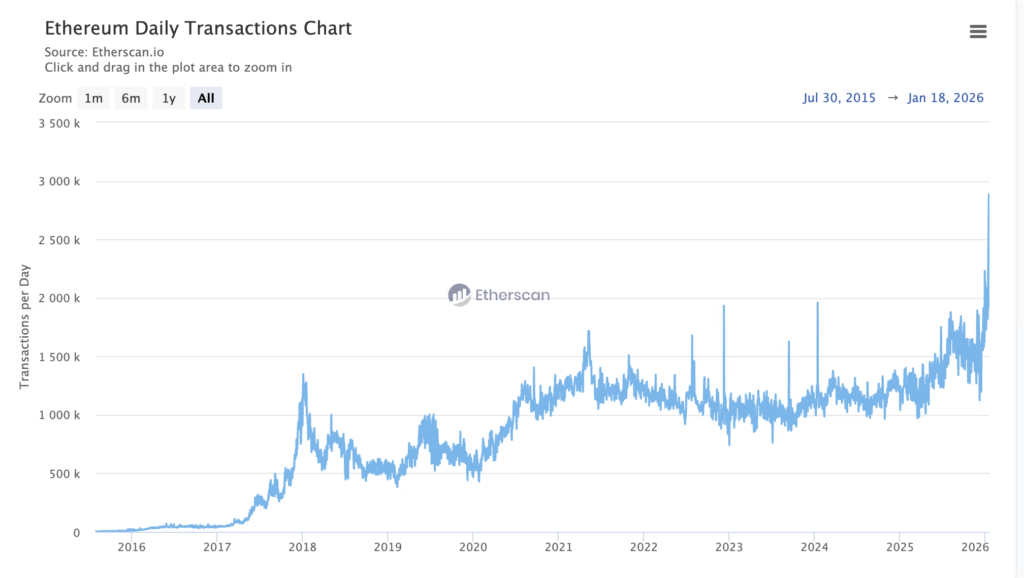
Applications across decentralized finance, NFTs, gaming, and infrastructure tools appear to contribute to the load, while bridges and rollups feed additional demand as users move assets between layer-2 networks and the Ethereum base layer. Ethereum transactions now push the protocol closer to the limits that once triggered major congestion in earlier cycles, yet the experience for everyday users looks different than during previous waves. In earlier bull phases, rapid increases in on-chain demand often translated into sharp jumps in gas prices, long wait times for confirmation, and frequent complaints from retail users priced out of simple transfers or basic DeFi interactions. This time, the network processes nearly three million transactions in a day without the same degree of visible strain, and median fees stay closer to the lows seen during quieter market periods. The data points to both structural changes in how Ethereum handles traffic and a more mature ecosystem of scaling solutions that offload some of the pressure from the main chain. The rise in Ethereum transactions also carries implications for revenue and security. Higher raw throughput typically means more fees collected at the protocol level, even when the average cost per transaction remains modest. Part of those fees still burn under EIP-1559, removing ETH from circulation and providing a counterweight to issuance. Yet the recent pattern suggests that the old narrative of “fees must spike to drive scarcity” no longer tells the full story. With efficient blocks and more consistent gas markets, Ethereum can host high activity while keeping individual transaction costs manageable, which changes how analysts think about long-term value capture and the balance between user affordability and monetary tightening.
Low fees, network upgrades, and the role of layer-2
The fact that Ethereum transactions sit near record levels while fees hover around recent lows highlights the combined impact of protocol upgrades and the rapid expansion of layer-2 scaling. Over the last years, Ethereum developers focused on optimizing block utilization, improving fee markets, and enabling rollup-centric designs that shift a large portion of execution off the base chain. EIP-1559 introduced a more predictable base fee mechanism, and subsequent improvements in client performance and block construction helped validators pack more activity into each block while maintaining stability. As a result, higher throughput no longer means automatic congestion, and the network can absorb surges of transactions more gracefully than during earlier growth phases. Layer-2 networks play an essential role in this shift. Rollups batch thousands of individual user actions into compressed data posted to Ethereum, so raw Ethereum transactions now often represent aggregated activity rather than one-to-one user interactions. When rollup operators publish proofs or data blobs, each on-chain call can encapsulate a large amount of off-chain execution, multiplying the effective capacity of the broader ecosystem. That design helps explain why Ethereum transactions reach 2,885,524 in a day without causing fee spikes similar to those seen in 2021 and 2022. More of the computational work happens on specialized L2 environments, while Ethereum focuses on security, settlement, and data availability. For users and developers, this environment changes how they plan and launch new products. Teams that once avoided deploying at times of peak Ethereum transactions now see more predictable costs and may feel more comfortable running campaigns, token launches, or protocol upgrades even when general demand is rising. At the same time, rollup architectures encourage builders to choose the right venue for their applications, directing high-frequency, low-value interactions to L2s while reserving the base chain for settlement, governance, and larger value transfers. This layered structure reduces the risk that sudden spikes in one corner of the ecosystem will immediately disrupt the entire network, contributing to the smoother experience observed during the current upswing in activity.
Staking dynamics, validator queues, and their link to Ethereum transactions
Alongside the increase in Ethereum transactions, staking metrics on the network show a notable change in behavior. On the validator side, the exit queue has fallen to zero, which means any staker who wants to stop validating and withdraw their ETH can start the process almost immediately, subject only to protocol-level churn limits. In earlier months, long exit queues sometimes signaled periods of stress or rising risk perception, especially when market conditions looked uncertain. The current absence of an exit backlog suggests that validators feel relatively comfortable with the state of the network and see little reason to leave en masse or hedge against technical or economic shocks. In contrast, the entry queue for new validators still shows a meaningful backlog, implying that demand to stake remains healthy even if it does not reach the extremes associated with a full-blown boom. Fresh participants continue to lock up ETH and join the active set, but they must wait in line as the protocol gradually adds validators at a controlled pace.

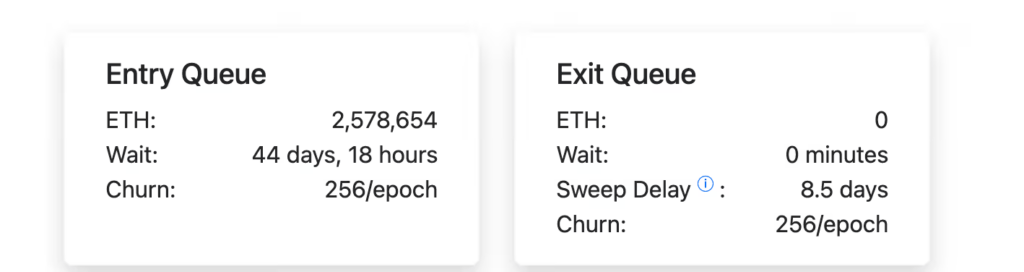
This combination of a clear entry queue and an empty exit queue points to a steady, balanced staking environment rather than a one-sided rush to either stake or withdraw. It also means that the rise in Ethereum transactions occurs against a backdrop of stable validator participation, which supports network security and helps maintain consistent performance as block demand increases. The relationship between staking behavior and Ethereum transactions also touches on the broader question of incentives. When validation remains attractive and queues behave normally, the network can handle more activity without resorting to extreme fee swings to keep validators engaged. In earlier narratives, surging fees during congestion periods were sometimes framed as a necessary feature that burned large amounts of ETH and rewarded validators for processing heavy loads. Now, with 2,885,524 transactions in a single day and fees still subdued, the chain demonstrates that it can reward validators, maintain security, and serve users without leaning on dramatic pricing shocks. That outcome supports the idea of Ethereum as a neutral, robust settlement layer that can scale economically while offering predictable conditions to both stakers and users.
What record Ethereum transactions mean for users, markets, and the next cycle
The new records in Ethereum transactions, combined with calm fee markets and steady staking, send several signals about the state of the ecosystem as it moves through the next market cycle. For everyday users, the main takeaway is practical: they can transact, trade, and interact with applications even during busy periods without facing the prohibitive costs that once defined peak activity. Transfers, swaps, and contract interactions still reflect supply and demand for block space, but the current structure keeps the experience closer to a normal operating range, even as raw transaction counts reach all-time highs. That stability could draw more long-term users who previously left during periods of severe congestion, especially when they combine Ethereum’s security with cheaper execution on layer-2 networks. For markets and analysts, the picture looks more nuanced. Record Ethereum transactions typically suggest strong engagement, but they now exist in a world where scaling tools spread that activity across multiple layers and fee dynamics no longer follow past patterns. Observers must separate raw transaction counts from effective economic throughput, rollup usage, and application-level metrics to understand what the chain’s numbers really imply for value capture. The fact that the network can process 2,885,524 transactions in a day without major disruption underscores its growing resilience, yet it also weakens simple narratives that link scarcity or price directly to congestion. Instead, attention shifts to how consistently the protocol attracts users, how much value settles on-chain over long periods, and how well the ecosystem sustains development through different market phases. At a higher level, the current environment hints at a more mature stage in Ethereum’s evolution. The base layer now serves as a foundation that can support both heavy transaction loads and sophisticated scaling systems without recurring breakdowns. Ethereum transactions still matter as a visible barometer of activity, but they tell only part of the story in a landscape defined by rollups, staking, and a modular technology stack. The challenge for the next phase lies in maintaining this balance as adoption grows, ensuring that the network continues to handle rising demand with the same smoothness seen in early 2026 while offering clear, reliable conditions for users, validators, and builders across the ecosystem.
Conclusion
Record Ethereum transactions, capped by the 2,885,524-transaction day that set a new high for the network, highlight a shift in how the protocol handles growth, demand, and security. Activity has accelerated since mid-December after a slow 2025, yet fees remain near recent lows, staking queues look stable, and validators face no exit backlog as they secure the chain. This mix shows an ecosystem that processes more transactions than ever while avoiding the bottlenecks and fee spikes that once dominated discussion. As adoption expands and layer-2 solutions continue to absorb execution, Ethereum enters a phase where rising usage no longer needs to collide with user experience, and where long-term value depends less on short bursts of congestion and more on sustained, efficient settlement of global activity.
Disclaimer
The information provided in this article is for informational purposes only and should not be considered financial advice. The article does not offer sufficient information to make investment decisions, nor does it constitute an offer, recommendation, or solicitation to buy or sell any financial instrument. The content is opinion of the author and does not reflect any view or suggestion or any kind of advise from CryptoNewsBytes.com. The author declares he does not hold any of the above mentioned tokens or received any incentive from any company.
Featured image created by AI


Subscribe To Our Newsletter
Join our mailing list to receive the latest news and updates from our team.