

- Three straight months of redemptions have pulled about $6 billion from us-listed spot bitcoin ETFs, reversing last year’s inflows
- The 12 bitcoin ETFs have shed roughly 4,595 BTC so far in 2026, while Bitcoin trades more than 37% below its October 2025 peak
Demand for us-listed spot bitcoin ETFs has shifted sharply, with the 12 active products collectively seeing $1.6 billion in net withdrawals so far this month. The reversal marks a clear break from the strong inflows that characterized the early phase of these funds after their launch in January 2024, and it comes against the backdrop of a steep decline in Bitcoin’s price from its late-2025 peak.
Prolonged Outflows Hit bitcoin ETFs
Data from SoSoValue show that spot bitcoin ETFs in the United States are now in their third consecutive month of net outflows. Over this stretch, investors have pulled around $6 billion from the 12 funds, marking the longest sustained period of redemptions since the US Securities and Exchange Commission approved them in January 2024.

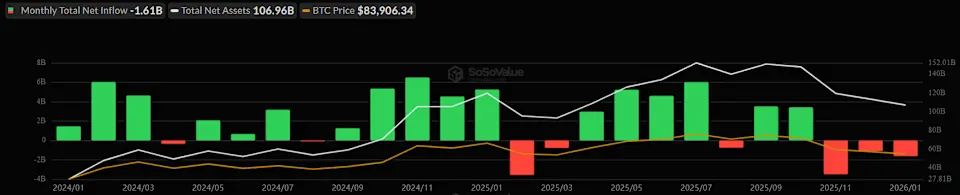
This reversal stands in sharp contrast to the rapid asset growth seen in the first year of trading. At that time, bitcoin ETFs were widely viewed as a gateway for traditional investors to gain exposure to the asset class. The recent pattern of consistent selling suggests that this phase has given way to a more cautious stance.
Market observers interpret the steady withdrawals as evidence that appetite for Bitcoin exposure through regulated funds is cooling. Instead of intermittent redemptions tied to short-term volatility, the products are now seeing prolonged and sizeable reductions in assets, pointing to a broad shift in sentiment rather than a temporary adjustment.
Investor Sentiment Turns as Price Rally Unwinds
Blockchain analytics from CryptoQuant reinforce the picture of declining demand. Since the beginning of 2026, the 12 us-listed bitcoin ETFs have shed about 4,595 BTC in aggregate. The scale of that reduction becomes more striking when compared with the same period a year earlier, when these funds attracted nearly 40,000 BTC in new inflows.
This swing from heavy buying to consistent selling underscores how quickly investor positioning has turned. Market participants link the exodus to what they describe as “narrative exhaustion,” occurring alongside Bitcoin’s weaker price performance.
Bitcoin reached an all-time high of more than $126,000 in October 2025. Since then, its price has dropped by over 37%, eroding a substantial portion of the gains tied to earlier enthusiasm around institutional engagement and regulatory milestones. For investors who entered near the top, the sustained drawdown has translated into sizable mark-to-market losses, which may be encouraging some to exit ETF positions.
Jim Bianco, founder of Bianco Research, argues that the phase of rapid institutional uptake is effectively over. He describes financial markets as discounting mechanisms that incorporate widely discussed narratives long before the underlying events fully unfold. In his view, Bitcoin’s integration into traditional finance was a key driver of a 400% advance that stretched from the first ETF-related filings in 2023 through political developments in late 2024.
Bianco characterizes the subsequent rise to $126,000 in late 2025 as a “zombie rally” sustained more by leftover momentum than by new capital flows.

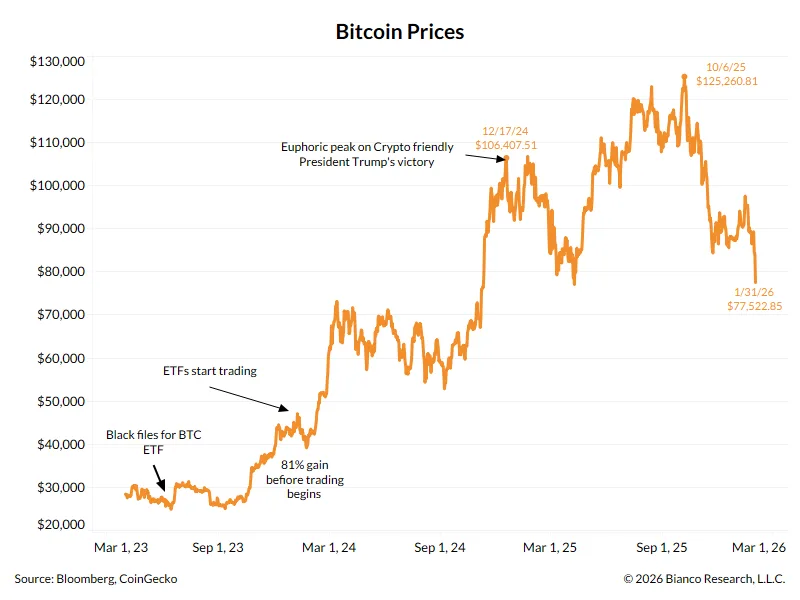
He notes that the current environment is marked by indifference to news that would previously have supported prices, including announcements of crypto-friendly appointments to important economic posts. The lack of a price response to such headlines suggests to him that the market has already fully absorbed the “adoption story.”
bitcoin ETFs Face a Maturing, More Volatile Market
As that adoption narrative loses its ability to attract new buyers, bitcoin ETFs are left operating in a market that Bianco describes as reverting to a high-volatility risk asset regime. In this setting, Bitcoin no longer gains the benefit of a powerful structural storyline to pull in incremental institutional funds, and ETF flows instead reflect shorter-term risk appetite and performance pressures.
The recent three-month stretch of net outflows signals that many holders are reassessing their exposure. With the underlying asset down more than a third from its record level, some long-term buyers may be concluding that the initial pitch of seamless institutional integration has run its course for now. Others may see the ETF structure as a convenient vehicle for trimming risk in response to changing macro conditions or portfolio constraints.
Even developments that, in earlier cycles, might have been interpreted as strong positives—such as policy shifts seen as favorable to digital assets—have not been enough to reverse the tide of selling. That lack of reaction supports the notion that earlier expectations around regulatory acceptance and mainstream access are now fully embedded in prices.
For ETF sponsors, the challenge is that a product built around a maturing narrative must now compete in an environment where investors are more focused on realized returns and volatility than on symbolic milestones. The move from strong inflows in early 2024 to net redemptions in early 2026 illustrates how quickly conditions can change when a widely anticipated theme reaches saturation.
Key takeaways
- The 12 us-listed spot bitcoin ETFs have seen $1.6 billion in net withdrawals this month.
- Outflows have persisted for three straight months, totaling about $6 billion.
- Year-to-date, the funds have lost roughly 4,595 BTC, versus inflows of nearly 40,000 BTC in the same period last year.
- Bitcoin is down more than 37% from its October 2025 high above $126,000.
- Analysts say the institutional “adoption story” is now fully priced in, leaving Bitcoin as a high-volatility risk asset.
Conclusion
The reversal in flows into us-listed spot bitcoin ETFs marks a notable turning point after the strong inflows that followed their launch in early 2024. With three months of continuous outflows, a year-to-date reduction in BTC holdings, and a significant price decline from the 2025 peak, the products now reflect a market in which the earlier adoption narrative has faded. As Bitcoin reverts to trading more like a conventional high-risk asset, ETF investors are confronting a phase defined less by structural optimism and more by the realities of a maturing, volatile market.
Disclaimer
The information provided in this article is for informational purposes only and should not be considered financial advice. The article does not offer sufficient information to make investment decisions, nor does it constitute an offer, recommendation, or solicitation to buy or sell any financial instrument. The content is opinion of the author and does not reflect any view or suggestion or any kind of advise from CryptoNewsBytes.com. The author declares he does not hold any of the above mentioned tokens or received any incentive from any company.
Featured image created by AI


Subscribe To Our Newsletter
Join our mailing list to receive the latest news and updates from our team.