

- X revised its API policy to restrict apps paying for posts; it revoked access for InfoFi tools after growth of spam and AI replies on the platform.
Nikita Bier said users should see improvement as bots stop earning, and X pushes back on decentralized reward schemes. - Kaito’s KAITO token fell about 20%, from $0.70 to $0.55, after API access loss devalued its yaps-based posting rewards on X.
Founder Yu Hu said Kaito will end Yaps and shift to Kaito Studio, while X adds smart tickers for crypto and stocks.
X API Policy has shifted again as the social network X tightens control over how third-party developers use its data and infrastructure, with the latest update targeting apps that reward users for posting. The head of product at X, Nikita Bier, announced that the platform has revoked API access for a category of projects known as InfoFi, which had grown rapidly in the cryptocurrency community by paying users for engagement.
This change follows mounting concern inside X that these reward systems drove a surge of low-value content, automated replies, and posts generated by artificial intelligence tools. By redefining X API Policy in this way, the company aims to reclaim the quality of user timelines, even as projects that relied on these incentives face immediate disruption.
X API Policy clampdown on InfoFi reward apps and spam incentives
The latest X API Policy update focuses squarely on InfoFi projects, a term used to describe applications that blend financial incentives with information production on social platforms, particularly around cryptocurrencies. Nikita Bier said the popularity of these projects brought “a tremendous amount of AI slop and reply spam” to X, as users and bots tried to maximize rewards from every post, comment, and mention. Under the new policy, X revoked API access for apps that reward users for posting, effectively cutting off the data and integration pipelines these services used to track activity and distribute incentives. Bier added that users should soon notice an improvement in their feed experience once automated systems understand they no longer earn payments for spamming replies or publishing repetitive content. This decision highlights how X API Policy now draws a firmer line between acceptable developer use and models that monetize engagement in ways the platform sees as harmful. Many InfoFi platforms required deep integration with X APIs to read timelines, track mentions, log posts, and manage reward points, which gave them significant visibility into user behavior. Once X removed these connections, entire reward systems lost their backbone, as they could no longer verify user activity or calculate earnings accurately. The move shows X prefers to keep engagement organic or at least controlled by its own features, rather than delegated to external systems that pay users for volume instead of relevance. Developers now face a new reality in which any design that directly incentivizes posting at scale risks conflict with the X API Policy and could lose access with little warning.
X API Policy decision hits Kaito token and InfoFi business models
The immediate market impact of the X API Policy change became clear when Kaito, one of the most prominent InfoFi platforms, saw its native token KAITO drop sharply. Following the announcement, KAITO fell nearly 20%, sliding from about $0.70 to roughly $0.55 in a short time window.
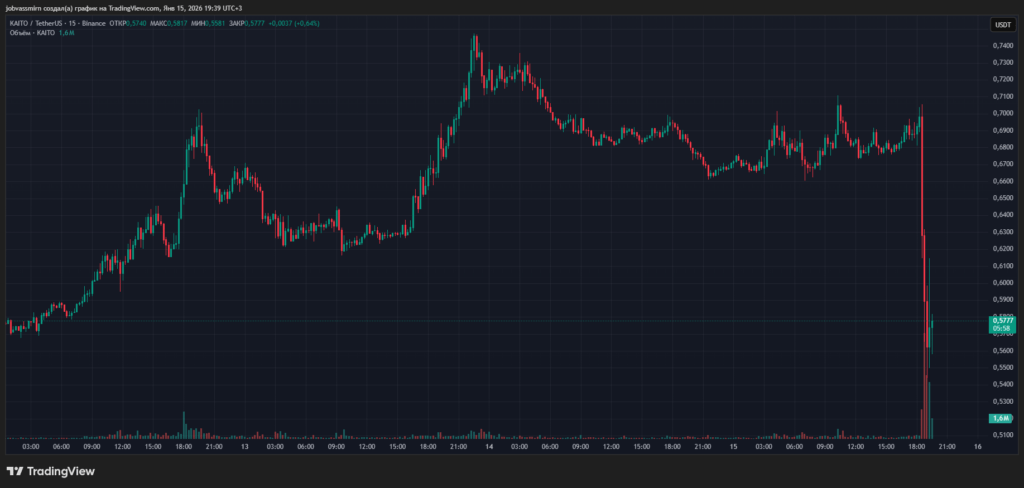
Kaito had built its model around using artificial intelligence to analyze on-chain data and social media sentiment, including content from X, and then converting user activity into a reward system. Participants could earn points, called yaps, for posts on X about cryptocurrencies, and later exchange those points for KAITO tokens. This structure depended fully on seamless API access to monitor posts and attribute engagement back to specific user accounts. When X revoked API access for apps in this category, it effectively erased the foundation for Kaito’s yap-based rewards. Without the ability to track posts in real time or link them reliably to wallets and accounts, the platform’s point system lost its value. Users suddenly held a balance of yaps that no longer mapped to on-chain incentives in a predictable way, and the market reacted by discounting the KAITO token. The X API Policy update did not name Kaito directly, yet the consequences for this project showed how quickly an InfoFi model can unravel when it depends on a third-party data source controlled by a large platform. It underlined that any token whose utility rests on continued API access to X carries a structural risk, especially when policy changes can arrive with little advance notice. In response to the change, Kaito’s founder, Yu Hu, announced that the project will abandon Yaps and other related solutions tied to direct posting incentives. Instead, the team plans to introduce a new marketing direction called Kaito Studio, which aims to reposition how the platform promotes projects and content. A representative for Kaito acknowledged the core issue that triggered X API Policy enforcement, admitting that a fully decentralized content distribution system no longer fits the needs of high-quality brands, serious content creators, or the X platform itself. That admission marks a pivot away from the earlier vision where open, incentivized posting across social channels could drive both discovery and token demand. It also sends a message to other InfoFi developers that they may need to rethink any assumption that X will allow large-scale, token-based reward schemes to run on its infrastructure.
X API Policy, spam concerns, and the end of fully decentralized distribution
The shift in X API Policy reflects a broader tension between open, decentralized content flows and the need for platforms to manage spam and maintain brand safety. InfoFi projects argued that paying users for contributions created a more participatory and data-rich ecosystem, especially in fast-moving markets like crypto. In practice, many of these systems encouraged users and automated bots to flood replies, tags, and trending topics with posts designed more to earn points than to inform or discuss. X viewed this outcome as a direct threat to content quality and user experience, leading to a more restrictive stance on how developers can tie rewards to posting behavior. By cutting their access to APIs, X removed the primary tool these apps used to coordinate campaigns and measure contributions at scale. Kaito’s statement after discussions with X gives a clear description of the new expectations. The project said the parties agreed that a fully decentralized content distribution system no longer works for X, high-quality brands, or serious creators. That line signals that X prefers centralized moderation and curation, which require control over the flows of both content and incentives. The X API Policy now supports this priority, closing the door on models that encourage users to spray content everywhere in exchange for tokens. Instead, X appears to favor features it designs internally, such as smart tickers with cryptocurrency and stock prices, which Nikita Bier introduced in January, to provide market data and engagement without handing control to external reward platforms. The addition of these tickers shows X still values financial and crypto information on the platform, but it wants that activity to occur within tools it supervises rather than through InfoFi incentives. This recalibration also reflects the needs of advertisers and institutional partners, who often hesitate to associate with feeds dominated by spam or low-effort AI content. Brands that consider X as a channel for campaigns want some assurance that their messages will not sit beside reply threads full of bot-generated posts chasing token payouts. By enforcing a tighter X API Policy, the platform sends a signal that it will protect its environment from such dynamics, even if that decision disrupts innovative but messy experiments in decentralized distribution. Developers now need to design applications that complement X’s own features and respect stricter thresholds for automation, volume, and financial incentives tied directly to posting.
Implications for developers, crypto projects, and X users
For developers, the latest evolution of X API Policy sets clearer boundaries on what types of products can integrate deeply with the platform. Apps that read data to provide analytics, sentiment dashboards, or monitoring tools still have a path forward, as long as they do not use that access to reward users for posting or to automate spam-like engagement. Projects need to examine whether their business models depend on incentivizing large numbers of low-quality interactions or on running bots that generate AI content at scale. If they fall into that category, they now face the risk of losing API access and should adapt before similar enforcement actions reach them. Building within the guidelines may require closer collaboration with X, formal agreements, or acceptance that some revenue ideas no longer fit the platform’s policy direction. Crypto projects that rely on social sentiment signals and community engagement must also adjust to this new landscape. Kaito’s experience shows that tokens linked to posting rewards on X can suffer fast price declines when policy changes remove their core utility. Future designs may favor on-chain behavior, off-chain research, or curated contribution models over raw posting volume. Developers might shift from public reward feeds to invite-only programs, private communities, or in-app tasks that do not lean on X APIs for verification. They could also explore partnerships where X-approved tools, such as smart tickers and curated data panels, provide context without turning every interaction into a paid action. In this environment, understanding and respecting X API Policy becomes a strategic factor for any crypto platform that touches social data. For users, the promised outcome is a cleaner feed with fewer repetitive replies driven purely by token rewards. As bots stop earning from InfoFi programs, many will reduce activity or disappear, which should cut down on identical messages and AI-generated comments under popular posts. Regular users may notice less noise around crypto hashtags and more space for organic discussions, though some might miss the discovery element that came from wide-ranging incentives. Over time, X could refine internal engagement tools to surface useful market information without inviting the same level of spam, building on early steps like the introduction of smart tickers in January. The balance between openness and control will continue to evolve, but the current direction shows X wants to keep a firm hand on how developers and tokens intersect with its social graph.
Conclusion
The latest change to X API Policy marks a turning point for how the social network treats third-party apps that pay users for posting, especially in the InfoFi segment tied to cryptocurrencies. By revoking API access for these reward platforms, X aims to reduce AI-generated slop and reply spam, restoring a more manageable flow of content on timelines. Kaito’s KAITO token drop from about $0.70 to around $0.55 illustrates how fast markets can react when a project’s core feature, such as yaps earned on X, loses its foundation. The platform’s discussions with Kaito, and the statement that a fully decentralized content distribution system no longer meets the needs of brands, creators, or X itself, show that centralized oversight now guides policy decisions. Developers, crypto teams, and users must adapt to a tighter framework in which incentives tied directly to posting face strict limits, while X focuses on its own tools, like smart tickers, to support financial content under closer control.
Disclaimer
The information provided in this article is for informational purposes only and should not be considered financial advice. The article does not offer sufficient information to make investment decisions, nor does it constitute an offer, recommendation, or solicitation to buy or sell any financial instrument. The content is opinion of the author and does not reflect any view or suggestion or any kind of advise from CryptoNewsBytes.com. The author declares he does not hold any of the above mentioned tokens or received any incentive from any company.
Featured image created by AI