
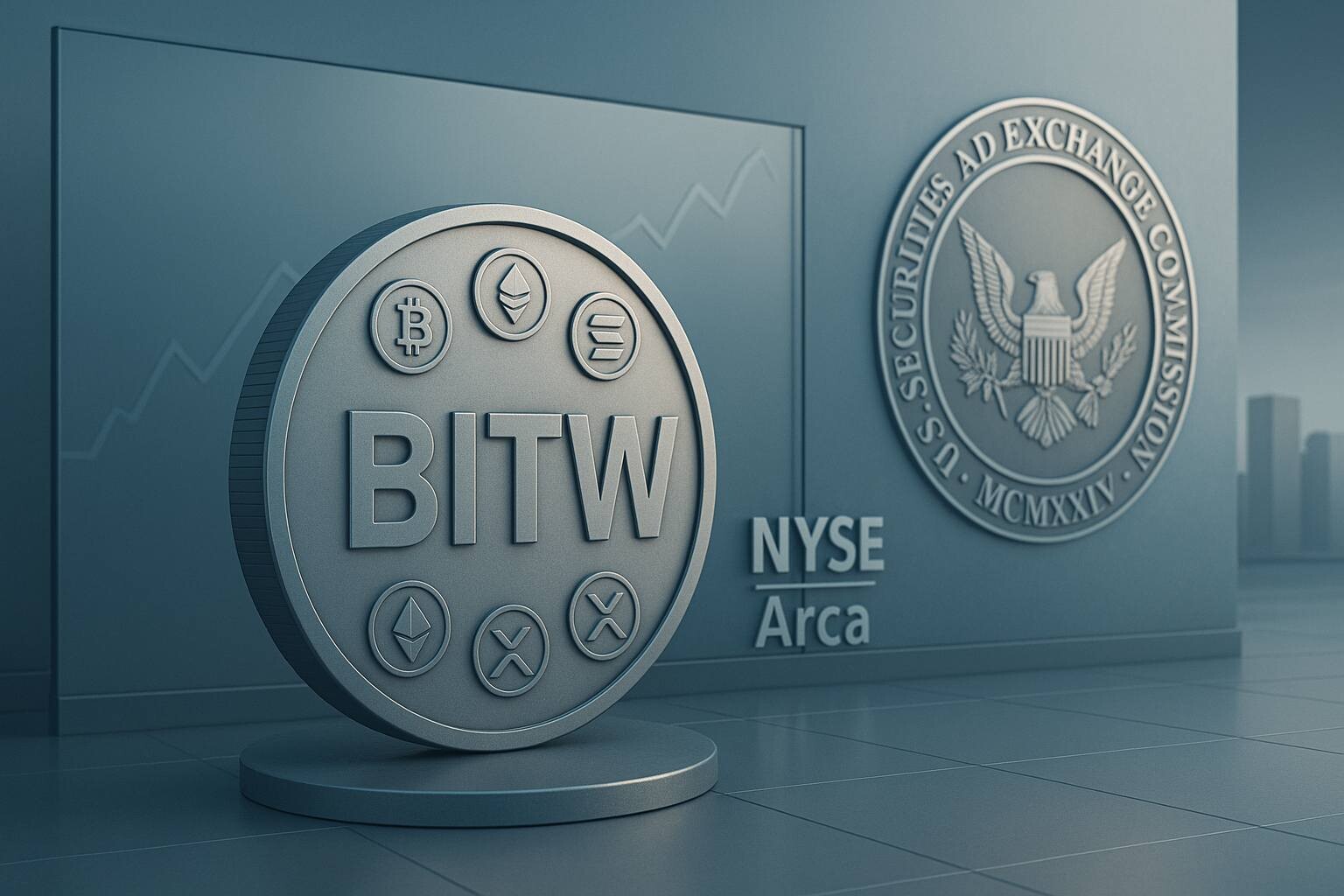
- SEC approves Bitwise BITW to trade as a crypto index ETP on NYSE Arca.
- Fund tracks the 10 largest digital assets, including BTC, ETH, SOL and XRP.
- BITW becomes the second U.S. multi-asset crypto index product listed as an ETP.
The SEC has cleared the Bitwise 10 Crypto Index Fund (BITW) to trade on NYSE Arca as an exchange-traded product, shifting a long-running private crypto index into a listed vehicle that sits on the same screen as traditional ETFs. The fund, now a $1.25 billion product, tracks the 10 largest digital assets and begins trading on NYSE Arca after the regulator signed off on the exchange’s rule change and completed a review that stretched across 2024 and 2025. This move gives retail traders and institutions a way to access Bitcoin, Ether, Solana, XRP and other top cryptocurrencies through a single security instead of holding individual tokens or managing multiple exchange accounts. BITW’s uplisting also marks the second time the SEC has allowed a multi-asset crypto index fund to operate as a full ETP in the United States, following the earlier approval of Grayscale’s Digital Large Cap product.
BITW’s NYSE Arca debut under SEC approval
BITW arrives on NYSE Arca with eight years of live history behind it, rather than as an untested launch. The trust that underlies the fund began operations on 22 November 2017 and has since tracked an index of the ten most valuable cryptocurrencies, using free-float market capitalization and strict eligibility filters. In 2020, Bitwise shifted the structure into a Delaware statutory trust and began public quotation on OTCQX on 9 December 2020, which gave investors secondary-market access but still kept trading in the over-the-counter arena. The new step, backed by the SEC, moves trading to NYSE Arca and aligns BITW with the framework already used by many commodity-linked ETPs, including vehicles that hold gold or oil. The size of the fund at the time of listing highlights how much demand built up before the SEC allowed the uplisting. Bitwise reports approximately $1.25 billion in assets under management in BITW as trading begins on the exchange, and notes that it now manages more than $15 billion across its broader product range. That asset base reflects several years of inflows from investors who wanted diversified crypto exposure without running their own wallets or dealing with self-custody risk. By approving the NYSE Arca rule change that covers BITW, the SEC effectively acknowledged that this structure now fits within the updated U.S. regime for digital-asset ETPs, after a review that included a public notice in the Federal Register in December 2024 and multiple follow-up orders in 2025. The regulatory path was not linear. Early in 2025, the SEC extended the timeline for a decision and then, in July, granted approval but simultaneously imposed a stay on the conversion, which delayed the launch and echoed the pattern seen with Grayscale’s multi-asset fund. Further amendments from NYSE Arca and additional analysis eventually led to a final order in November 2025 that set aside the delegated action and gave accelerated approval for the listing of the Bitwise 10 Crypto Index ETF under amended Rule 8.500-E. Once that order took effect, the way was open for BITW to leave OTC trading and begin life as an exchange-traded product.
How SEC oversight shapes access to crypto index exposure
SEC oversight defines how investors can use BITW inside traditional portfolios. The fund is not registered under the Investment Company Act of 1940 and does not operate as a mutual fund or a standard 1940-Act ETF, a point that Bitwise and the regulator both stress in filings and disclosures. Instead, BITW follows the model used for commodity- and digital-asset-based ETPs, where a trust holds portfolio assets directly and lists its shares on an exchange under bespoke rules such as NYSE Arca Rule 8.800-E or the updated Rule 8.500-E. Under this structure, the SEC focuses on market integrity, disclosure quality, index methodology and surveillance links with underlying trading venues, rather than on the full set of diversification and governance tests that apply to 1940-Act funds. Inside the portfolio, the index that BITW tracks holds the 10 largest eligible digital assets by free-float-adjusted market capitalization, with monthly rebalancing to keep weights aligned with the market. As of late 2024 and 2025, the index has typically included Bitcoin, Ether, Solana, XRP and a rotating cast of other high-cap coins that pass liquidity, custody and regulatory screens, while excluding tokens that fail thresholds on volume, custody standards or potential securities-law risk. The SEC’s review of the NYSE Arca filing examined this methodology in detail, including requirements that at least 90% of the index weight sit in assets for which the exchange can obtain surveillance information through the Intermarket Surveillance Group or a similar agreement. Those conditions explain why the SEC allowed BITW to move forward in the current environment. The Commission has recently adopted generic listing standards for commodity-based ETPs, which streamline approvals for products that rely on underlying futures markets and robust surveillance mechanisms, and this change has reduced the need for separate 19(b) rule filings for every new crypto-related fund on major exchanges. Although BITW still needed a specific rule change because it holds spot digital assets directly, its structure now fits within a broader policy line in which the SEC permits more diversified crypto exposure when an index uses strict eligibility rules and the exchange can monitor for manipulation.
ETP structure, diversification and comparison with earlier products
BITW’s launch on NYSE Arca under SEC oversight comes after the regulator already approved the first U.S. multi-asset crypto index ETP earlier in 2025. Grayscale’s Digital Large Cap product, now trading as the CoinDesk Crypto 5 ETF, received permission to list on NYSE Arca as a multi-coin ETP and holds a basket that currently includes Bitcoin, Ether, XRP, Solana and Cardano, with market-cap-weighted allocations. That fund converted from a previously private or OTC-traded vehicle and became the first U.S. product to offer diversified spot crypto exposure inside an exchange-traded wrapper. BITW now joins it as the second such index product, and the first that tracks a ten-asset index rather than a five-coin basket. The SEC treats both funds as ETPs that sit outside the 1940-Act framework, which means that investors must rely on prospectus risk disclosures rather than on the full mutual-fund rule set. In both cases, NYSE Arca holds responsibility for monitoring trading, working with the Intermarket Surveillance Group and ensuring that pricing for the underlying digital assets comes from transparent, multi-venue benchmarks. BITW, for example, uses reference prices supplied by CF Benchmarks for each of its portfolio assets, based on consolidated trade data from several large digital-asset trading platforms during a fixed afternoon window. That mechanism aims to reduce the impact of outlier trades or thin liquidity and gives the SEC a clear standard when it evaluates how the trust values its holdings at the daily net asset value. Diversification represents one of the main differences between this new wave of index ETPs and the earlier single-asset spot Bitcoin and Ether funds. Products such as BITW allow investors to hold exposure to several major coins through one ticker, which reduces single-asset risk but still subjects them to the broader swings of the crypto market. Other issuers have followed the same direction under different rules; for example, 21Shares has launched a pair of crypto index ETFs in the United States that obtain crypto exposure indirectly through European ETPs and operate under the 1940-Act rather than the trust-based ETP regime that BITW uses. The SEC’s willingness to accept several structures for multi-coin exposure shows a gradual shift from simple Bitcoin-only products toward more complex baskets.
Market reaction, institutional interest and future SEC decisions
BITW’s move from OTCQX to NYSE Arca changes how different categories of investors can access the fund under SEC rules and internal policies. Many institutional accounts, including some financial advisers, banks and pension plans, place limits on OTC trading or avoid it entirely, even when they allow clients to invest in crypto-related products. Once BITW trades on a national securities exchange, those investors can route orders through standard brokerage systems, use the same best-execution processes they apply to other ETPs and rely on familiar reporting and settlement workflows. That operational change matters as much as the underlying asset mix for many large allocators. Comments from Bitwise’s leadership stress this shift in access rather than only the headline of SEC approval. Chief Investment Officer Matt Hougan argues that an index approach lets investors “own the largest, most successful assets in the space” without having to guess which coin will lead the next cycle, since BITW automatically rebalances each month to keep the ten-asset basket aligned with the market. Chief Executive Hunter Horsley describes the uplisting as the point at which a crypto index fund finally appears on the NYSE Arca screen alongside long-established commodity products, closing part of the gap between digital assets and traditional markets. These statements underline how Bitwise expects advisers and institutions to use the fund as a one-ticket core allocation rather than a short-term trading tool. The broader regulatory backdrop also shapes expectations for what the SEC may approve next. In September 2025 the Commission adopted generic listing standards for commodity-based ETPs that significantly shorten the path to market for funds that meet predefined conditions, and the first product to benefit from these standards was Grayscale’s multi-asset GDLC vehicle. After that, additional issuers including Bitwise, Hashdex and 21Shares pushed forward with multi-coin index products, and several have now reached the market under different regulatory umbrellas. BITW’s approval fits into that sequence: as one of the early diversified crypto ETPs holding spot assets, it will likely serve as a reference case when exchanges and issuers design future proposals and when the SEC evaluates whether index methodologies and surveillance tools work as intended.
Conclusion
BITW’s transition from an over-the-counter trust to an NYSE Arca-listed exchange-traded product marks a clear milestone in how the SEC approaches diversified crypto exposure. A fund that started operations in November 2017, built up $1.25 billion in assets and tracked the ten largest digital assets now trades on the same exchange infrastructure as many long-standing commodity ETPs. The move follows a detailed regulatory process that included a proposed rule filing in December 2024, several extensions and a temporary stay in 2025, and it arrives in a year when the Commission has already approved the first multi-asset crypto index fund and new generic standards for commodity-based products. For investors, the practical result is straightforward. Under SEC oversight, BITW offers one-ticket access to Bitcoin, Ether, Solana, XRP and other top-tier cryptocurrencies inside a regulated index fund that rebalances monthly, rather than requiring direct token custody or complex exchange setups. For policymakers, the listing shows that the SEC can accommodate spot-based crypto baskets when exchanges provide detailed index rules and surveillance commitments. How BITW trades from its first session on NYSE Arca, and how much capital flows into this structure versus competing multi-asset funds, will help shape the next round of decisions on crypto index products in the United States.
Disclaimer
The information provided in this article is for informational purposes only and should not be considered financial advice. The article does not offer sufficient information to make investment decisions, nor does it constitute an offer, recommendation, or solicitation to buy or sell any financial instrument. The content is opinion of the author and does not reflect any view or suggestion or any kind of advise from CryptoNewsBytes.com. The author declares he does not hold any of the above mentioned tokens or received any incentive from any company.
Featured image created by AI