
Moonbeam is an Ethereum-compatible smart contract parachain on Polkadot. Moonbeam makes it easy to use popular Ethereum developer tools to build or redeploy Solidity projects in a Substrate-based environment.
Moonbeam is much more than just an EVM implementation. It’s a highly specialized para chain that mirrors Ethereum’s Web3 RPC, accounts, keys, subscriptions, logs, and more. The platform extends the base Ethereum feature set with additional features such as on-chain governance, staking, and cross-chain integrations.
Founders of Moonbeam Crypto (GLMR)
Derek Yoo, the CEO of PureStake, established the Moonbeam Network. PureStake is a platform dedicated to delivering secure and dependable public blockchain infrastructure for blockchain app developers, projects, and enterprises.
Stefan Mehlhorn, renowned for his expertise in early-stage company management and operation is the Chief Operations Officer at both Moonbeam and PureStake. With a rich professional background that includes roles at Samsung Pay, Candibell Inc., LoopPay, Permessa, and Thinking Phone Network, Stefan brings valuable experience to the team.
In leading the marketing and business development teams for the Moonbeam Network, Katie Butler and Nate Hamilton, both from PureStake, contribute their skills and insights to further the platform’s growth and outreach.
Moonbeam’s architecture
Moonbeam is a parachain on the Polkadot network. This means that it is a blockchain that is connected to the Polkadot relay chain. The relay chain is the central blockchain in the Polkadot network, and it is responsible for coordinating the other parachains.
It uses a sharded architecture. This means that the network is divided into multiple shards, each of which can process transactions in parallel. This makes the platform much faster and more scalable than Ethereum, which uses a single-chain architecture.
Moonbeam’s Consensus Mechanism
Moonbeam employs a hybrid consensus protocol derived from Delegated Proof-of-Stake (DPoS). DPoS builds upon Polkadot’s Nominated Proof of Stake (NPoS), empowering token holders. Delegators can actively choose and influence the collator candidate they support, determining the extent of their support. This system enhances the role of token holders in shaping the network’s dynamics. In NPoS, users stake their DOT tokens to nominators. Nominators then select validators to secure the network. Validators produce blocks and verify transactions.
Here is a more detailed explanation of how NPoS works.
Staking: Users stake their DOT tokens to nominators. By staking their DOT tokens, users are supporting the security of the network and are eligible to earn rewards.
Nomination: Users nominate validators to secure the network. Validators are responsible for producing blocks and verifying transactions.
Election: The network elects a set of validators to produce blocks. The number of validators elected is determined by the amount of DOT tokens staked to each validator.
Block production: Validators produce blocks and verify transactions. Validators are rewarded for producing blocks and verifying transactions.
Finality: Once a block has been produced and verified by the validators, it is finalized. Finality means that the block is irreversible and cannot be changed.
NPoS has a number of advantages over traditional Proof-of-Stake (PoS) mechanisms. One advantage is that NPoS is more decentralized. In traditional PoS mechanisms, the validators with the most stake have the most power. In NPoS, users can delegate their stake to nominators, which gives them a voice in the election of validators. This makes NPoS more resistant to centralization.
Another advantage of NPoS is that it is more efficient. In traditional PoS mechanisms, validators need to maintain a copy of the entire blockchain. In NPoS, validators only need to maintain a copy of a small portion of the blockchain. This makes NPoS more efficient and scalable.
Overall, NPoS is a secure, efficient, and decentralized consensus mechanism. Moonbeam’s use of NPoS makes it a good choice for developers and users who are looking for a fast, secure, and scalable platform to build or deploy Ethereum-based applications.
Moonbeam’s Smart Contracts
Moonbeam is fully compatible with the Ethereum Virtual Machine (EVM). This means that Ethereum smart contracts can be deployed to Moonbeam with minimal changes. The EVM establishes the precise guidelines for transitioning states from one block to another. This makes it easy for developers to migrate their existing Ethereum applications to Moonbeam.
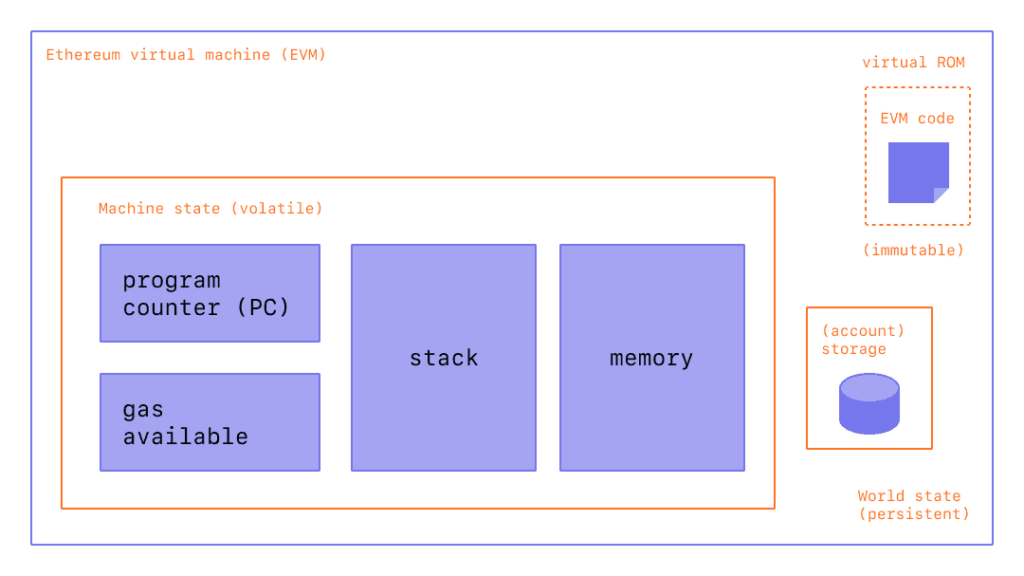
It also supports a number of smart contract development tools, such as Hardhat, Truffle, and Remix. This makes it easy for developers to get started with building smart contracts on Moonbeam.
Moonbeam’s Cross-Chain Compatibility
Moonbeam is connected to the Polkadot network, which gives it access to all of the other chains that are connected to Polkadot. This makes it easy for Moonbeam to communicate with other chains and exchange data and assets.
Moonbeam also has a number of bridges that connect it to other blockchains, such as Ethereum and Bitcoin. This makes it even easier for developers to build cross-chain applications.
Moonbeam’s native tokens (GMLR and GLMR)
GMLR and GLMR are both ERC-20 tokens, which means that they can be traded on Ethereum-based exchanges. However, they also have a number of unique features. For example, GMLR can be used to pay for transaction fees on the Moonbeam network. This means that users can interact with Moonbeam DApps without having to hold any ETH.
GLMR can be staked on the Moonbeam network to secure the network and earn rewards. GLMR holders also have the right to participate in Moonbeam’s governance system. Moonriver (MOVR) is the equivalent token on Moonriver, a Kusama parachain. MOVR is used for the same purposes as GMLR on Moonbeam.
GMLR and MOVR holders can also stake their tokens to secure the Moonbeam and Moonriver networks, respectively, and earn rewards. Staking is essential for the security and decentralization of the networks. Finally, GMLR and MOVR holders have the right to participate in the governance of the Moonbeam and Moonriver networks, respectively. This includes voting on proposals to change the networks’ parameters and policies.
Moonbeam Tokenomics
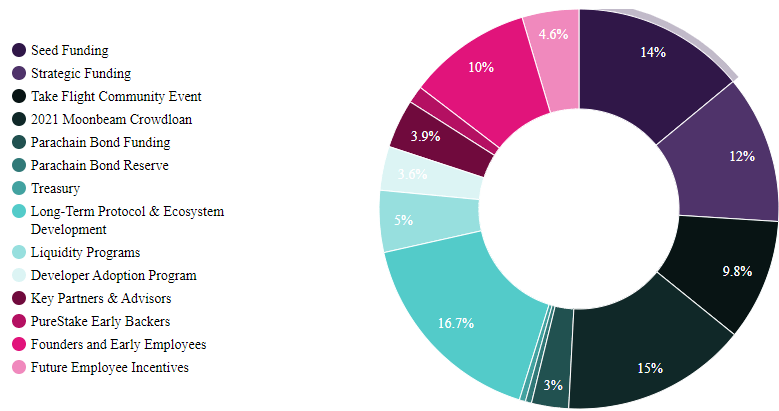
When Moonbeam started, it had one billion Glimmer tokens. Some tokens were kept aside for the Polkadot slot. Also, parts were reserved for the Take Flight event (10%), the 2021 Moonbeam crowdloan (15%), and later parachain bond funding (3%).
As of this time, the market cap of Moonbeam (GMLR) is $156,845,222, with a circulating supply of 774,360,777 GLMR. The tokens of Moonbeam GLMR were distributed as shown in the chart.
Moonbeam’s Projects
1. SushiSwap
SushiSwap is a decentralized exchange (DEX) that allows users to trade assets on Moonbeam. It is a popular choice for users because it offers low fees and a wide variety of assets to trade.
SushiSwap also offers a number of features that make it unique, such as the ability to stake SUSHI tokens to earn rewards and the ability to participate in governance.
2. Curve Finance
Curve Finance is another popular DEX on Moonbeam. It is known for its low slippage and its focus on stablecoins. Curve Finance is a good choice for users who want to trade stablecoins or who want to avoid high slippage.
3. Moonbeam Lending
Moonbeam Lending is a decentralized lending platform that allows users to borrow and lend assets on Moonbeam. It is a good choice for users who want to earn interest on their assets or who need to borrow assets.
Moonbeam Lending is still under development, but it has the potential to become a major player in the decentralized lending space.
4. Moonbeam Bridge
The Moonbeam Bridge is a bridge that allows users to transfer assets between Moonbeam and other blockchains, such as Ethereum and Bitcoin. It is a convenient way to move assets between blockchains without having to go through a centralized exchange.
The Moonbeam Bridge is a valuable tool for users who want to use Moonbeam DApps but who also want to use assets from other blockchains.
5. Moonbeam Name Service
The Moonbeam Name Service is a decentralized naming service that allows users to create and manage human-readable names for Moonbeam addresses. It is a convenient way for users to interact with Moonbeam DApps and to send and receive assets.
The Moonbeam Name Service is a valuable tool for users who want to make it easier to use Moonbeam DApps.
6. Moonbeam NFT Marketplace
The Moonbeam NFT Marketplace is a marketplace for buying and selling NFTs on Moonbeam. It is a good choice for users who want to buy or sell NFTs on a decentralized platform. There are three phases involved in the roadmap. The first phase is about launch and expansion. The second phase, as shown below, is about nurture and propagation. The third phase is about rooting and establishment.

The Moonbeam NFT Marketplace is still under development, but it has the potential to become a major player in the NFT space.
7. Moonbeam Collectibles
Moonbeam Collectibles is a platform for collecting and showcasing NFTs on Moonbeam. It is a good choice for users who want to collect NFTs and who want to share their collections with others.
Moonbeam Collectibles is still under development, but it has the potential to become a popular platform for NFT collectors.
8. Moonbeam Gaming
Moonbeam Gaming is a platform for playing blockchain-based games on Moonbeam. It is a good choice for users who want to play blockchain games without having to use a centralized exchange.
Moonbeam Gaming is still under development, but it has the potential to become a major player in the blockchain gaming space.
Conclusion: Unlocking the Future Potential of Moonbeam
Moonbeam is a smart contract platform that brings Ethereum compatibility to Polkadot. This means that developers can easily port their existing Ethereum applications to Moonbeam, and users can access their favourite Ethereum DApps on a more scalable and secure network.
Moonbeam has a number of advantages over other smart contract platforms. Moonbeam works well with Ethereum, so developers can move their apps to Moonbeam without big changes. It’s also friends with other blockchains in Polkadot, letting users easily move things between Moonbeam and other places like Ethereum and Cosmos. Moonbeam can handle lots of actions without slowing down because it’s part of Polkadot, which is good at managing many tasks. Moonbeam keeps things safe, like money and info, because it’s built on a secure system called Polkadot. This makes Moonbeam a reliable choice for users.
Overall, Moonbeam is a promising smart contract platform with a number of advantages over other platforms. It is still under development, but it has already attracted a large number of users and developers. As Moonbeam continues to mature, it is expected to become one of the leading smart contract platforms in the world.
Suggested Reading on Moonbeam:
- Moonbeam: Bridging Ethereum Capabilities to Polkadot and the Glimmer Token
- Uniswap Expands onto Moonbeam Network, Enabling Integration with Polkadot
Disclaimer: CryptoNewsBytes does not provide investment, financial, or legal advice. The content on the Website must not be taken as professional advice and should not be relied upon for making financial decisions. It is advised to consult with a qualified professional for advice concerning your particular situation.