

- Bitcoin fell about 17% in November, its second-worst month of 2025
- ETF outflows reached about $3.48B, cutting institutional demand
- Short-term holders realized heavy losses as price dipped below $80K before rebounding
Bitcoin faced a difficult November, with the price dropping 17.28% over the month and setting up its second-worst performance of the year after February’s 17.39% slide. Data from derivatives and spot markets shows that this fall did not occur in isolation, but followed an already volatile October that pushed the asset to a record high near 126,000 dollars before conditions shifted. November then turned into a period of sustained selling pressure, leaving many traders focused on the link between macro events, institutional flows, and behaviour across different groups of Bitcoin market participants. The decline also marked the sharpest November setback for Bitcoin since 2022, when the asset dropped 16.23% in a single month, and it briefly drove the price to a seven-month low below 80,000 dollars before a late rebound. By the end of the month, the market had recovered to around 90,773 dollars, yet the pattern of price action revealed clear structural stress. Short-term holders realised large losses, exchange flows changed direction, and the gap widened between investors who reacted to headlines and those who continued to hold through the turbulence.
Macro backdrop and Bitcoin November drawdown
The month opened with Bitcoin trading near 110,000 dollars, a level that reflected the strong rally from earlier in the year but also the exhaustion left by October’s swings. In October the price pushed to a new peak near 126,000 dollars, only to erase roughly 20 billion dollars in market value as risk sentiment cooled. That reversal set the tone for November and meant that the Bitcoin market entered the new month with fragile confidence and elevated sensitivity to new macro shocks. Those shocks arrived quickly. On 10 October, former president Donald Trump expanded tariffs on Chinese imports, which prompted a broad reassessment of risk across global equity and commodity markets and bled into Bitcoin and other digital assets. Investors reduced exposure to higher-beta positions, and some of that unwinding carried into November as portfolios continued to adjust. The situation grew more tense when the record US government shutdown further constrained liquidity in traditional markets, tightening financial conditions and encouraging more de-risking among funds that also trade crypto assets. As liquidity thinned, intraday ranges narrowed while downside moves attracted more follow-through than attempts at recovery. Bitcoin still reacted to local rallies in equities or easing in the dollar, but the balance of flows leaned toward selling into strength rather than building fresh long exposure. By the middle of the month, the tone of trading reflected this broader macro strain, with many desks describing a Bitcoin market that felt heavy even on quieter days.
ETF flows and Bitcoin demand from institutions
An important feature of this November decline came from the behaviour of spot exchange-traded funds. According to SoSo Value data, Bitcoin ETFs saw about 3.48 billion dollars in net outflows over the month, the second-largest monthly outflow since these products launched in 2024.
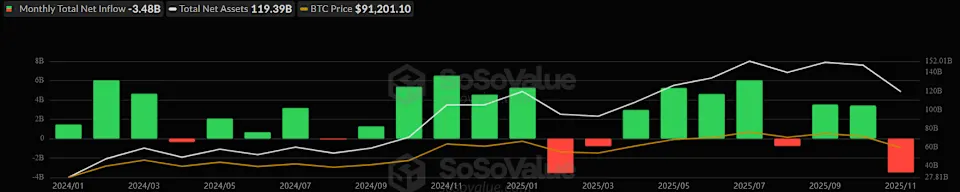
For Bitcoin, that figure underlined how one of the main sources of demand in the previous quarters temporarily turned into a consistent source of supply. The outflow trend started quietly in the second half of October, then gained speed as global markets digested the changing macro backdrop during November. Each day of net redemptions forced fund providers and authorised participants to sell underlying BTC into the market, which added an extra layer of pressure on spot prices. Bitcoin therefore had to absorb not only discretionary selling from traders reacting to news, but also systematic selling linked directly to the ETF redemption process. Institutional investors who use these vehicles often follow mandates that respond to volatility, drawdowns, or shifts in broader indices. As those triggers activated, ETF outflows compounded the impact of weaker risk appetite, even if long-term theses for the asset did not change. For Bitcoin traders and portfolio managers, the message was that funding conditions and regulated investment channels still play a major role in shaping day-to-day price action.
Short-term holders, realised losses and market stress
On-chain data adds another layer to the picture. Glassnode metrics show that the realised loss for short-term holders surged during November, with the seven-day exponential moving average reaching about 427 million dollars per day. That level represented the highest concentration of realised losses for this cohort since November 2022 and highlighted how aggressively newer entrants sold into the Bitcoin decline.
These losses aligned with behaviour seen near the previous two major Bitcoin lows of the current cycle, when panic selling from recent buyers flushed out weak hands. Many of these addresses bought during the late stages of the prior rally near the record high above 120,000 dollars and then capitulated once the market moved sharply against them. Instead of a gradual rotation from long-term holders to new participants, the flow of coins suggested that impatient owners chose to exit quickly, often at a loss. The data points toward reactive selling as the defining force in this phase rather than steady distribution by long-term holders. Entities that accumulated over earlier years tended to adjust positions more slowly, while traders with shorter time horizons took on the majority of realised losses. That split helped limit forced selling from the most established cohorts, but it did little to soften the immediate impression of stress on public order books.
Price levels, volatility and structural signals for the market
Price behaviour across the month reflected the interaction between macro factors, ETF flows, and on-chain dynamics. After opening near 110,000 dollars, Bitcoin moved lower in a series of steps, eventually pushing under 80,000 dollars at the local low before finding support. The subsequent rebound to roughly 90,773 dollars restored some lost ground, yet left the price well below October’s record peak near 126,000 dollars and maintained a sense of caution among traders. Volatility remained contained compared with earlier crisis periods, but the direction of travel stayed negative for most of November. Rallies found sellers waiting at prior support zones, and funding rates in derivatives markets reflected more defensive positioning. Bitcoin retained deep liquidity on major exchanges, although order books tilted toward offers as market-making firms adjusted inventory in line with the persistent flow of ETF redemptions and short-term holder selling. Despite the drawdown, some structural signals stayed constructive in the background. Long-term holder supply showed only limited signs of distribution, suggesting that core conviction among seasoned investors remained intact. At the same time, the reset in short-term positioning reduced leverage and cleared out some of the excess that built up during the surge to all-time highs, creating conditions that could support more stable Bitcoin trading once macro pressures ease.
Conclusion
November closed as one of the toughest months of the year for Bitcoin, with a 17.28% decline that ranked only slightly behind February’s 17.39% drop and marked the steepest November setback since 2022. The move unfolded against a backdrop of higher tariffs on China, a record US government shutdown, and weaker risk appetite across global markets, all of which reduced liquidity and encouraged investors to step back from risk. At the same time, spot ETFs shifted from net buyers to significant net sellers, recording about 3.48 billion dollars in outflows, the second-largest monthly total since their launch in 2024. Short-term holders realised losses of around 427 million dollars per day on a seven-day average basis, echoing the stress seen at earlier cycle lows and confirming that reactive selling played a central role in the slide. Price action that carried the Bitcoin market from an opening level near 110,000 dollars to a low below 80,000 dollars, before a rebound toward 90,773 dollars, showed how several sources of pressure converged during the month. For observers tracking the asset, the episode underlined how closely macro events, regulated investment products, and holder behaviour now interact when conditions turn against risk assets.
Disclaimer
The information provided in this article is for informational purposes only and should not be considered financial advice. The article does not offer sufficient information to make investment decisions, nor does it constitute an offer, recommendation, or solicitation to buy or sell any financial instrument. The content is opinion of the author and does not reflect any view or suggestion or any kind of advise from CryptoNewsBytes.com. The author declares he does not hold any of the above mentioned tokens or received any incentive from any company.
Featured image created by AI