

- Spot Bitcoin ETFs saw about $1.1B in net outflows over three trading days through Jan 8, after a $697.25M inflow on Jan 5.
- Total net assets stayed at $117.66B and cumulative inflows reached $56.65B, with $3.08B traded on Jan 8.
Spot Bitcoin ETFs opened 2026 with fast-moving flows that shifted from a strong inflow day to a three-day stretch of heavy redemptions through January 8. Over those three trading days, U.S. products shed roughly $1.1 billion, a move that nearly erased the modest gains posted at the start of the month. The daily numbers show how quickly positioning changed, with outflows peaking at $486.08 million on January 7 and reaching $398.95 million on January 8, after a $697.25 million inflow on January 5. Even as money moved out, trading activity stayed elevated, and that matters because it points to active rebalancing across funds rather than a sudden stop in participation. Since launch, Spot Bitcoin ETFs have still drawn cumulative net inflows of $56.65 billion and hold $117.66 billion in total net assets, equal to about 6.48% of Bitcoin’s market capitalization. With Bitcoin trading around the $90,000 area during these swings, flows have become a daily gauge of how institutions adjust exposure, rotate between issuers, and react to short-term price moves.
Spot Bitcoin ETFs post three-day $1.1B drawdown
SoSoValue data shows that U.S. spot Bitcoin funds logged daily net outflows of $398.95 million on January 8, after larger redemptions earlier in the week. Outflows peaked at $486.08 million on January 7, which set the tone for the three-day decline.

January 5 looked very different, as the same group recorded $697.25 million of net inflows, underlining how fast positioning can change. Trading activity stayed high during the pullback rather than dropping, which points to rotation across products instead of a simple retreat. Spot Bitcoin ETFs still sit on a large base of adoption, with cumulative net inflows of $56.65 billion since launch and total net assets of $117.66 billion through January 8. That asset figure equals about 6.48% of Bitcoin’s total market capitalization, which makes these funds a structural part of how many participants access BTC exposure.
Spot Bitcoin ETFs flows concentrate in the largest funds
The heaviest January 8 selling hit the biggest products, and the day’s breakdown highlights that concentration. BlackRock’s iShares Bitcoin Trust led the outflows with $193.34 million leaving the fund, equal to about 2,130 BTC.

Even after that redemption, IBIT still held $70.41 billion in assets, which represents close to 4% of Bitcoin’s total market value. Investors also kept trading IBIT actively, with $2.20 billion exchanged on January 8 alone, which helped lift the category’s total value traded to $3.08 billion that day. Fidelity’s FBTC reported $120.52 million of net outflows, and Grayscale’s GBTC posted another $73.09 million in redemptions. GBTC’s longer trend remained clear, as cumulative net outflows topped $25 billion since its conversion. Smaller funds showed mixed action rather than a single direction, with Bitwise’s BITB and WisdomTree’s BTCW recording modest inflows while several others, including VanEck’s HODL and Invesco’s BTCO, held flat flows. The distribution suggests that Spot Bitcoin ETFs can absorb selling while participants reallocate between issuers, fee structures, and liquidity profiles.
Weekly and monthly flow context for U.S. crypto ETF products
On a weekly basis, flows turned negative again, with Spot Bitcoin ETFs posting a net outflow of $431.02 million after the prior week delivered a $458.77 million net inflow.
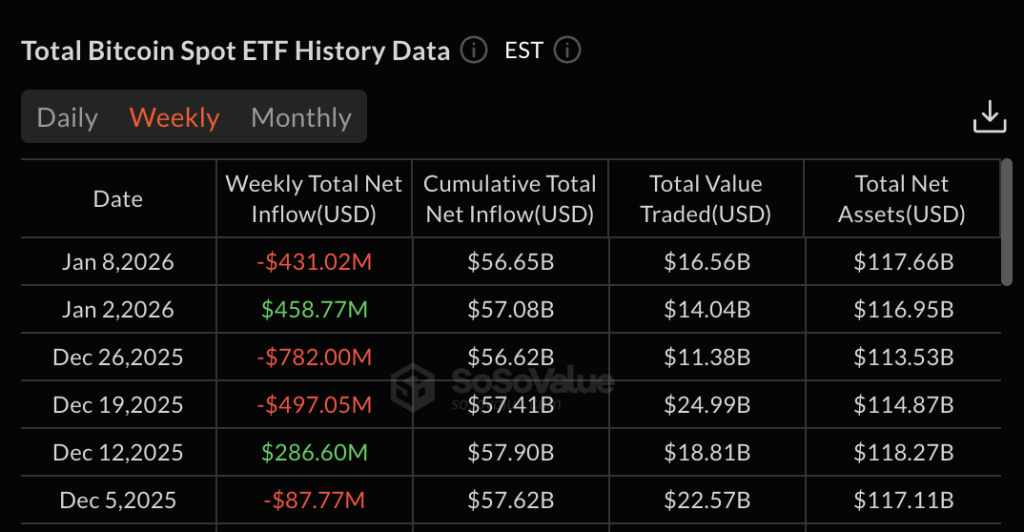
January still remained slightly positive at around $40 million, yet that small gain contrasts with the final months of 2025. December ended with more than $1 billion of net outflows, and November saw even heavier redemptions.
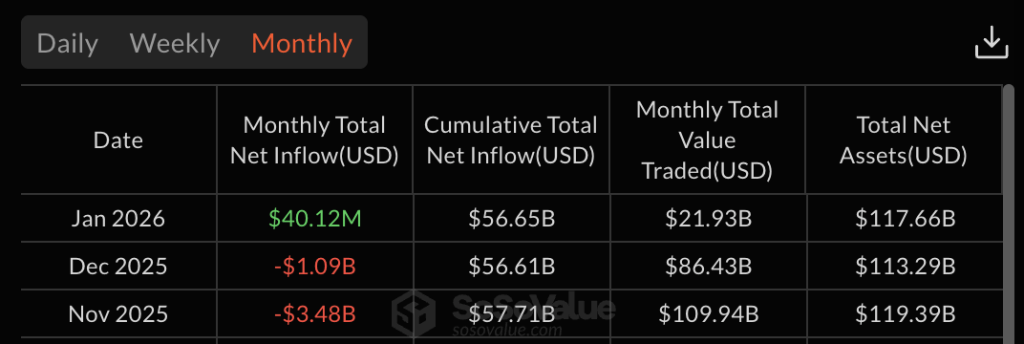
Earlier in the fall, September and October each attracted inflows above $3.4 billion, a period that aligned with stronger prices and steadier institutional demand. Since then, total assets across these vehicles moved down from a peak above $150 billion to the current $117.66 billion level through January 8. That shift matters because it frames recent outflows as a swing inside a large installed base, not a reset to the early-stage phase of the market. The weekly reversal also fits with the high daily trading values, since flows can flip quickly when investors rebalance, hedge, or adjust risk budgets around spot price movement.
Bitcoin price stability and cross-asset rotation across crypto ETFs
Bitcoin’s price stayed relatively firm while flows swung, with a brief dip toward $89,190 before a rebound above $90,000. The market traded near $90,224 later, up slightly on the day, even as outflows hit several major products. BTC also remained about 28% below its all-time high of $126,080, which kept a wide gap between current prices and the prior peak. Reduced trading volumes in spot markets did not stop ETF turnover, and that combination supports the view of active position management inside funds. Other crypto-linked products showed a similar tone, as U.S. Ethereum spot ETFs recorded $159.17 million in net outflows on January 8 while cumulative inflows still stood at $12.53 billion. Some sessions have shown ETH products taking in capital when BTC products see redemptions, which lines up with portfolio rotation rather than broad risk cutting. XRP spot ETFs also registered their first day of net outflows this week after more than a month of uninterrupted inflows, which adds to the short-term caution across digital asset vehicles. Institutional product development continued at the same time, with Morgan Stanley filing registration statements to launch its own spot Bitcoin ETF alongside proposed Ethereum and Solana products, a signal that issuers still see demand for regulated access even during volatile flow periods.
Conclusion
Spot Bitcoin ETFs ended the week under pressure after roughly .1 billion in net outflows over three trading days through January 8, which nearly removed the month’s early gains. Even with that drawdown, the category still reflects a large base of adoption, with cumulative net inflows of $56.65 billion since launch and total net assets of $117.66 billion. The flow pattern also stayed uneven across issuers, as selling concentrated in the largest funds while some smaller products held steady or drew modest inflows, which fits a rotation setup rather than a broad exit. Trading activity remained high, with $3.08 billion changing hands on January 8, and that level of turnover suggests that investors actively adjusted positions while Bitcoin traded near $90,224 after dipping toward $89,190. The next signal will come from whether flows stabilize around the $90,000 area or continue to swing, especially as other crypto ETFs, including Ethereum spot ETFs, also recorded outflows on January 8.
Disclaimer
The information provided in this article is for informational purposes only and should not be considered financial advice. The article does not offer sufficient information to make investment decisions, nor does it constitute an offer, recommendation, or solicitation to buy or sell any financial instrument. The content is opinion of the author and does not reflect any view or suggestion or any kind of advise from CryptoNewsBytes.com. The author declares he does not hold any of the above mentioned tokens or received any incentive from any company.
Featured image created by Ai