
- Nevada court declined an emergency halt on coinbase prediction markets, setting a hearing so the exchange can answer regulators’ claims
- coinbase argues CFTC oversight should preempt Nevada gambling rules, while other states like Tennessee and Michigan also question these markets
A Nevada judge has declined a request from state regulators for an emergency order to immediately shut down a new prediction market product offered by Coinbase, giving the exchange more time to argue that its listings fall under federal, not state, oversight. Tevent he dispute centers on whether certain event contracts offered through a Commodity Futures Trading Commission (CFTC)-regulated venue should be treated as regulated derivatives or as unlicensed gambling under Nevada law.
Nevada regulators target Coinbase prediction markets
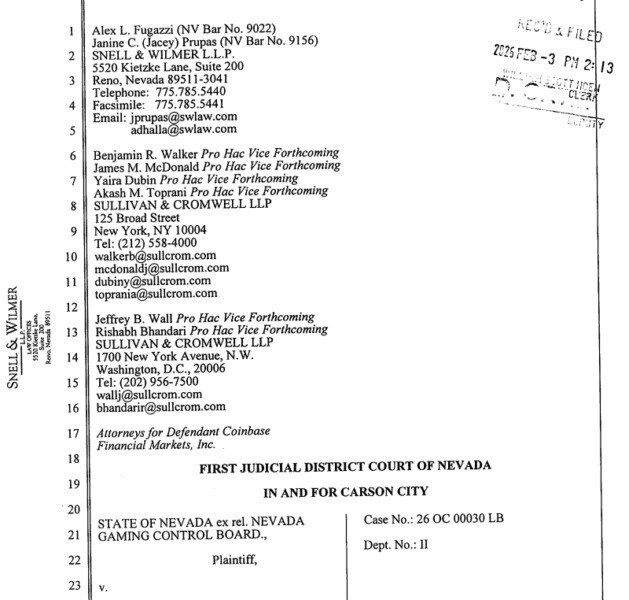
The Nevada Gaming Control Board (NGCB) launched a civil enforcement action in Carson City on Monday, claiming that Coinbase is making unlicensed sports event wagers available to residents. In its filing, the agency asked the court for a temporary restraining order and a preliminary injunction that would have forced an immediate halt to the products. Regulators argued that the contracts amounted to sports betting that requires state licensing.
A state court, however, refused to issue the emergency temporary restraining order sought by the NGCB. Instead of granting the immediate shutdown, the judge scheduled a hearing for the following week so Coinbase can formally respond to the allegations. According to Coinbase chief legal officer Paul Grewal, this decision allows the company to continue operating the product in Nevada while it prepares its defense.
The NGCB’s challenge arrives amid growing scrutiny of prediction markets across the United States. Just days before the Coinbase ruling, a different Nevada judge imposed a 14-day temporary restraining order on Polymarket, requiring that platform to pause certain event markets in the state. The Nevada actions form part of a broader pattern in which state regulators question whether novel event-based contracts should be treated as gambling rather than federally regulated derivatives.
Coinbase response and argument over scope of Nevada order
In a Tuesday court filing, Coinbase argued that Nevada’s requested order went far beyond sports betting. The company said that, as drafted, the relief would effectively prevent it from listing any CFTC-regulated “event contracts” for Nevada users, even when those contracts relate to financial or commodity outcomes rather than sports. From Coinbase’s perspective, the state’s attempt to halt the products would reach a wide range of federally supervised instruments.
The exchange also challenged Nevada’s claim of urgent and irreparable harm. In its submission, Coinbase noted that Kalshi, the CFTC-registered exchange whose contracts Coinbase lists, is still permitted to offer those same products directly to users in Nevada while the case unfolds. That fact, the company argued, undercuts the idea that the state must block Coinbase immediately to prevent ongoing injury.
At the same time, Coinbase has taken the fight beyond the state court system. Grewal said the company has filed a separate action in federal court in Nevada, seeking to stop the state’s enforcement effort on the grounds that it conflicts with federal law. By opening a federal case, Coinbase is asking a second court to confirm that the disputed contracts sit within a regulatory structure defined by Congress and implemented by the CFTC.
Federal jurisdiction claims and Coinbase legal strategy
Coinbase’s core legal position is that Congress has already decided who regulates the type of contracts at issue. In public comments, Grewal has emphasized that Congress assigned the CFTC “exclusive jurisdiction” over the listed event contracts in question, and that federal lawmakers, not state agencies, determine how those markets are supervised. The company’s court brief cites the Commodity Exchange Act, which it says grants the CFTC sole authority over swaps and event contracts traded on duly regulated exchanges.
According to Coinbase , Nevada is attempting to reframe these CFTC-regulated instruments as state-regulated gambling products. The exchange argues that this move is preempted by the federal derivatives framework, because the same contracts cannot simultaneously be treated as both CFTC-supervised event contracts and unlicensed wagers under state gaming law. In Coinbase’s view, once a product is listed on a CFTC-regulated market such as Kalshi, the relevant oversight rests with federal regulators.
This jurisdictional argument is not confined to Nevada. In December, Coinbase followed a path first taken by Kalshi and sued regulators in Connecticut, Illinois and Michigan. Those lawsuits similarly contend that prediction markets listed on a CFTC-regulated platform fall under federal authority rather than state gambling rules. The exchange is attempting to establish a consistent legal interpretation across multiple states, aiming to prevent each jurisdiction from imposing its own separate licensing scheme on the same federally regulated contracts.
Wider pushback against prediction markets
The conflict in Nevada is part of a broader standoff between state regulators and platforms offering event-based contracts. In January, Tennessee’s Sports Wagering Council directed several firms, including Kalshi and Polymarket, to stop offering sports event contracts to people in that state. Tennessee’s move underscored how state-level bodies are increasingly treating these products as sports betting offerings that must comply with local licensing and consumer protection regimes.
Nevada’s recent action against Polymarket illustrates how state courts are willing to grant temporary orders while regulators probe whether specific markets resemble prohibited gambling. In that case, the judge issued a 14-day temporary restraining order that compelled Polymarket to suspend certain event contracts for Nevada users. Regulators have not limited their concern to one company or one type of event, suggesting a more systemic examination of prediction platforms.
Against this backdrop, Coinbase is arguing that its role is different because it lists contracts that are already under CFTC supervision through Kalshi. The exchange maintains that if Congress has granted the CFTC exclusive jurisdiction, then state attempts to reclassify those products risk creating conflicting rules for the same markets. The Nevada federal and state court cases will test how far that federal jurisdiction extends and whether state gaming agencies can still exercise authority over residents’ access to such contracts.
Conclusion
The Nevada court’s decision to deny an immediate shutdown of Coinbase’s prediction markets keeps the products available for now, but the legal questions remain unresolved. The NGCB continues to allege that Coinbase is facilitating unlicensed sports event wagering, while coinbase counters that it is dealing in CFTC-regulated event contracts that fall under a federal regime set by Congress and the Commodity Exchange Act. With hearings scheduled in state court and a new federal lawsuit underway in Nevada, alongside parallel disputes in Tennessee, Connecticut, Illinois and Michigan, the outcome of Coinbase’s jurisdictional fight will shape how prediction markets operate across state lines in the United States.
Disclaimer
The information provided in this article is for informational purposes only and should not be considered financial advice. The article does not offer sufficient information to make investment decisions, nor does it constitute an offer, recommendation, or solicitation to buy or sell any financial instrument. The content is opinion of the author and does not reflect any view or suggestion or any kind of advise from CryptoNewsBytes.com. The author declares he does not hold any of the above mentioned tokens or received any incentive from any company.
Featured image created by AI