
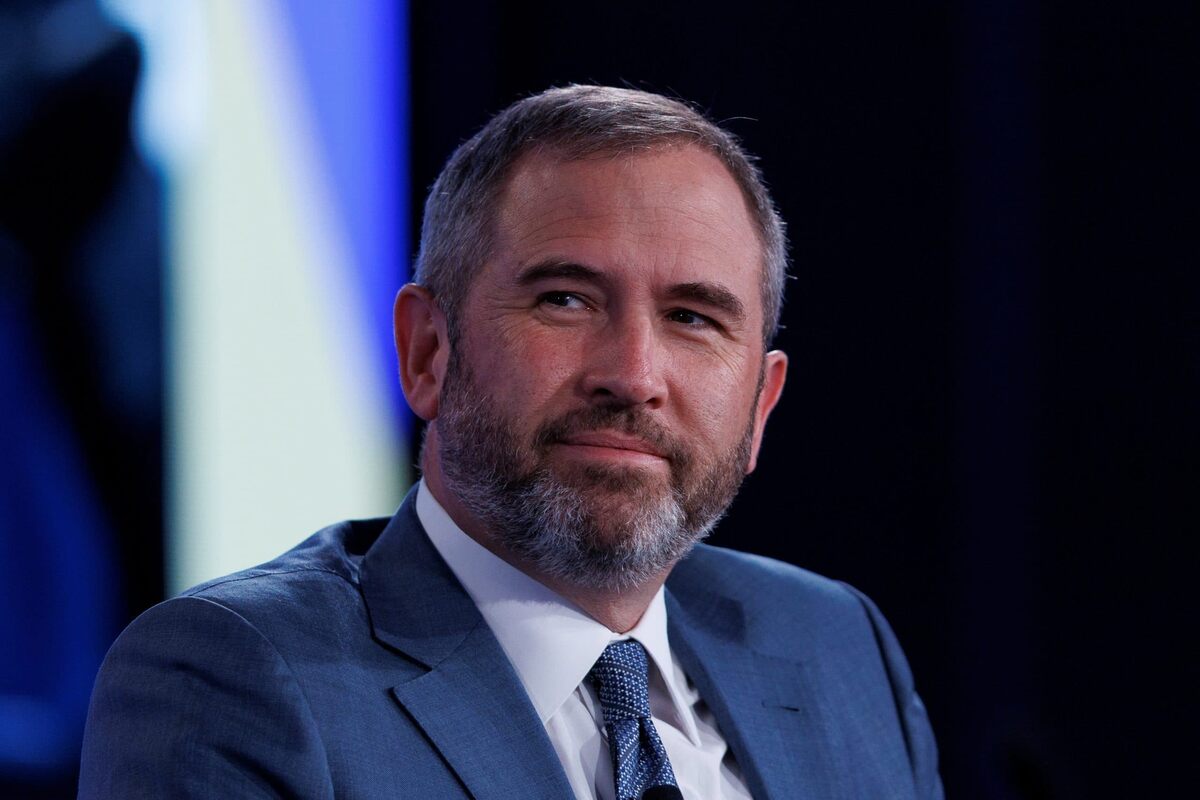
- Ripple CEO Brad Garlinghouse says there is a 90% chance the Clarity Act will pass by the end of April, after new talks with lawmakers and the White House.
- The bill seeks to define which crypto assets are securities, while Ripple shifts focus to integrating nearly $3 billion in acquisitions amid ongoing market uncertainty.
Ripple CEO Brad Garlinghouse now puts the odds of the long-discussed Clarity Act passing by the end of April at 90%. His latest comments reflect a growing belief within the crypto sector that U.S. lawmakers may soon deliver clearer rules for digital assets after years of uncertainty.
Ripple CEO sees shifting political momentum on regulation
Speaking on Fox Business, Garlinghouse said political momentum around the Clarity Act has accelerated, pointing to renewed engagement from both Congress and the White House. He described a recent series of meetings in Washington that brought together senior figures from crypto firms and traditional banks, suggesting that interest in moving the bill forward has strengthened after months of slow progress.
According to the Ripple CEO, those discussions indicate that policymakers are increasingly willing to address regulatory gaps that have left many digital asset projects in a gray area. He linked this shift to broader changes in how financial institutions and officials view crypto, contrasting current attitudes with the skepticism that dominated several years ago.
Polymarket bettors appear to share some of that optimism, assigning the bill an 82% chance of passage by the end of the year. Garlinghouse’s 90% probability by the end of April suggests he is more bullish than prediction markets on the near-term timeline, underscoring the sense of momentum he perceives in Washington.
What the Clarity Act would change
The Clarity Act aims to set boundaries around which digital assets should be treated as securities and which would fall under the oversight of the Commodity Futures Trading Commission. By creating a clearer split between securities regulation and commodities supervision, the bill is intended to reduce ambiguity for developers, exchanges, and institutional users.
However, the proposal has encountered resistance in several areas. One key friction point involves stablecoin reward features and whether platforms should be allowed to offer yield-style incentives to customers. Lawmakers and industry participants have been debating how those rewards should be classified and what safeguards might be required.
The White House has reportedly set March 1 as a target date to push negotiations forward, indicating that the administration wants to keep the legislative process on track. The Ripple CEO characterized the bill as flawed but essential, arguing that perfect legislation is unlikely yet a structured framework is necessary to move beyond the status quo.
Garlinghouse highlighted that Ripple obtained a federal court ruling that XRP is not a security, giving the company a level of legal clarity that many other projects do not yet enjoy. He contrasted Ripple’s position with the wider market, where many tokens still face questions about how regulators might treat them.
Ripple CEO links uncertainty to market and innovation strain
Garlinghouse warned that prolonged ambiguity has weighed on innovation and sentiment across the crypto ecosystem. “The industry can’t live in limbo,” he said, stressing that unclear rules complicate product planning, capital allocation, and institutional adoption.
His remarks come during a period of broader weakness and volatility for digital assets. Bitcoin and other major tokens have struggled in recent weeks, adding to concerns about market resilience. Against this backdrop, the Ripple CEO said the company is still seeing rising interest from corporate treasurers and financial institutions.
According to Garlinghouse, demand is growing around several specific use cases. These include stablecoins for payments and settlements, liquidity management tools, and solutions aimed at improving cross-border transfers. He presented these areas as examples of continued institutional engagement despite market turbulence and regulatory unknowns.
Ripple has been pursuing an expansion strategy to address those needs. Since 2023, the company has deployed nearly $3 billion on acquisitions, targeting businesses in custody, prime brokerage, and treasury management. Garlinghouse said that after this rapid deal activity, Ripple plans to pause large transactions in the near term to concentrate on integrating the businesses it has already acquired.
He added that interest in clearer rules is no longer limited to crypto-native firms. Traditional financial institutions, he noted, increasingly want a defined regulatory framework so they can compete on terms that match those applied to newer market entrants. The Ripple CEO portrayed this as evidence of how much attitudes toward digital assets have evolved, with established players now seeking a level playing field rather than staying on the sidelines.
Conclusion
The Ripple CEO’s 90% probability estimate for the Clarity Act’s passage by the end of April underscores a rising sense of confidence that U.S. lawmakers may soon clarify how digital assets are regulated. The bill’s push to distinguish securities from assets overseen by the Commodity Futures Trading Commission, and its debates over stablecoin reward features, sit at the center of that effort. Garlinghouse has framed the legislation as an imperfect but necessary step, arguing that persistent uncertainty has constrained innovation and dampened sentiment even as institutions continue to explore stablecoins, liquidity tools, and cross-border solutions. With nearly $3 billion in acquisitions since 2023 and a pause now planned to focus on integration, Ripple is positioning itself for a regulatory environment that could shift markedly if the Clarity Act advances.
Disclaimer
The information provided in this article is for informational purposes only and should not be considered financial advice. The article does not offer sufficient information to make investment decisions, nor does it constitute an offer, recommendation, or solicitation to buy or sell any financial instrument. The content is opinion of the author and does not reflect any view or suggestion or any kind of advise from CryptoNewsBytes.com. The author declares he does not hold any of the above mentioned tokens or received any incentive from any company.
Featured image source