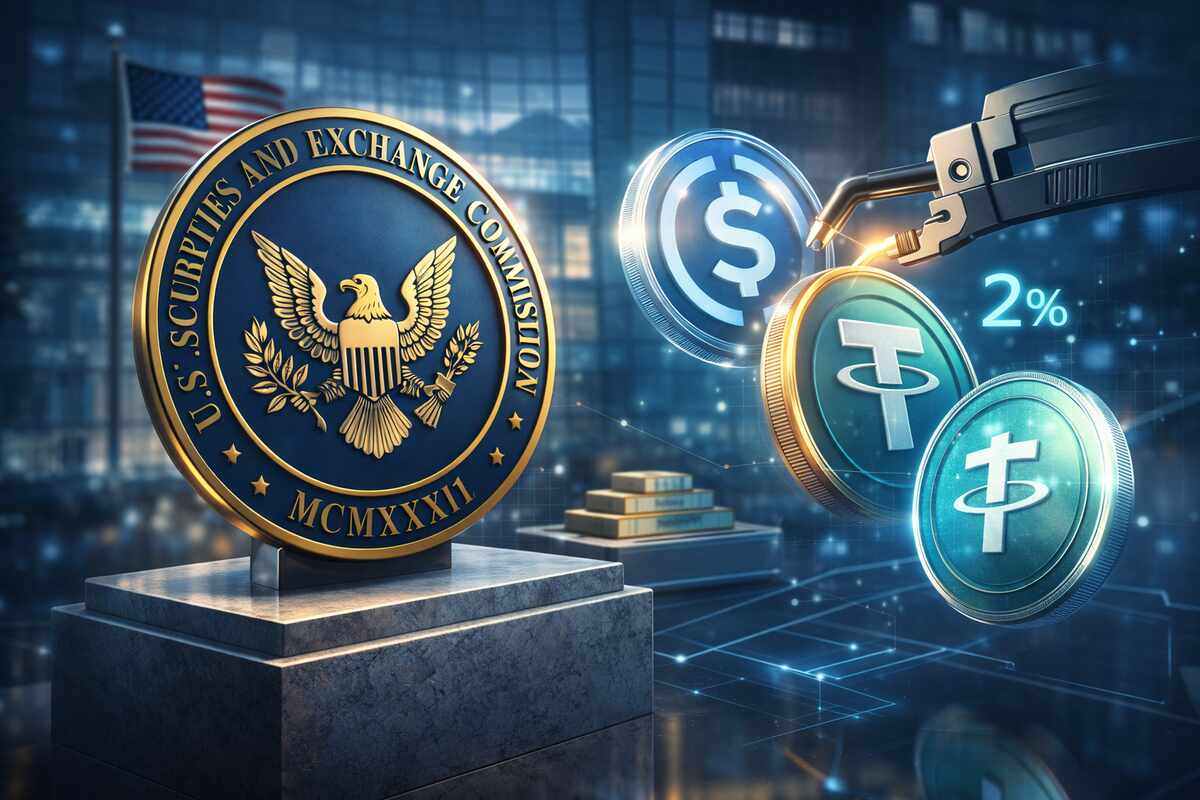
- SEC introduces a 2% haircut for certain stablecoin positions, replacing previous practices where some brokers applied a 100% haircut
- Guidance may let broker-dealers treat payment stablecoins more like money market funds and support wider use in tokenized securities
- Moves align with broader SEC and federal efforts including GENIUS to create clearer frameworks for stablecoins and digital assets
The U.S. Securities and Exchange Commission ([SEC]) has issued new guidance that could significantly alter how broker-dealers treat certain stablecoins on their balance sheets. By allowing a standardized “2% haircut” on proprietary positions in eligible stablecoins, the agency is reshaping the regulatory treatment of these digital assets in a way that some market participants say brings them closer to traditional financial instruments such as money market funds.
New SEC guidance on stablecoin haircuts
The guidance, released on Thursday by the SEC’s Division of Trading and Markets, addresses how broker-dealers comply with an existing customer protection rule. That rule requires firms to protect client assets and to maintain a financial buffer—often implemented through regulatory capital and margin requirements—against the assets they hold. In this context, a “haircut” is a percentage reduction applied to the stated value of an asset when it is used as collateral, reflecting the risk that its price might change.
Under the new approach, staff said it would “not object” if a broker-dealer applied a 2% haircut to proprietary positions in certain stablecoins. Until now, some firms had been far more conservative. According to fintech strategist and Digital Currency Group board member Tonya Evans, some brokers had imposed a 100% haircut on stablecoins, effectively treating them as having no collateral value at all for regulatory purposes. That stance made holding stablecoins costly and discouraged their use within broker-dealer operations.
A 2% haircut, by contrast, places payment stablecoins much closer to established low-volatility instruments. Evans argued in a Forbes article that this adjustment aligns stablecoins with money market funds, which also hold portfolios of short-term, high-quality assets such as U.S. Treasuries, cash, and short-term government securities. By aligning the regulatory treatment in this way, the SEC is signaling that at least some stablecoins may be managed within risk frameworks more akin to those used for conventional cash-like products.
Stablecoins, broker-dealers, and expanding use cases
The [SEC] guidance has prompted reaction from within the agency as well as from the broader digital asset industry. SEC Commissioner Hester Peirce highlighted the potential operational benefits for securities firms, emphasizing that stablecoins are central to transactions executed on blockchain networks. In her view, the ability to rely on stablecoins could enable broker-dealers to broaden their activities in areas tied to digital assets.
Peirce pointed specifically to the prospect of broker-dealers taking on a wider range of business related to tokenized securities and other crypto assets. Stablecoins can serve as a transaction medium or settlement asset in such markets, and the lower haircut reduces the regulatory cost of holding them. That, in turn, may make it more viable for firms to incorporate blockchain-based settlement or tokenized instruments into their core operations.
Industry participants outside the agency share a similar assessment of the impact. Former Avalanche COO Luigi D’Onorio DeMeo interpreted the guidance as effectively putting stablecoins on the same footing as money market funds within regulatory capital frameworks. He described the prior treatment as a “major friction point” for integration with traditional finance. Reducing that friction, he suggested, opens the door to larger-scale adoption of stablecoins in established capital markets infrastructure.
D’Onorio DeMeo also pointed to specific benefits he expects from this change. Lowering the barrier to deeper integration of stablecoins into traditional finance rails, he wrote, can support:
- Increased liquidity
- More efficient settlement
- A broader institutional on-ramp for digital assets
These anticipated outcomes reflect a view that the 2% haircut treatment can make stablecoins a more practical tool for institutions, rather than an experimental or peripheral asset class.
SEC and federal efforts to integrate digital assets
The new guidance is not an isolated action by the [SEC]. Over the past year, the agency has taken several steps aimed at adapting its regulatory regime to the growth of digital assets and tokenization. It has formed a dedicated crypto task force to examine issues including custody, tokenization, and other aspects of digital asset markets. That task force is tasked with reviewing how existing rules apply to new technologies and where updated guidance or rulemaking may be needed.
In parallel, the [SEC] has launched “Project Crypto,” an initiative designed to modernize its rules as they relate to crypto. While details of specific rule proposals were not covered in the guidance, the project reflects the agency’s recognition that existing frameworks must be interpreted or updated to accommodate blockchain-based instruments, including tokenized versions of traditional securities.
The Commission has also outlined plans to propose an “innovation exemption” that would help integrate tokenization into capital markets. Such an exemption, as described by the agency, would aim to allow controlled experimentation with tokenized products and processes while maintaining core investor protections. The new stablecoin haircut guidance can be seen as consistent with this broader push: it refines the regulatory treatment of a specific digital asset category to enable more practical use within established broker-dealer structures.
Beyond the [SEC], federal agencies more broadly are working to implement a new statute known as GENIUS, enacted last year. GENIUS establishes a federal regulatory framework for stablecoins, signaling a coordinated effort across the federal government to bring payment-focused digital assets under a comprehensive set of rules. While the new haircut guidance arises from existing securities regulations rather than GENIUS itself, both developments point in the same direction—toward clearer, more predictable oversight of stablecoins.
Implications for stablecoins and traditional finance
By moving from 100% haircuts at some firms to a staff-supported 2% haircut, the [SEC] has materially changed the calculus for broker-dealers considering stablecoin use. Evans underscored that the earlier treatment made stablecoin holdings economically unattractive, since firms had to reserve capital as if those assets had no collateral value. The updated guidance does not eliminate risk adjustments, but it signals that payment stablecoins, when properly structured, can be viewed more like low-risk cash equivalents.
This shift places stablecoins conceptually closer to the spectrum occupied by money market funds and other short-duration instruments. The link is not just rhetorical. As Evans noted, both stablecoins and money market funds may be backed by similar portfolios of assets, such as U.S. Treasuries, cash, and short-term government securities. Allowing a modest haircut reflects an assumption that, while there is some price or operational risk, it is limited enough to justify a relatively small capital charge.
For traditional financial institutions, the revised approach may remove a key barrier that had slowed adoption of blockchain-based settlement and tokenized assets. If stablecoins can be treated within existing collateral frameworks in a way comparable to other low-volatility instruments, they become more practical for everyday operations. That includes functions like:
- Funding and liquidity management
- Collateral movement and margining
- Settlement of tokenized securities transactions
D’Onorio DeMeo’s comments emphasized how this integration could increase liquidity and improve settlement efficiency. With a lower regulatory cost of holding stablecoins, broker-dealers may be more willing to use them as settlement assets or as part of their treasury operations. This, in turn, can create deeper markets and more robust trading activity around tokenized instruments and other blockchain-based products.
The guidance also underscores a gradual convergence between digital asset markets and traditional finance. Stablecoins, once viewed largely as tools for crypto-native trading venues, are increasingly being evaluated in terms familiar to conventional financial regulation: collateral haircuts, customer protection rules, and statutory frameworks such as GENIUS. The [SEC]’s move to clarify how stablecoins fit under its customer protection regime reflects this trend toward normalization.
Conclusion
The [SEC]’s decision to permit a 2% haircut on certain stablecoin positions within broker-dealer portfolios represents a notable adjustment in regulatory posture. By aligning the treatment of payment stablecoins more closely with that of money market funds and other low-risk instruments, the agency is reducing the costs that previously discouraged their use in traditional securities operations. Comments from SEC Commissioner Hester Peirce, Tonya Evans, and Luigi D’Onorio DeMeo all point to the same conclusion: the new guidance can make stablecoins a more practical component of broker-dealer activities, especially in areas involving tokenized securities and blockchain-based settlement.
Set against the backdrop of broader efforts such as the SEC’s crypto task force, Project Crypto, planned innovation exemptions, and the implementation of the GENIUS law, the haircut policy is another step toward integrating digital assets into established regulatory structures. How quickly broker-dealers adjust their practices will determine the pace at which stablecoins move from the periphery of crypto markets into the core of traditional finance.
Disclaimer
The information provided in this article is for informational purposes only and should not be considered financial advice. The article does not offer sufficient information to make investment decisions, nor does it constitute an offer, recommendation, or solicitation to buy or sell any financial instrument. The content is opinion of the author and does not reflect any view or suggestion or any kind of advise from CryptoNewsBytes.com. The author declares he does not hold any of the above mentioned tokens or received any incentive from any company.
Featured image created by AI