- Four Democratic senators asked the SEC how safeguards apply to tokenized stock trading and later transfers.
- The lawmakers questioned whether tokenized shares moved outside regulated platforms could be frozen or recovered.
- They sent SEC Chair Paul Atkins 13 questions and requested answers within 30 days.
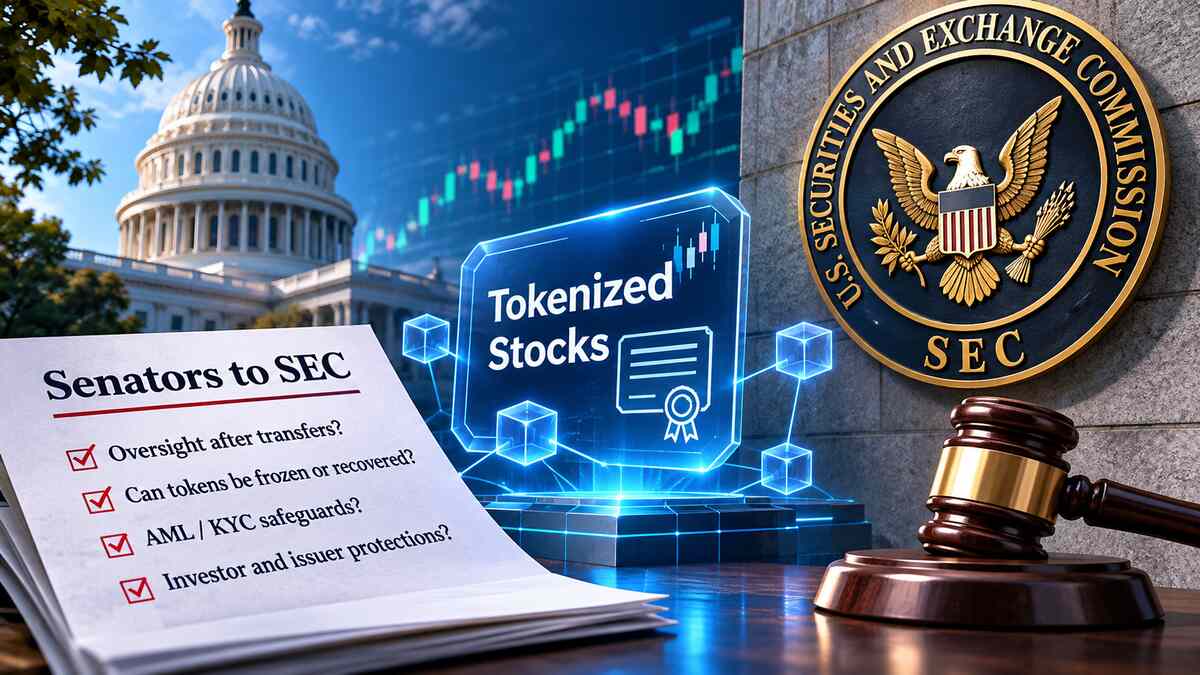
Four Democratic senators are asking the US Securities and Exchange Commission to clarify how its rules would work for tokenized stocks when those assets move beyond regulated venues. In a letter released Monday, Senators Angela Alsobrooks, Catherine Cortez Masto, Mark Warner and Ruben Gallego said tokenized shares bought by verified investors could later be transferred to offshore or unverified wallets. Their questions focus on Anti-Money Laundering and Know Your Customer safeguards, the limits of the SEC’s Innovation Exemption and whether tokenized stocks can be frozen or recovered once they leave approved trading platforms.
Senators raise concerns over tokenized stocks
The senators said the SEC’s Sept. 17 Innovation Exemption allows certain venues to trade some US stocks without registering as securities exchanges. In their view, the framework requires venues to control who can access trading, but it does not clearly require limits on what happens after a tokenized share is transferred away from that venue.
That concern led them to press the SEC on possible gaps in oversight. They warned that tokenized stocks initially sold to verified investors could still end up in offshore wallets or with users who have not gone through verification, raising broader questions about how financial crime safeguards would work after the first transaction.
SEC questions on tokenized stocks transfers
The lawmakers asked who would be responsible if tokenized stocks are moved outside regulated platforms. They also asked whether the SEC would have the authority or practical ability to freeze or recover those tokens once they are no longer held or traded within the approved venue structure.
Their letter also asked how AML and KYC requirements apply to tokenized securities venues operating under the exemption. In addition to transfer controls, the senators raised questions about issuer rights, custody protections and whether retail investors would still receive best execution protections under this model.
Tokenized stocks draw issuer objections
The letter was addressed to SEC Chair Paul Atkins and included 13 questions. The senators said they want more transparent rulemaking and asked the agency to respond within 30 days, signaling that concerns about tokenized stocks are not limited to technical trading rules but also extend to accountability and investor protection.
When Atkins announced the exemption in September, he said federal anti-fraud and anti-manipulation rules would still apply in full. Even so, friction has appeared elsewhere in the market. OKXICE, a venture between OKX and Intercontinental Exchange, published a Nov. 5 notice listing 67 companies that objected to their tokenized shares being traded on the venue.
Separate CFTC approval for Backpack
In a separate development, crypto exchange Backpack said Monday that it had secured Commodity Futures Trading Commission approval to establish a US derivatives exchange and clearinghouse using blockchain infrastructure. The approval opens a path for leveraged crypto perpetual futures trading in the United States.
CFTC Chair Michael Selig said blockchain-based operators must meet the same regulatory standards as traditional firms, including AML, customer protection and market surveillance rules. Backpack also has a tokenized equities business, but the CFTC approval relates to derivatives and not to the SEC exemption that lawmakers are now questioning.
Conclusion
The senators’ letter shows that tokenized stocks are facing growing scrutiny as US regulators weigh how digital versions of shares should be monitored after trading begins. Lawmakers want the SEC to explain who is accountable if tokens move beyond regulated venues, whether those assets can be frozen or recovered and how investor and issuer protections would apply. Their questions also highlight unresolved issues around AML, KYC, custody and best execution. With 13 questions sent to Chair Paul Atkins and a 30-day deadline for answers, tokenized stocks are now at the center of a broader debate over how existing securities safeguards translate into blockchain-based markets.
Disclaimer
The information provided in this article is for informational purposes only and should not be considered financial advice. The article does not offer sufficient information to make investment decisions, nor does it constitute an offer, recommendation, or solicitation to buy or sell any financial instrument. The content is opinion of the author and does not reflect any view or suggestion or any kind of advise from CryptoNewsBytes.com. The author declares he does not hold any of the above mentioned tokens or received any incentive from any company.
Featured image created by AI