
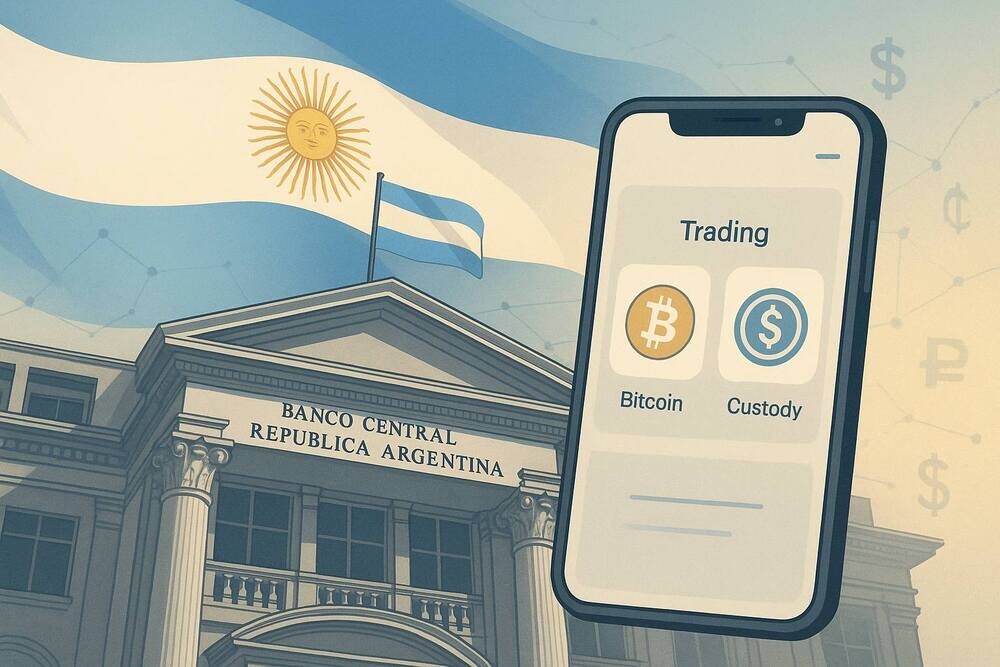
- Central Bank of Argentina plans to let banks offer crypto trading and custody
- Banks must run separate crypto units with strict risk rules
- Move shifts stablecoin use from informal chats into supervised banks
The Central Bank of Argentina is preparing one of its most significant policy shifts in years, as it moves to let licensed private banks offer cryptocurrency trading and custody services to retail and institutional clients under a new supervisory framework due to start in 2026. This plan comes after a period of triple-digit inflation, strict capital controls, and years in which many savers already split their financial lives between pesos in bank accounts and dollar-linked stablecoins on phones. The reform aims to pull this parallel onchain economy out of informal peer-to-peer chats and offshore platforms and bring it into regulated branch banking.
At the same time, the Central Bank of Argentina wants to keep tight control over risk by forcing banks to segregate crypto operations, route orders through approved venues, and hold extra capital against these activities. In a country where inflation reached more than 200 percent in 2023 and remained above 140 percent late in 2024, the stakes for this experiment are high for banks, supervisors, and households.
Central Bank of Argentina shift to bank-based crypto services
Under the draft rules, the Central Bank of Argentina will lift a three-year ban that has barred commercial banks from offering or facilitating crypto trading for their customers, and instead allow them to operate dedicated crypto units that sit alongside, but not inside, traditional deposit and lending operations. Supervisors plan to require each participating bank to create a separate legal entity or ring-fenced business line for crypto services, with its own infrastructure, risk controls, and governance, rather than simply bolting a trading button onto existing checking accounts. Banks that take part will need to route client orders through approved trading venues and liquidity providers, use institutional-grade custody solutions that segregate client assets from the bank’s own balance sheet, and maintain higher levels of capital and liquidity than they do for many traditional securities. The Central Bank of Argentina intends to start with a narrow set of assets that meet tests for liquidity, transparency, and auditability. Early drafts suggest that only large “blue-chip” coins such as Bitcoin and major dollar-pegged stablecoins like USDT and USDC will pass the first filter, alongside a limited range of tokenized instruments that meet new disclosure rules under capital markets regulator CNV. Staking and yield products may follow later but will sit under stricter suitability checks and tax reporting obligations. Customers will see explicit on-screen and in-branch warnings that these products do not benefit from deposit insurance, that they expose holders to market, technology, and legal risk, and that the bank can freeze or unwind positions if regulators or courts order such action. This framework uses earlier regulation as a foundation. Law 27,739, approved in 2024, forced virtual asset service providers in Argentina to register and comply with anti-money laundering rules, and the Central Bank of Argentina now wants traditional banks to follow similar or stricter standards when they add crypto to their menus. Supervisors also take cues from global Basel Committee work on the prudential treatment of bank crypto exposures, which assigns higher capital charges to unhedged positions in volatile assets. The aim is simple from the regulator’s point of view: banks can touch crypto, but only with thick buffers and full transparency.
Argentina’s onchain parallel economy and the move into formal banking
The new rules recognise a reality that built up long before the Central Bank of Argentina showed much interest in digital assets. For years, many Argentines have treated stablecoins as a digital version of the dollar, using them as a shield against peso devaluation and as a channel to move money across borders despite capital controls. Chainalysis data shows that from mid-2023 to mid-2024, residents moved about 91.1 billion dollars’ worth of crypto, and roughly 61.8 percent of that volume involved stablecoins, a share far above the global average of about 45 percent. In 2023, official inflation surpassed 200 percent, and remained above 140 percent in late 2024, while the government repeatedly devalued the peso and tightened currency controls, pushing households and firms further toward “crypto dollars”. Surveys and usage data suggest that as much as one-third of the population now uses crypto in some form, whether to protect savings, receive part of a salary, pay suppliers, or arbitrage gaps between official and parallel exchange rates. People already move value between pesos and stablecoins through local wallets like Lemon, Ripio, and Belo, and through informal over-the-counter chats, often at rates that reflect the blue dollar market more than the official rate. By allowing banks to operate crypto desks, the Central Bank of Argentina tries to pull a large share of this activity into institutions it already supervises. Instead of sending funds from a salary account to an app and then to a peer, a customer could keep the flow inside a single bank interface and settle trades through an on-screen order ticket. For the authorities, that change means cleaner records of who buys what, at which price, and with which source of funds. Tax agencies gain better data to enforce income and capital gains rules, and supervisors gain direct visibility into how demand for stablecoins maps onto pressure on the peso and on foreign reserves. The Central Bank of Argentina also hopes that by giving banks a formal role, it can reduce the weight of offshore exchanges and informal brokers in the local crypto market.
Bank implementation, custody design, and risk management under the new regime
To operate under the new framework, banks will need to build or rent infrastructure that many of them do not yet have. The Central Bank of Argentina expects each institution to appoint specialised onchain risk teams that track wallet flows, monitor protocol events, and respond quickly to hacks, forks, and smart contract failures that could affect client positions. Custody systems must separate keys for client assets from the bank’s own holdings and include clear procedures for recovery, audits, and incident reporting, including thresholds for when an outage or loss triggers notification to the central bank and to the market regulator. Compliance standards will follow, and often exceed, those already applied to other financial products. Banks must run full know-your-customer checks and continuous transaction monitoring on crypto flows, attach risk scores to addresses and assets, and refuse or file reports on trades that involve sanctioned wallets or high-risk jurisdictions. The Central Bank of Argentina also wants banks to map crypto exposures into existing stress-testing frameworks so they can see how a sharp move in Bitcoin or a depeg of a major stablecoin would hit their capital ratios and liquidity buffers. On top of that, supervisors discuss limits on the share of a bank’s balance sheet that can be tied to unbacked tokens and plan to treat most holdings as high-risk assets for capital purposes. Client experience will change, but not as dramatically as the plumbing behind the scenes. A typical retail user could log into a banking app, see a new section for digital assets, and choose from a short list of supported coins and tokenized products with prices, fees, and disclosures listed in pesos and dollars. Orders would route through a matching engine at an approved venue, settle in a custodial wallet managed by a bank or a partner, and appear alongside other positions in a consolidated portfolio view. The Central Bank of Argentina insists that users receive clear warnings that crypto holdings can lose value quickly, that they do not carry the same legal protections as deposits, and that redemptions may face delays during extreme market events. Banks will also need to give clients simple ways to download transaction histories for tax reporting and to understand how spreads, fees, and taxes affect net performance.
Central Bank of Argentina impact on banks and savers
The reform creates new income lines for local lenders but also exposes them to operational and reputational risk. Traditional banks in Argentina have seen deposits eroded by inflation, competition from neobanks, and the growth of informal dollar and stablecoin markets. The new rules give them a way to earn fees on an activity that already takes place at large scale, but every outage, hack, or token collapse that touches a bank’s platform could damage public trust in the wider system. The Central Bank of Argentina will expect fast responses to incidents and may demand that banks switch off certain assets or products when risk indicators flash red. Corporate treasurers and funds stand to benefit if the rollout proceeds smoothly. With a clear rulebook from the Central Bank of Argentina, they can seek on-balance-sheet exposure to Bitcoin, major stablecoins, and tokenized instruments through banks they already use for cash management and lending. That access could support hedging strategies against peso inflation, provide new collateral types for structured deals, and open the door to participation in tokenized government or corporate bonds if those markets develop. Retail savers would gain a path to trade and store digital assets without navigating offshore platforms, complex self-custody, or anonymous brokers. The same change, however, could shift activity away from existing local crypto apps and smaller exchanges that helped build Argentina’s onchain ecosystem over the past decade. For policymakers, this change acts as an experiment in running a partial dual-money system inside the formal banking sector. The Central Bank of Argentina remains responsible for the peso and for financial stability, yet it now acknowledges that dollar-linked stablecoins and Bitcoin have become important instruments in everyday finance. If banks integrate crypto services without major incidents, supervisors may treat the framework as a model for other high-inflation economies that face similar pressures. If the experiment goes badly, with large losses, fraud, or destabilising flows out of pesos, the central bank can tighten or reverse the rules and point to the warnings it required from day one. Either way, the decision signals that Argentina no longer sees crypto as a fringe activity but as part of its broader financial landscape.
Conclusion
The new framework marks a turning point in how the Central Bank of Argentina manages the relationship between pesos, dollars, and digital assets, as it moves from prohibition toward supervised integration. By letting licensed banks open dedicated crypto desks for trading and custody, while forcing them to hold extra capital, segregate client assets, and follow strict reporting rules, the Central Bank of Argentina tries to balance innovation with control in a country where stablecoins and Bitcoin already play a central role in daily economic life. The coming years will show whether this cautious embrace of onchain finance strengthens the formal system or deepens the parallel one that grew in response to inflation and capital controls.
Disclaimer
The information provided in this article is for informational purposes only and should not be considered financial advice. The article does not offer sufficient information to make investment decisions, nor does it constitute an offer, recommendation, or solicitation to buy or sell any financial instrument. The content is opinion of the author and does not reflect any view or suggestion or any kind of advise from CryptoNewsBytes.com. The author declares he does not hold any of the above mentioned tokens or received any incentive from any company.
Featured image created by AI