
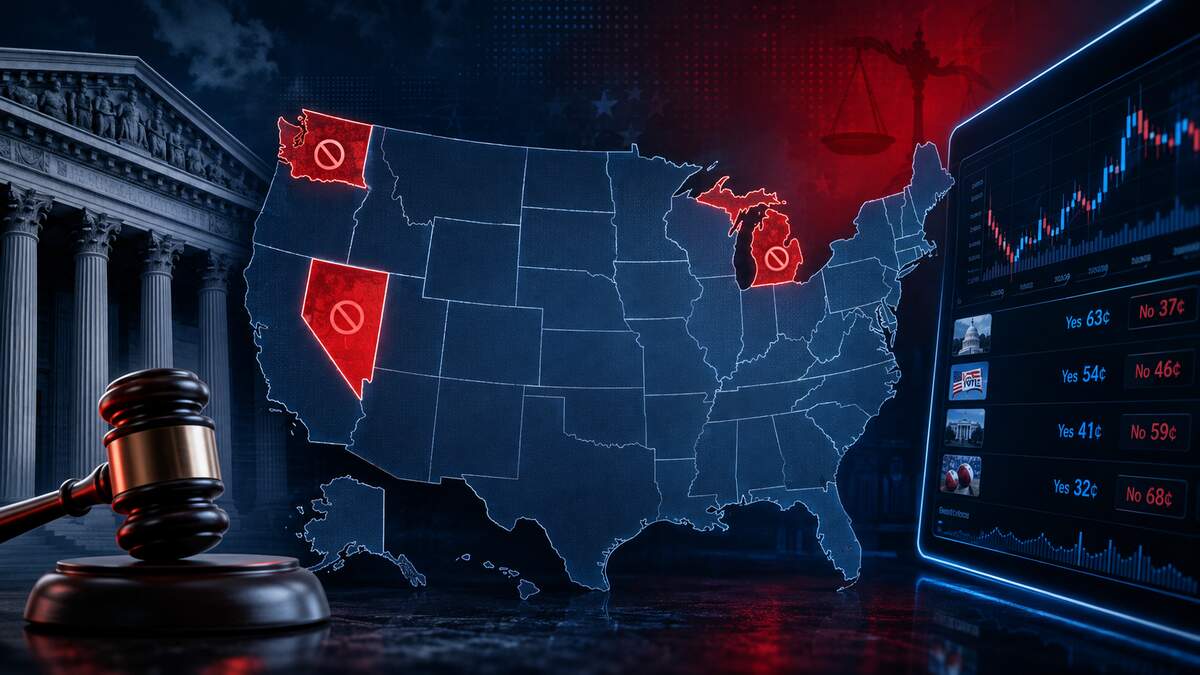
- Kalshi customers in Washington Michigan and Nevada are currently blocked from the platform.
- The CFTC held an innovation meeting and Chairman Mike Selig said the agency plans new event contract and consumer protection rules.
- Court disputes involving Kalshi continued this week in states including Washington Connecticut and New York.
Kalshi states disputes widened this week as customers in Washington joined users in Michigan and Nevada who are unable to use the prediction market platform. The latest fight unfolded while the Commodity Futures Trading Commission took a more supportive stance toward the industry at a government meeting in Washington. Federal and state officials are now pulling in different directions, with state regulators pressing gambling-related claims and the CFTC arguing that prediction markets need a formal national framework. The result is a busy legal and regulatory moment for Kalshi states access, with court filings, emergency actions and new rule plans all shaping what customers and competitors may face next.
Kalshi states restrictions spread
Kalshi customers in Washington state were cut off after a local court last week imposed a statewide ban in a dispute over whether the company was operating an illegal gambling business there. The company then emailed users to say that the Washington state government had blocked their right to trade freely on Kalshi.
Washington Attorney General Nick Brown said Kalshi had become rich by promoting wagers on sports, elections, natural disasters, events related to the Iran War and more. He said the order bans Kalshi from offering wagers on most of those topics in Washington. Washington now joins Michigan and Nevada on the list of places where customers are currently unable to use the platform.
Kalshi states case in Washington court
Kalshi is now trying a new legal argument in Washington. In a Thursday filing, the company asked the court to reconsider its position after state authorities allowed Crypto.com to operate in Washington under the same terms that had been outlawed for Kalshi.
In that motion, Kalshi argued that six days after the court ordered its halt, the state said it would not enforce the law against Crypto.com until appeals are resolved in a higher court. Kalshi said the same event contracts that were deemed unacceptable from its platform are now available to Washington residents through an identically situated competitor with the state’s blessing.
CFTC outlines prediction market rules
The industry’s strongest federal support came from CFTC Chairman Mike Selig, who has made it a priority to defend what he says is the agency’s sole authority over prediction markets. He also said the CFTC is moving ahead with formal rulemaking to govern the products in the United States.
At the inaugural Innovation Advisory Committee meeting in Washington, Selig said earlier agency leaders had either ignored or tried to outlaw event-contract activity. He said the CFTC had never created a comprehensive framework for the policy issues tied to these products. Selig, currently the only member of what is meant to be a five-person commission, said the agency will soon modernize event contract rules and add consumer protection requirements, including expectations for product governance, market design and incentive programs.
Industry tensions and wider court fights
Legal clashes continued beyond Washington. The article said disputes remain active in Massachusetts, Minnesota, Ohio, Maryland, Utah, Arizona and New York. In some of those states, the industry could face serious restrictions or punishments, often focused on sports betting. This week also brought more federal court exchanges between Connecticut regulators and Kalshi as the state sought to apply its gambling laws to the business.
New York was also still contesting the CFTC’s recent emergency action that kept Kalshi activity going there. At the same time, the rise of prediction markets drew criticism from traditional financial firms. At the committee meeting, CME Group chief Terry Duffy argued that prediction markets can be vulnerable to manipulation and cited incidents tied to Polymarket bets and Kalshi bets. Selig pushed back on one example, and Kalshi chief operating officer Luana Lopes Lara also challenged Duffy during the exchange.
Conclusion
Kalshi states access is now at the center of a broader conflict between state enforcement efforts and federal regulatory support. Washington’s ban added another blocked market for customers, while Kalshi answered with a court motion pointing to different treatment for Crypto.com. At the federal level, the CFTC used its Washington meeting to signal more formal oversight of event contracts and new consumer protection standards. With active disputes in Connecticut and New York and additional state fights still underway, the week showed that the future of Kalshi states access is being shaped both in courtrooms and at the national regulator charged with overseeing these markets.
Disclaimer
The information provided in this article is for informational purposes only and should not be considered financial advice. The article does not offer sufficient information to make investment decisions, nor does it constitute an offer, recommendation, or solicitation to buy or sell any financial instrument. The content is opinion of the author and does not reflect any view or suggestion or any kind of advise from CryptoNewsBytes.com. The author declares he does not hold any of the above mentioned tokens or received any incentive from any company.
Featured image created by AI