
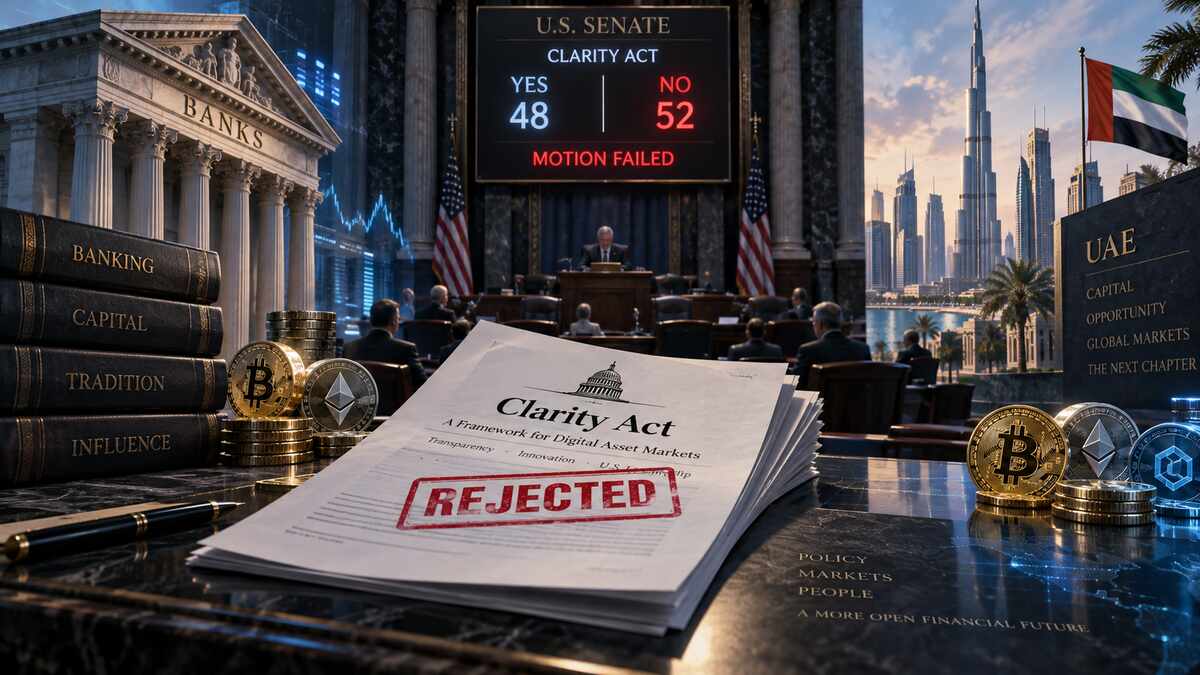
- The Senate failed to advance the Clarity Act in a 49-50 cloture vote.
- Industry experts said banks and overseas hubs such as the UAE could benefit from the setback.
The Clarity Act setback has left the U.S. crypto industry without the federal market structure framework many had sought, after the Senate voted 49-50 against advancing the bill. That result means crypto policy in the United States remains shaped largely by the Securities and Exchange Commission and the Commodity Futures Trading Commission through existing rules, interpretations and exemptions. Lawyers and industry observers said the outcome may favor two groups in particular: U.S. banks that oppose stablecoin rewards competing with deposits, and overseas jurisdictions such as the United Arab Emirates, where clearer regulatory frameworks are already in place. The failed Clarity Act vote also renewed debate about how digital asset rules should be created.
Clarity Act vote leaves agencies in charge
The Senate’s failure to move the Clarity Act forward means Congress did not deliver the market structure legislation the crypto sector had been seeking. Instead, oversight remains in the hands of the SEC and the CFTC, which will continue to influence policy through their current authorities, interpretations and exemptions. That approach became visible quickly after the vote. The SEC issued a temporary conditional exemption allowing eligible venues to trade tokenized U.S. stocks through permissioned liquidity pools on public blockchains. Soon after, the CFTC sent a new crypto proposal to the White House for review, though its details were not disclosed.
Banks seen as winners after Clarity Act setback
The fight around the Clarity Act was not only about which regulator should oversee crypto markets. It also highlighted a dispute over whether stablecoin platforms should be able to offer rewards that might compete with traditional bank deposits. Anton Golub, head of exchange go-to-market at Forte, said banks won this round. He said banks are pushing back because they increasingly view stablecoins as competition for deposits rather than simply another crypto product. That view places deposit competition at the center of the policy conflict described by industry participants.
UAE gains from regulatory clarity
Some legal experts said the stalled U.S. process could create an advantage for offshore crypto hubs. Irina Heaver, a Dubai-based crypto lawyer and founder of NeosLegal, said that while the United States continues debating the Clarity Act, the UAE already has clarity. Heaver said more than 110 regulated virtual-asset businesses operate in the country, with about 20 more holding in-principle approvals. She added that every additional year major markets spend debating crypto rules gives jurisdictions with functioning frameworks more time to attract businesses, founders, talent and capital.
Calls for durable rules after the Clarity Act vote
The immediate result of the failed legislation is that U.S. crypto rules will keep developing outside Congress. Yet some advocates for digital asset policy say that does not solve the broader need for a lasting framework. Kyle Bligen, executive director at the Decentralization Research Center, said Congress remains the best route to a comprehensive market structure framework. He described the Senate vote as disappointing and said digital assets still need clear and durable rules, even though the Clarity Act is now effectively stalled for the time being.
Conclusion
The Clarity Act did not clear the Senate, with a 49-50 cloture vote leaving the crypto industry without the federal framework it had sought. In the near term, that keeps the SEC and CFTC at the center of U.S. crypto policymaking through existing mechanisms rather than new legislation. Experts cited in the report said this outcome benefits U.S. banks that oppose stablecoin rewards competing with deposits, while also helping jurisdictions such as the UAE that already offer clearer regulatory systems. As the Clarity Act remains stalled, the debate over who should shape digital asset rules in the United States is still unresolved.
Disclaimer
The information provided in this article is for informational purposes only and should not be considered financial advice. The article does not offer sufficient information to make investment decisions, nor does it constitute an offer, recommendation, or solicitation to buy or sell any financial instrument. The content is opinion of the author and does not reflect any view or suggestion or any kind of advise from CryptoNewsBytes.com. The author declares he does not hold any of the above mentioned tokens or received any incentive from any company.
Featured image created by AI