
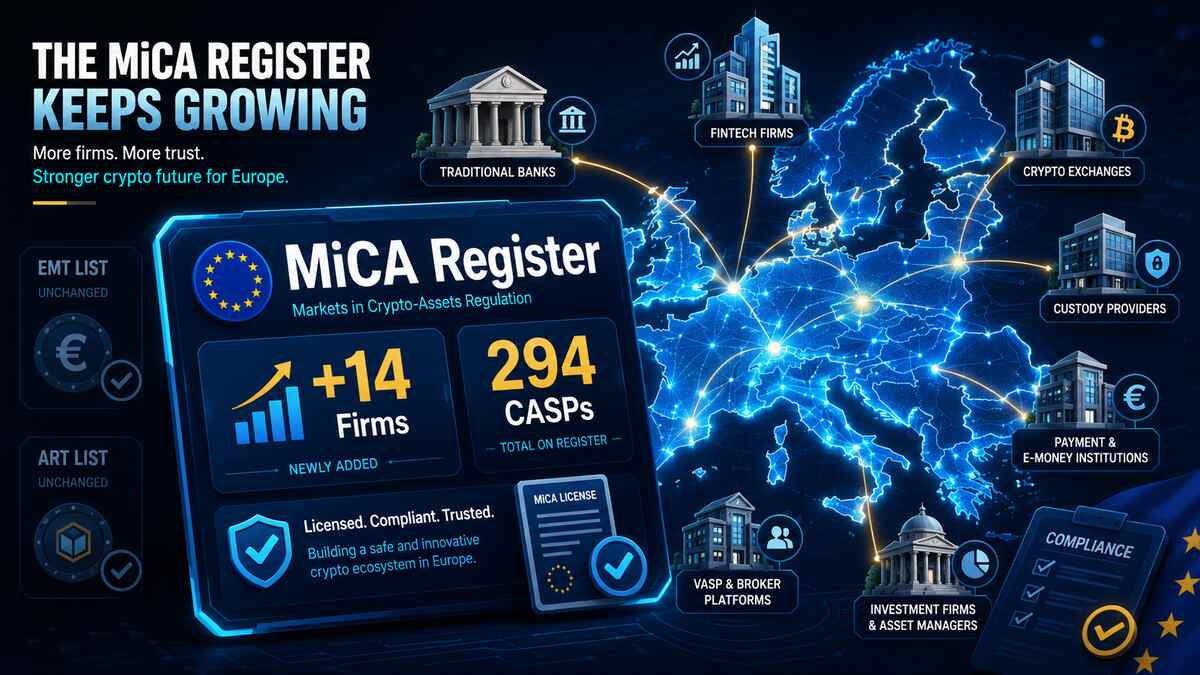
- ESMA added 14 firms to the MiCA register, raising the CASP total to 294.
- New entries included Ripple Payments Europe and several banks from Portugal, Croatia, Germany, and Liechtenstein.
- ESMA left EMT and ART registers unchanged and added two names to its non-compliant list.
The MiCA register expanded again in ESMA’s latest update, although the pace was slower than the first large revision after Europe’s transition period ended. On Thursday, the European Securities and Markets Authority added 14 crypto-asset service providers, bringing the total number of licensed CASPs to 294. The latest MiCA register update included Ripple Payments Europe, Portugal-based Bison Bank, Croatia’s state-owned Hrvatska poštanska banka, and several other banking groups. Compared with the July 3 update, when ESMA added 37 CASPs, the latest figures suggest that licensing activity is continuing but no longer moving at the same early post-deadline speed.
MiCA register growth slows after earlier surge
ESMA’s latest interim revision added 14 firms to the MiCA register, making it the second update since MiCA’s transitional period ended. The total number of licensed crypto-asset service providers now stands at 294, showing that approvals are still moving forward across the European market as firms continue entering the regulated framework. The latest increase was smaller than the previous post-deadline update on July 3, when ESMA added 37 CASPs in one round. That comparison points to slower momentum after the initial burst of licensing activity that followed the end of the transition period, but it still shows that the MiCA register is continuing to expand.
New names join the MiCA register
Among the most notable additions to the MiCA register was Ripple Payments Europe, the European payments arm of Ripple. ESMA also added Portugal-based Bison Bank and Croatia’s state-owned bank, Hrvatska poštanska banka, also known as HPB, showing that the latest update included both crypto-linked payment firms and established banking institutions. The latest MiCA register update also included two cooperative banks from Germany: Volksbank Schwarzwald-Donau-Neckar and Raiffeisenbank Auerbach-Freihung. Liechtenstein-based Kaiser Partner Privatbank was also added, increasing the number of private banking groups now appearing in Europe’s regulated crypto services framework.
Banks expand their role in regulated crypto services
The new entries show that traditional financial institutions are continuing to enter Europe’s regulated crypto market. The addition of banks and payment groups suggests that MiCA is attracting firms beyond crypto-native businesses, especially as more established financial companies seek a licensed role in crypto-asset services. ESMA’s register already includes dozens of traditional finance institutions. Those listed include Spain’s BBVA and CaixaBank, Germany’s Commerzbank, France’s CACEIS Bank, and Standard Chartered Luxembourg. Their presence shows the widening overlap between mainstream banking and regulated crypto services under Europe’s MiCA framework.
MiCA register update leaves token lists unchanged
Outside the CASP list, ESMA reported no changes to its registers for electronic money tokens and asset-referenced tokens. These categories cover crypto-assets designed to track one official currency in the case of EMTs, or multiple assets such as currencies or commodities in the case of ARTs. As of the latest update, the EMT register still showed 21 unique issuers, while the ART register continued to list no approved issuers. ESMA also added Reversal Investment Group and Kortex to its non-compliant register following actions by Italy’s securities regulator, CONSOB, bringing that total to 164 entries, including MEXC.
Conclusion
The latest ESMA revision shows that the MiCA register is still expanding, but at a slower pace than the first major update after the deadline passed. With 14 new firms added, the number of licensed CASPs reached 294, and the latest approvals included Ripple Payments Europe along with several banks from across Europe. The update also underlined the steady involvement of traditional finance institutions in the regulated crypto market. At the same time, ESMA made no changes to its EMT and ART lists, while its non-compliant register grew by two more names. Overall, the MiCA register continues to develop as Europe’s crypto licensing framework takes shape.
Disclaimer
The information provided in this article is for informational purposes only and should not be considered financial advice. The article does not offer sufficient information to make investment decisions, nor does it constitute an offer, recommendation, or solicitation to buy or sell any financial instrument. The content is opinion of the author and does not reflect any view or suggestion or any kind of advise from CryptoNewsBytes.com. The author declares he does not hold any of the above mentioned tokens or received any incentive from any company.
Featured image created by AI