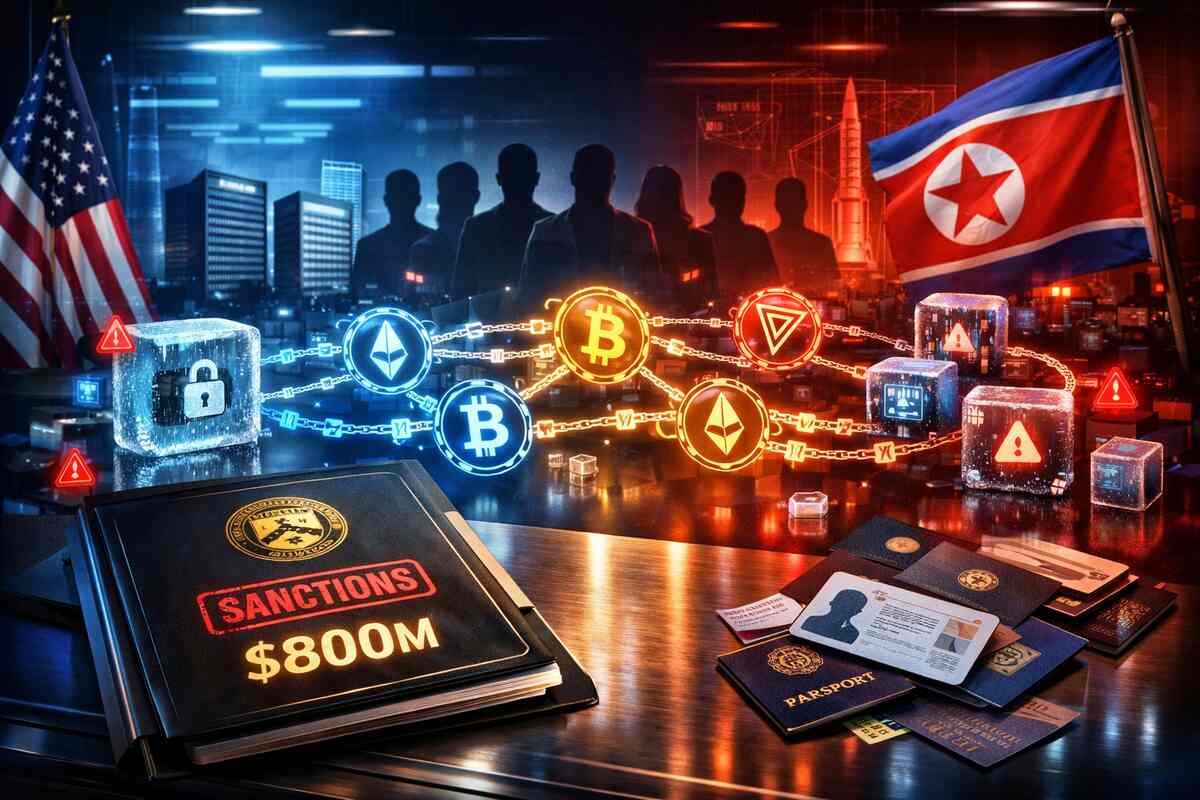
- U.S. sanctions six people and two firms accused of helping North Korea convert $800 million in 2024 into crypto to support weapons programs
- DPRK-linked operatives allegedly used fake identities to get IT jobs abroad, then funneled wages through multichain crypto laundering networks
U.S. authorities are tightening their focus on crypto laundering as a key source of funding for North Korea’s weapons programs. The Treasury Department has announced sanctions on individuals and entities accused of helping the Democratic People’s Republic of Korea (DPRK) turn hundreds of millions of dollars into cryptocurrency and move those funds through a complex global network.
U.S. sanctions target crypto laundering network tied to DPRK
The U.S. Treasury Department said it has sanctioned six people and two companies that allegedly assisted North Korea in converting $800 million into digital assets during 2024. According to the announcement, the money was laundered through cryptocurrency channels and ultimately used to support the country’s weapons of mass destruction and ballistic missile projects. The Treasury’s Office of Foreign Assets Control (OFAC) outlined how the network placed IT professionals inside foreign businesses, including in the United States and allied nations, then redirected their income to Pyongyang.
Officials said the scheme operated across several jurisdictions, naming Vietnam, Laos and Spain among the countries involved. These overseas workers were accused of using false documents, stolen identities and fabricated personas to secure jobs with legitimate companies. Once employed, they allegedly sent most of their earnings back to the North Korean state, which, according to Treasury, captured hundreds of millions of dollars through this method. In some cases, these workers were also said to have installed malware on corporate systems, allowing access to sensitive information and proprietary data.
Tools and techniques of DPRK-linked crypto laundering
North Korea’s use of digital assets has been under scrutiny for years, with U.S. officials and private analysts warning that crypto laundering plays a central role in evading sanctions. The Treasury noted that DPRK-linked hackers and financial networks have increasingly targeted cryptocurrency protocols and platforms to steal and disguise funds. Blockchain analytics firm Chainalysis reported that in the previous year alone, North Korea-connected hackers stole a record $2 billion worth of cryptocurrency.
Chainalysis said that the newly sanctioned network made use of a broad spectrum of crypto infrastructure. This included centralized exchanges, hosted wallets, decentralized finance protocols and cross-chain bridges. By shifting assets across these different services, the participants attempted to make it harder to trace the origin and final destination of the funds. The firm’s researchers described this as part of an “increasingly multichain” strategy by DPRK-linked actors, who now move illicit assets across multiple blockchains instead of relying on a single network.
OFAC’s designation listed 21 wallet addresses associated with the scheme. These addresses span major blockchains such as Ethereum, Tron and Bitcoin, reflecting the diverse set of platforms used to obscure money flows. U.S. officials said that by targeting these addresses and related entities, they aim to disrupt the DPRK’s ability to cash out or further circulate the digital assets.
Corporate infiltration and international enablers
Treasury officials emphasized that the network did not rely solely on hacking but also on covert placement of IT workers inside foreign firms. Secretary of the Treasury Scott Bessent said North Korea targets American companies through deceptive hiring, using overseas operatives who can misuse access to data and extort payments. Treasury’s findings indicated that teams backed by the DPRK used forged credentials to pose as legitimate professionals, enabling them to gain positions that provided both income and access to corporate systems.
The sanctions also highlight the role of facilitators outside North Korea. Among those named is Nguyen Quang Viet, the CEO of Vietnam-based Quangvietdnbg International Services Co. Treasury alleges that between mid-2023 and mid-2025, he converted roughly $2.5 million into cryptocurrency on behalf of North Korean actors. This conversion activity formed part of the wider effort to turn fiat earnings into digital assets that could then be routed through the broader crypto laundering infrastructure.
Treasury’s statement underscores that the DPRK’s government appropriates the majority of wages earned by these overseas workers. Those funds, once moved into cryptocurrency, are then used to help sustain the country’s weapons of mass destruction and ballistic missile programs. By designating individuals, companies and wallet addresses, OFAC aims to cut off the channels that have enabled North Korea to exploit global labor markets and digital asset systems.
Conclusion
The latest U.S. sanctions detail how North Korea’s overseas IT operations and crypto laundering practices intersect to finance its weapons ambitions. By infiltrating workers into foreign companies, converting their wages into digital assets, and moving funds across multiple blockchains and services, DPRK-linked networks have generated substantial revenue despite international restrictions. The designation of six individuals, two firms and 21 wallet addresses marks another step in efforts to constrain these activities, while highlighting the continuing challenge of policing illicit finance in a multichain cryptocurrency landscape.
Disclaimer
The information provided in this article is for informational purposes only and should not be considered financial advice. The article does not offer sufficient information to make investment decisions, nor does it constitute an offer, recommendation, or solicitation to buy or sell any financial instrument. The content is opinion of the author and does not reflect any view or suggestion or any kind of advise from CryptoNewsBytes.com. The author declares he does not hold any of the above mentioned tokens or received any incentive from any company.
Featured image created by AI