- A $61.5 million long position on HTX linked to a Bitcoin whale was liquidated as Bitcoin slipped from $68,600 to $64,400
- Total crypto liquidations reached $467.64 million in 24 hours, with long positions making up about 93% of the wiped-out trades
A large Bitcoin whale position was wiped out on Monday as a sharp price reversal triggered one of the biggest liquidations in the market over the past day. The forced closure of a highly leveraged bullish bet coincided with a wider washout across major cryptocurrencies, underscoring how quickly sentiment has swung from optimism to stress. Data from several analytics platforms show that the selloff hit leveraged long traders especially hard and pushed market sentiment back into levels that signal deep anxiety among participants.
Major liquidation highlights leveraged risk for a Bitcoin whale
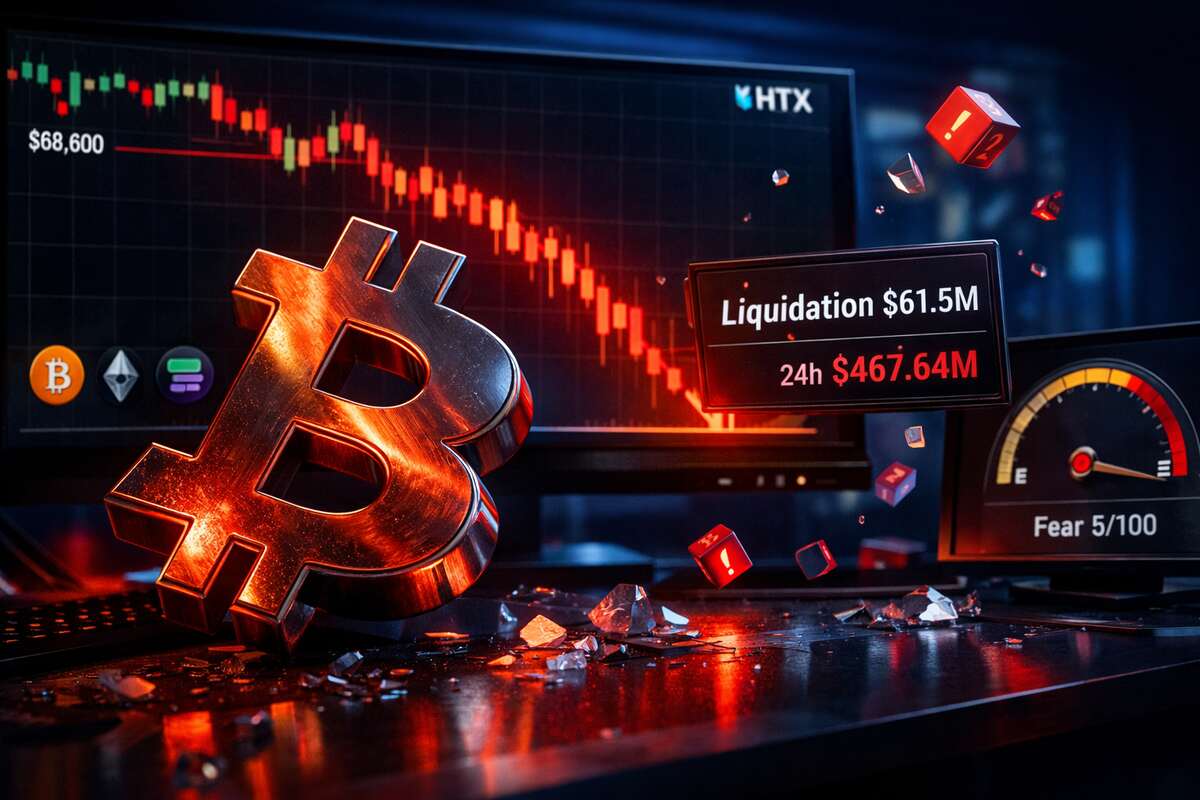
The largest single forced closure in the last 24 hours came from a $61.5 million long position on cryptocurrency exchange HTX, according to data from Coinglass. The trade was liquidated as Bitcoin slid from a weekend high of $68,600 on Saturday down to $64,400, removing the entirety of the recent price gains in only a few hours. CoinDesk contacted HTX for details on the event, but no further information was immediately available.
The size of the position points to a concentrated holder rather than a collection of smaller retail accounts. Market observers often use the term Bitcoin whale for such large players, and the scale of the loss suggests it was likely a single whale or a fund using significant leverage. The position was part of a much broader liquidation wave that swept through the derivatives market as buy orders thinned and prices retreated.
Across all tracked venues, Coinglass recorded $467.64 million in liquidations over the same 24-hour window, affecting 137,422 traders. Longs made up $434 million of the total, about 93%, indicating that the market had been leaning heavily toward further upside ahead of the new week. When the price began to fall and liquidity receded, those bullish positions were rapidly forced out.
Bitcoin futures bore the brunt of the unwinding, with $213.62 million in contracts closed by exchanges as margin requirements were breached. Ether (ETH) futures saw $113.89 million in liquidations, while solana (SOL) futures added another $19.89 million. Hyperliquid’s HYPE token contributed $10.72 million to the tally, a sizable figure given that it typically does not appear alongside larger assets on daily liquidation leaderboards.
The pattern described by the liquidation data shows a market repeatedly caught on the wrong side of short-term moves. Traders have been building leveraged long exposure into price rebounds, only to see those positions closed out when bids disappear and prices fall back.
Sentiment sinks to “extreme fear” as losses mount
Beyond the visible impact on derivatives traders, sentiment indicators show that the latest downturn has reinforced a climate of persistent unease. Alternative.me’s Crypto Fear and Greed Index dropped back to a reading of 5 out of 100 following Monday’s move. The index classifies that level as “extreme fear,” a zone it has only reached three other times since its launch in 2018: August 2019, June 2022, and earlier this month when bitcoin briefly traded near ,000.
The return to such a low reading suggests that recent price swings have left participants anxious about further downside, despite Bitcoin’s recovery from prior troughs. The index combines factors such as price momentum, volatility, market volume, social media activity, and dominance to gauge the prevailing mood. A reading of 5 implies that risk appetite is extremely limited and that many traders are either on the sidelines or positioned defensively.
On-chain data from Glassnode supports the view that pressure on recent buyers remains elevated. The analytics firm reported on Monday that the seven-day moving average of net realized losses for short-term holders was near $500 million per day. That figure captures the scale of losses locked in on-chain by addresses that acquired coins in the recent past and have since sold them at lower prices.
According to Glassnode, these sustained realized losses show that newer market entrants are still closing positions at a loss even after February’s initial selloff. The firm described the current environment as a “base formation phase” in which participants continue to capitulate, albeit with somewhat reduced intensity compared with the earlier flush. The suggestion is that the market has not yet fully shaken off downside pressure, and that selling from shorter-term holders is ongoing.
Market structure and price levels under strain for Bitcoin whale traders
The current price behavior highlights a tension between long-term benchmarks and shorter-term positioning. Bitcoin is now trading 48% below its October all-time high of $126,000, leaving it far from that peak despite multiple attempts to stabilize at higher ranges. It also stands 5.5% under its previous cycle high of $69,000 set in 2021, a level that once acted as a major resistance point during the last bull market.
That former peak has taken on a different character in the present cycle. Rather than serving as a ceiling that caps rallies, $69,000 has repeatedly functioned as a zone that the market tests from above and below, resembling more of a contested floor. The recent price action, in which rebounds toward the high-$60,000 range have been followed by swift reversals, fits into this evolving pattern.
Within this framework, leveraged traders, including any Bitcoin whale seeking to capitalize on rebounds, have repeatedly been caught in a loop. Rallies prompt the rebuilding of long positions, often with significant leverage in futures markets. When momentum fades and order books thin, prices slide, triggering margin calls and forced closures that amplify downside moves.
Key structural features evident in Monday’s trading include:
- A heavy skew toward long liquidations, suggesting a crowded bullish bias.
- Concentrated large positions, exemplified by the $61.5 million HTX closure.
- Ongoing realized losses among short-term holders, indicating continued stress.
These elements combine to create a backdrop where even modest pullbacks can cause disproportionate damage to leveraged players and weigh on broader sentiment. The presence of at least one large Bitcoin whale caught in the latest liquidation round reflects how exposed sizable accounts can be when positioning aligns with the majority and liquidity thins.
Conclusion
Monday’s market reversal erased weekend gains, forced a major Bitcoin whale position off the books, and swept away nearly half a billion dollars in leveraged trades across cryptocurrencies. Data from Coinglass and Glassnode show that the impact was concentrated in long futures positions and among recent buyers realizing substantial losses. Sentiment, as measured by the Crypto Fear and Greed Index, has fallen back into territory associated with prior periods of pronounced stress.
Bitcoin remains significantly below its October record and continues to oscillate around the 2021 high, with that level now functioning as a point of repeated testing rather than a distant milestone. The liquidation of a $61.5 million bullish bet on HTX, alongside the broader wave of forced closures, underlines how quickly optimistic positioning can unwind in a market still characterized by fragile confidence and ongoing capitulation.
Disclaimer
The information provided in this article is for informational purposes only and should not be considered financial advice. The article does not offer sufficient information to make investment decisions, nor does it constitute an offer, recommendation, or solicitation to buy or sell any financial instrument. The content is opinion of the author and does not reflect any view or suggestion or any kind of advise from CryptoNewsBytes.com. The author declares he does not hold any of the above mentioned tokens or received any incentive from any company.
Featured image created by AI